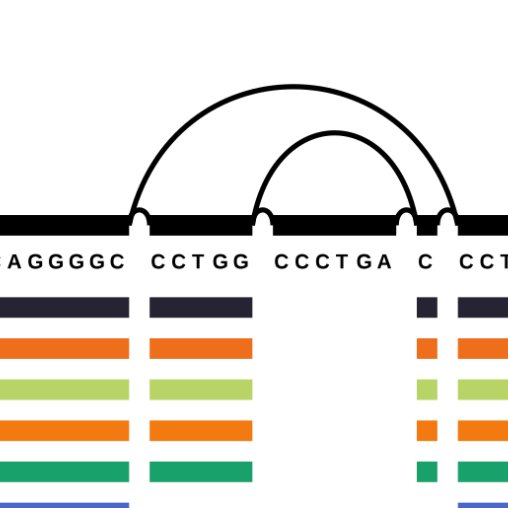
I'm excited to share this new work with a great collaborator @jsibbesen. I think we'll see pangenomics methods applied to more and more functional genomics analyses in the future--sequence graphs are fundamental tools in bioinformatics!
In an unconscionable move by the UC, University of California Police arrested 3 workers on felony charges and confiscated their possessions for writing messages in chalk and washable paint calling on UC to stop underpaying workers.🧵
Next week in Memphis: #MemPANG23 https://t.co/NciUhb4Jdy, a workshop on the theory and practice of working with lots of genomes. Join us online next Friday June 2nd from 9:00-16:00 (CDT/UTC-5) for 6 talks on pangenomics (webinar https://t.co/aENGA4NjlP)
We're ✨revolutionizing✨the human genome reference. The #HumanPangenome Consortium, co-led by @ucsc, has just published a draft of a more robust, diverse, and complete reference. This will be a game-changing resource for genomics & health research https://t.co/oDnJTlEowG
"Optimal gap-affine alignment in O(s) space" published online in Bioinformatics. Lots of thanks to all the authors and the reviewers. If you like sequence alignment and algorithms, this one is for you! As always, any feedback is welcome. https://t.co/NBZXBTpNoL
A computational pipeline for haplotype-aware pantranscriptome analysis enables spliced pangenome graph construction, RNA-seq data alignment, and estimation of haplotype-specific transcript expression levels. @BenedictPaten @jeizenga@ucscgenomics
https://t.co/kWAyNUhSVM
"What does it say about a university system touted as one of the Golden State’s best attributes if its intellectual workforce can’t afford to live in the state?"
https://t.co/ZgZptmyop7
🧬 Wonderful explanation of the limitations of the current reference genome, and what the Human Pangenome Reference Consortium is doing to address them. Written by our own @jeizenga ! @ucsc@genome_gov
Come join us in Portugal in late May! We are running the third edition of CPANG. Learning to use pangenome methods in a hands-on way. In previous courses students worked at the cutting edge of the effort to transform the theoretical foundation of bioinformatics and compbio
Celebrating the holiday by releasing v1.0.0 of GetBlunted. Pesky overlaps complicating your analyses on assembly graphs? Smoke them away with this handy tool so you can work with nice blunt-ended graphs :)
https://t.co/4kfyxjLLTE
Happy to share a unique result. Optimal gap-affine alignment in linear space, O(s=alignmentScore). Bidirectional WFA (BiWFA) computes 1Mbp-long optimal alignments using ~183MB as fast as the WFA. https://t.co/0KC3786It4 @jeizenga@erikgarrison@AndresGuarahino (1/4)
New #ink to commemorate my PhD at @ucscgenomics: This is an inversion in D. pseudoobscura polytene chromosome that Dobzhansky named the "Santa Cruz" allele in 1937. I'm super pleased with how it turned out!
@jeizenga@HumanPangenome Excellent! In wfmash, we (HPRC researchers who use WFA to build pangenomes) have not had problems with memory for around six months due to the implementation of memory reduction techniques in WFAv2 by @santiagomsola. Like your work, aspects of these mirror @TheGeneMyers's ideas
@jeizenga Hats off! All I'm reading are very interesting ideas. Mem consumption is a major limitation of WFA on long-seqs. With @AndresGuarahino@erikgarrison we've been working on a WFA low-memory approach for wfmash (https://t.co/8rJTYKhQDt). Glad to see other interesting works on this.
The modified WFA algorithm makes it possible for the first time to compute exact alignments of sequences like long nanopore reads or assembled genomic contigs across many threads simultaneously in a compute server with typical specifications. 4/4
Hi all, excited to share this preprint, which builds upon @santiagomsola's excellent recent work on the WFA algorithm, which can optimally align long, similar sequences very quickly.
https://t.co/nzAZhGtowz 1/4
This preprint contains a few results on WFA, the most significant of which is a variant of WFA with dramatically reduced memory use at the cost of a small reduction in speed. 3/4