Cada que creas que la vida es injusta contigo, recuerda esta imagen…
En el mundo hay millones y millones de personas que a pesar de todas las adversidades salen día a día a ganarse el pan que llevan a su mesa para sus familias.
Así que agradece todo lo que tienes, disfrútalo e intenta ayudar a quienes menos tienen.
Date cuenta que lo que tú consideras problemas, tal vez no lo son en realidad…
El Mayor Ladrón (masculino) de la Nación. Vive disfrutando de su mansión y del dinero malhabido.
Una muestra de por qué siempre digo que la Justicia en Argentina es PARTÍCIPE NECESARIA de la cleptocracia.
There’s a man in Genesis who never died. And the Bible gives him one sentence.
Genesis 5 is the chapter most people skip. A list of names. Ages. Sons and daughters. And over and over, like a funeral bell, the same three words:
“...and he died.”
Adam lived 930 years, and he died. Seth, and he died. Enosh, and he died. Eight times the bell rings.
And then, in the middle of the list, it doesn’t:
“Enoch walked with God, and he was not, for God took him.” - Genesis 5:24
No death. No burial. No explanation. He was just... gone.
The book of Hebrews confirms what it means: “By faith Enoch was taken up so that he should not see death, and he was not found, because God had taken him” (Hebrews 11:5).
One man in the whole ancient world skipped the grave. Only one other in all of Scripture shares that: Elijah, carried up in the whirlwind.
So what was so special about Enoch?
The Bible tells us exactly one thing about his life. Twice. He walked with God.
That’s it. No miracles. No kingdom. No great battles. Just a walk.
And the details are surprising.
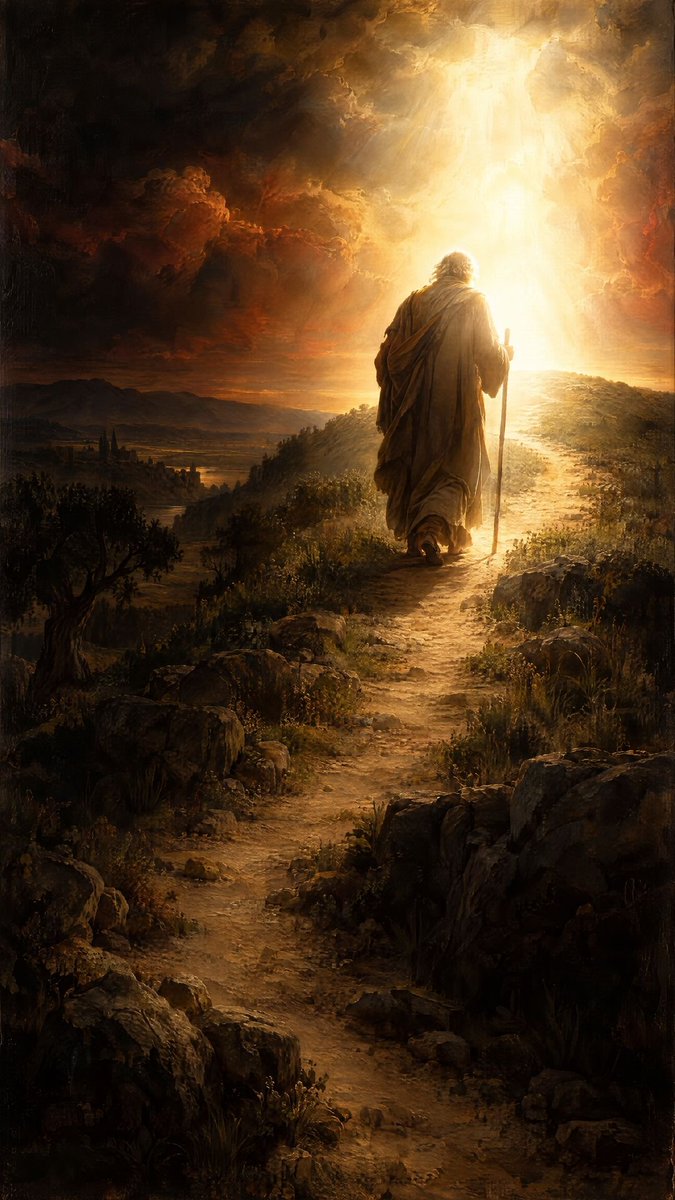
It started late. Verse 22 says Enoch walked with God after he became the father of Methuselah, when he was 65. Something changed when that child was born. Whatever his life was before, it turned there.
It was ordinary. He walked with God for 300 years, and the same verse says he “had other sons and daughters.” Enoch wasn’t a hermit on a mountain. He was a father. He raised kids, worked, ate, slept. He walked with God in the middle of an ordinary, busy, family life.
It was constant. The Hebrew verb is a special form, hithallek, meaning to walk about, to go to and fro, a continuous, ongoing walk. It’s the same form used in Genesis 3:8 of God Himself walking in the garden in the cool of the day. Enoch got back what Adam lost: walking with God, side by side.
So what does walking with God actually mean?
It’s not a feeling. It’s not a single dramatic moment. It’s a direction. Every day, going the same way He’s going.
The prophet Amos asks: “Do two walk together, unless they have agreed to meet?” (Amos 3:3). Walking with God means agreement. His way becomes your way. His pace becomes your pace. You stop running ahead and stop dragging behind.
And Hebrews tells us what made it possible: “Before he was taken he was commended as having pleased God. And without faith it is impossible to please him” (Hebrews 11:5–6). Not perfection. Faith. Trusting the One walking beside you.
There’s an old saying about this verse. Enoch and God walked together every day, and they talked, and they walked a little further each time. And one day they walked so far that God said, “Enoch, we’re closer to my house than yours. Why don’t you come home with me?”
That’s the end of every true walk with God.
For Enoch, it came without death. For us, Jesus has gone through death first so that it can never be the end of the road. “I will come again and will take you to myself, that where I am you may be also” (John 14:3).
He took Enoch.
He will take you too.
Just keep walking.
There’s a night in Genesis where a man wrestles God and wins. Or does he?
“And Jacob was left alone. And a man wrestled with him until the breaking of the day.” - Genesis 32:24
No introduction. No explanation of who the man is. Just a stranger in the dark and a fight that lasts all night.
Here’s the setup. Jacob is about to meet his brother Esau for the first time in twenty years. The last time they saw each other, Jacob had stolen Esau’s blessing, and Esau had sworn to kill him. Now word has come: Esau is on his way, with four hundred men.
Jacob sends his family across the river Jabbok. He stays behind alone. And someone grabs him in the dark.
Then comes the strangest detail in the story:
“When the man saw that he did not prevail against Jacob, he touched his hip socket, and Jacob’s hip was put out of joint.” (v.25)
Read that again. One touch, and Jacob’s hip is dislocated.
Whoever this was could have ended the fight at any moment. He wrestled all night anyway.
He wasn’t losing. He was letting it go on.
Then the stranger says, “Let me go, for the day has broken.” And Jacob, crippled, no longer able to fight, does the only thing he has left. He holds on.
“I will not let you go unless you bless me.” (v.26)
And the stranger asks a question that cuts deeper than any wound: “What is your name?”
Here’s why that hurts. Twenty years earlier, Jacob’s blind father asked him almost the same question, “Who are you, my son?”, and Jacob lied: “I am Esau” (Genesis 27:18–19). That lie stole the blessing.
Now he’s asked again. And this time he tells the truth: “Jacob.”
The name means heel-grabber. Schemer. Deceiver. It’s a confession.
And in that moment, he gets a new one: “Your name shall no longer be called Jacob, but Israel, for you have striven with God and with men, and have prevailed.” (v.28)
Who was the stranger? The text calls him “a man.” The prophet Hosea calls him an angel (Hosea 12:4). Jacob himself named the place Peniel, “for I have seen God face to face” (v.30). Many Christians through the centuries have seen here an appearance of Christ before His birth.
And Hosea adds one detail Genesis leaves out: “He wept and sought his favor.”
So this is how Jacob “won.” Not by strength. By weeping, clinging, and refusing to let go of the One who could have destroyed him with a touch.
That’s the God of the Bible. The God who lets Himself be held.
Who comes down into the dark, into the dirt, close enough to be grabbed. Who stays all night. Who wounds only to bless.
Centuries later, He came closer still. A God who let Himself be held as a baby in His mother’s arms. Who let Thomas touch His wounds. Who let sinners cling to His feet and wouldn’t push them away.
You don’t win with God by being strong enough.
You win by holding on.
“The sun rose upon him as he passed Penuel, limping because of his hip.” (v.31)
He walked into the morning with a limp and a new name.
Most people who’ve truly met God do.
Italia va a arrepentirse de no haber repoblado su país con los hijos y nietos de sus exiliados.
Nos hicieron imposible el papeleo para volver cuando lo necesitábamos... con el diario del lunes nos hicieron un favor.
Argentina es el futuro de occidente.