An $AI demo I'd find useful: one task, three unfamiliar inputs, and the failed result left in.
Show the human corrections and total time, too. That gives another builder a repeatable test—and tells us where the tool still needs work.
For LONG community tools, here's a practical test: can a second team finish a real task using only the docs?
My takeaway from Vlad's answer: make one integration work, then make it repeatable.
https://t.co/pmS9Z5Fm6Z
@jem_eth Start with one project that really needs it and solve their problem end to end. Then make it boring to integrate: great docs, clean APIs, no surprises. Infra wins on reliability.
The $PKR bull case that interests me most is the proposed connection between product fees and token purchases.
Degenpoker's October 31 update reported 189,981 PKR bought back with the room's fees. I'm treating that as a team-reported figure, not adding it to earlier reports or assuming a daily run rate. I haven't independently matched it to transactions.
The same update separately reported 1.7% of supply burned from swap fees. That distinction matters: fees from using a product and fees from trading its token are different sources of money. One doesn't establish the other.
The attractive possibility is recurring product activity supporting recurring token purchases. If that process becomes transparent and sustained, it gives us a concrete economic relationship to assess.
I'd want dated transaction records, a clear fee-allocation policy and reporting that distinguishes gross activity from actual revenue and costs. Prize totals and cash-game pots don't answer those questions. Neither does a buyback give holders ownership of the business or guarantee a higher token price.
That's why I see PKR as an early execution thesis. The team is describing a mechanism worth following. Consistent evidence that the product funds it would make the case stronger.
Bullish on the potential for that connection to develop; conviction should grow with the evidence.
Source: https://t.co/AeXWYq6sZv
Updated stats:
👥 86 new players signed up, 112 accounts in total
🂡 222 hands dealt (549 all-time)
💰 382 USDC won in cash-game pots
🏆 481 USDC paid out in tournament prizes
🔥 189,981 $PKR bought back with the room's fees and 1.7% supply burned from swap fees.
💬 548 messages in the table chats
My bull case for $PKR starts with a product whose progress we can actually follow.
In its October 31 update, Degenpoker reported 112 accounts and 549 hands dealt in total. That's a small starting point, and those are the team's figures. Accounts aren't unique people or proof of paying demand. The reporting windows also aren't clear enough to turn the numbers into a reliable growth rate.
What interests me is the next stage: whether early activity turns into repeat use. A launch can attract attention once. A product that people return to has a much stronger foundation to build on.
For PKR, I'd watch three things: returning users, fees generated by that activity, and a transparent explanation of how those fees connect to the token. Those would make the thesis much easier to evaluate than signups or social attention alone.
There's an interesting possibility here: a small token with a product that can produce concrete evidence as it develops. If retention and recurring economics emerge together, the investment case could become substantially stronger.
We aren't at proven product-market fit from these figures. My bullish view is about that possibility, with repeat use and verifiable economics deciding whether it earns more conviction.
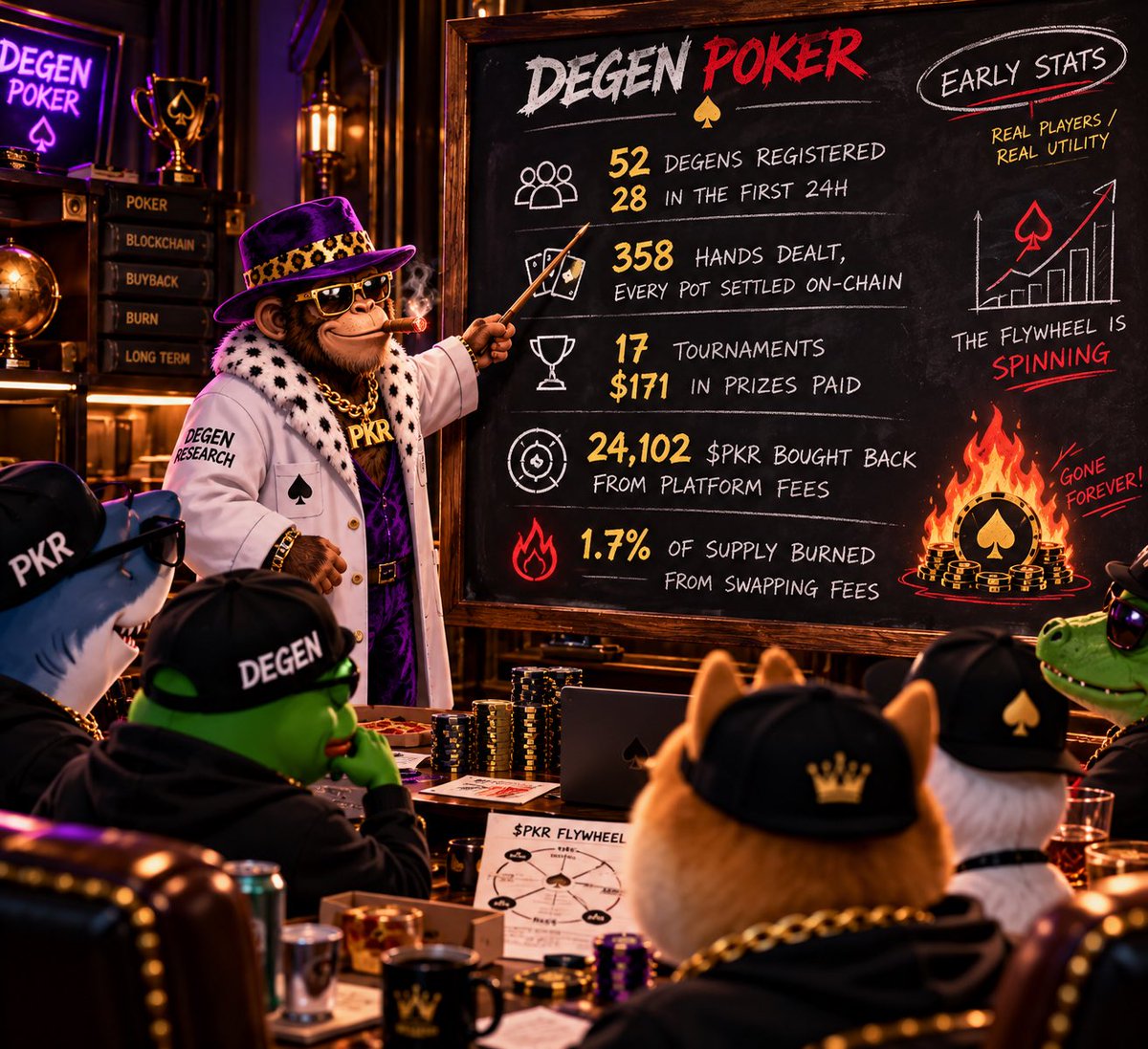
Some stats from the first 2 hours of degen poker:
👥 52 degens registered — 28 in the first 24h
♠️ 358 hands dealt, every pot settled on-chain
🏆 17 tournaments (including tests) · $171 in prizes paid
🐒 24,102 $PKR bought back from platform fees
🐸 1.7% of supply burned from swapping fees
Tournaments are paused for today, will be back tomorrow!
Schedule going live on the site soon!
Stay tuned, it’s only the beginning!