@MessengerAndrew Probably not. This premiership window will shut. But Duffy, Mozer, Walsh etc could be the spine of a very good team in 2-3 years time. Definitely need to sign another middle forward though.
There was discourse last week coming out of people misinterpreting some e61 estimates of filtering effects.
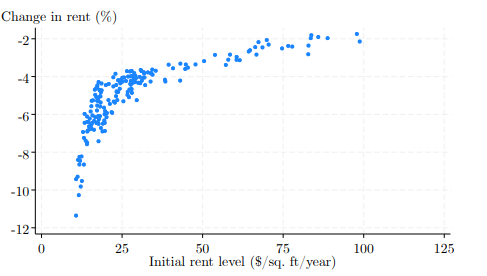
Those results are NOT an estimate of the impact of building more homes on rents, these are.
It's the cheapest rents which fall the most!
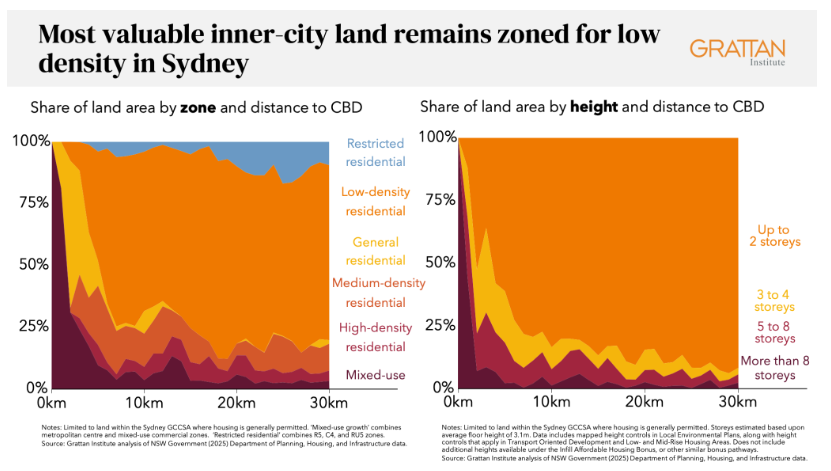
Zoning restricts a huge amount of inner-city housing to low density.
That is a costly waste of an extremely valuable resource.
It makes housing unaffordable.
https://t.co/0XPWnU3vLL
Also while Sydney does have some natural barriers to expanding supply, these are barriers to sprawl, not density. There is ample scope to let a lot more people live in Sydney with much lower housing costs than what we see currently 9/n
This is a great conversation and we could use a lot more of it. I’ve read a lot and written a little on this topic + have locked myself out of my house, so a good opportunity to throw my 2 cents in 1/n
The time has come to break the Sydney-Melbourne duopoly.
I think a large part of what makes the UK, for example, so pathologically broken is that they have all their eggs in the London basket.
We’re only one city away from that.
Where are Australia’s Austins and Phoenixes? Why aren't we scaling more cities to +1 million, or building new ones altogether?
This question has come up in a couple of my podcast chats.
A couple of years ago, Ken Henry revealed to me that Treasury had once looked into it.
And last week, when I asked Greg Kaplan (@GregWKaplan) and Michael Brennan (former Australian Productivity Commissioner) for the most ambitious idea they've encountered for raising Australian productivity, it came up again:
I would also challenge the idea that having only two big centres is bad per se. Or that London’s dominance is a net negative for the UK. My prior is that a cf with decentralised populations in these places in much poorer and less productive. 8/n
Joining the national conversation on productivity and economic reform, today I’ve released a working paper presenting the case that zoning reform in New Zealand boosted construction sector productivity over the past decade. Read it here: https://t.co/P8DX4l6Czk /1
We only end up with high rise in the middle ring (sometimes outer) because supply restrictions bind so tightly in centre, bidding up land values throughout the city + there is less organised resistance in these commuter suburbs.
@disco___cat In the city and surrounds high rise is perfectly fine but when people start talking about 20 storeys in established suburbs that just turns people off the idea of any density right away.
@StuartBDonovan Haven’t seen anyone argue (formally) that they’re >1. Do you have any studies in mind? Although have seen a lot of Cobb-Douglas preferences assumed.
@CameronGordon0@mjkerrison Interesting Cam. But doesn’t this boil down to the fact that labour supply curves slope upwards? Resources are finite so we make trade-offs. But I don’t think this qualifies as a shortage.
Somewhat related, I have always thought ‘skills shortages’ were a strange concept for this reason. At least w something like housing we can point to an objective benchmark like price > marginal cost.
@BenPhillips_ANU Shortage is a misnomer; it would imply that demand exceeds supply at a given price, and that price restrictions are preventing the market clearing. Rather than quantifying a number, we just need to build more housing as the welfare gains from removing zoning restrictions are +
@mjkerrison Or if there is a sudden increase in demand and there are reasonably long training lags. Although as Matt points out the market still actually clears even in these cases unless there are price controls 2/2
@mjkerrison Thanks for the thoughtful engagement. That’s a better def’n than usual but still leaves a lot of Qs. What is the social optimum? What are the frictions preventing it? I can foresee legit cases where there are tight supply restrictions…1/2