Are bacterial sRNA systems inherently more prone to negative regulation?
How relevant is sRNA recycling?
How can we use sRNAs for synthetic biology?
A review with @DSchindler_PDR and Bork Berghoff explores knobs and levers of sRNA-mediated regulation. https://t.co/j7NxoVqF8W...
I’m excited to see our review on bacterial small regulatory RNAs as tools for synthetic biology finally online. Great work together with @jensRNA and @BorkBerghoff it was fun to jointly work on that project. https://t.co/pIiuHooXMK - thanks to @MPDL for open access funding
Just accepted @iScience_CP https://t.co/YeQ3rVn6bc happy to see Michel Brück's master's project published. Great collaboration with @BorkBerghoff and @jensRNA. Check out the article if you are interested in #synthetic small RNAs! Congratulations and many thanks to the whole team.
Our new study on synthetic small regulatory RNAs just got available as preprint. We investigated the effect of seed region length for post-transcriptional regulators. Another productive collaboration with @BorkBerghoff@jensRNA. Find the preprint here: https://t.co/CwuUTwI9MH
Importantly, a simultaneous repression of cell elongation, potentially by repression of e.g. mepS, is required to limit the detrimental effects of the prevented cell division. 2/2
https://t.co/m8dapTllX7
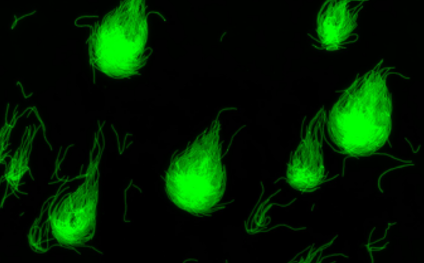
Check out this preprint about an sRNA that turns E. coli into a fireball. The @ShoshyAltuvia Lab and we could show that the repression of cell division by OxyS is likely a phylogenetically conserved mechanism that is conveyed by a changing target set. 1/2
Excited to see our design, construction and characterization of the one and only tRNA neochromosome out on @BioRxiv In this work I share co-authorship with @SynbioRoy, with the project led by @caiyizhi and @JefBoeke
https://t.co/3cBCEQhrqO. Big thanks to everyone involved.
‘rifi’ is a @Bioconductor R-package with segmentation by dynamic programming to enhance RNA stability estimation and to extract transcriptional features such as termination sites and efficiency, elongation rates and operon structures from rifampicin data.
https://t.co/vTpNGQZQkV
Our new paper shows that transcriptional interference by asRNAs is frequent in bacteria. Also RNA stabilty estimates can be significantly improved if the complex transcriptome arcitecture is considered. https://t.co/vTpNGQZQkV @CyanolabDE@UniFreiburg@BUnifr@denbiOffice