Alex Eala says seeing the massive crowd that came to support her for her Australian Open match was heartwarming, ‘Just the fact that everyone came out & really squeezed into that cozy court... I felt so loved’
“It was so heartwarming. That’s one of the things that make a loss like today a little bit harder. I know a lot of people were rooting for me. Alycia played really well. I just hope the support continues with the losses along with the wins. That would really touch me. Just the fact that everyone came out and really squeezed into that cozy court, I really appreciate it. I felt so loved. Even at 5-2 down in the 3rd I still felt the love. I’m really appreciative and super thankful.” 🇵🇭🥹
(via Australian Open Press)
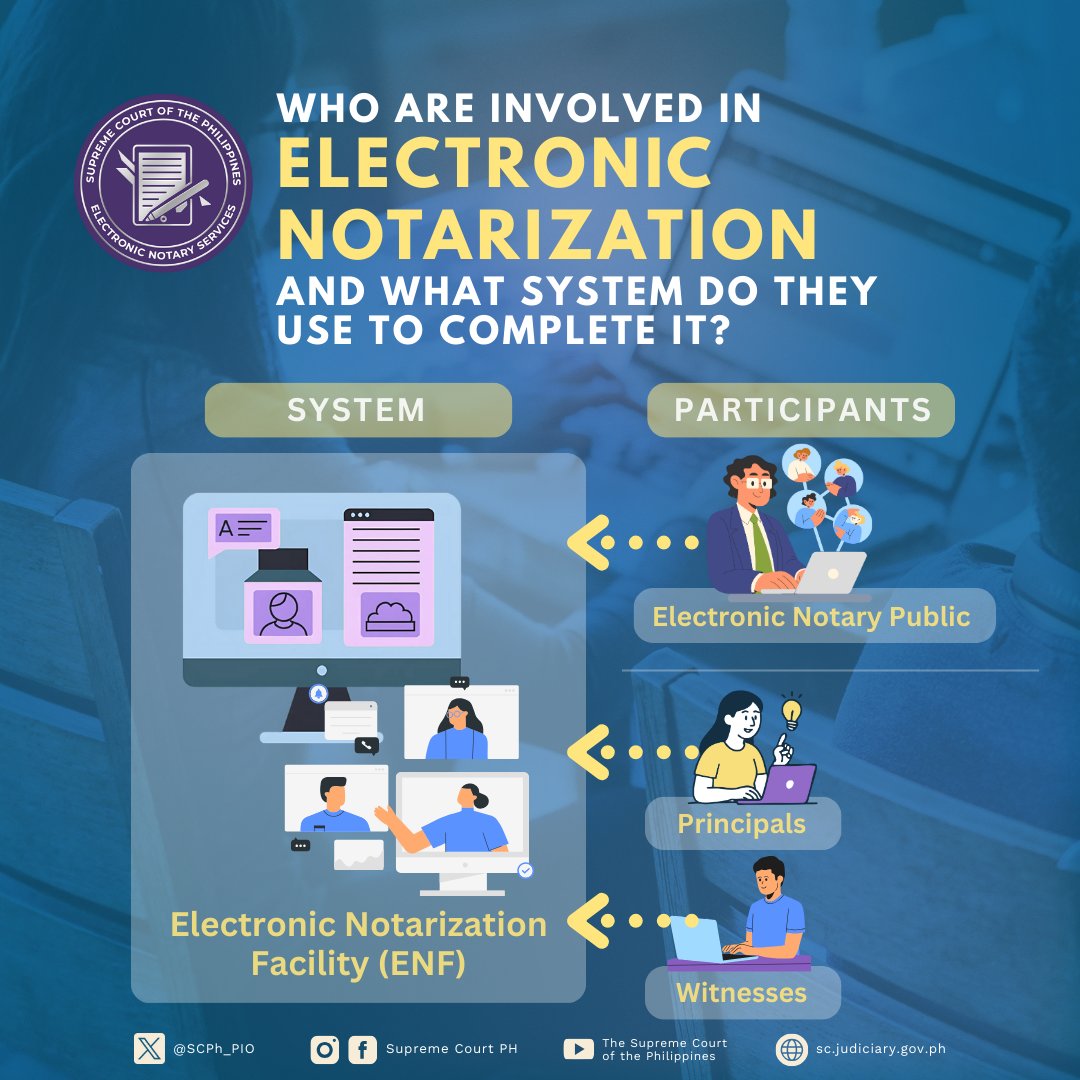
𝐖𝐡𝐚𝐭 𝐢𝐬 𝐭𝐡𝐞 𝐝𝐢𝐟𝐟𝐞𝐫𝐞𝐧𝐜𝐞 𝐛𝐞𝐭𝐰𝐞𝐞𝐧 𝐄𝐥𝐞𝐜𝐭𝐫𝐨𝐧𝐢𝐜 𝐍𝐨𝐭𝐚𝐫𝐢𝐳𝐚𝐭𝐢𝐨𝐧 𝐅𝐚𝐜𝐢𝐥𝐢𝐭𝐲 (𝐄𝐍𝐅) 𝐚𝐧𝐝 𝐄𝐥𝐞𝐜𝐭𝐫𝐨𝐧𝐢𝐜 𝐍𝐨𝐭𝐚𝐫𝐲 𝐏𝐮𝐛𝐥𝐢𝐜 (𝐄𝐍𝐏)?
ENF is the system or platform which the Electronic Notary Public and the parties to the electronic document must access to complete the electronic notarial act. An ENF is run by the ENF Provider, which shall be accredited by the Electronic Notary Services (ENS).
ENP is the lawyer, duly commissioned by the ENS, to perform electronic notarial act such as acknowledgment and jurat. A lawyer who seeks to be commissioned as ENP must first register an account with an accredited ENF.
Accreditation of ENF Provider will start tomorrow, December 9, 2025.
For questions, you may send them at https://t.co/Ttow93Ylnk
The Supreme Court reiterated that using online chat logs and videos as evidence does not violate the right to privacy if they are used to determine if a crime has been committed.
The Court upheld the conviction of a man for qualified trafficking in persons under Republic Act No. 9208 or the Anti-Trafficking of Persons Act of 2003, finding that the videos and recordings of the chat logs of his conversations with an undercover agent can be admitted as evidence.
The Court rejected the accused’s arguments that they were inadmissible for violating his privacy rights. Republic Act No. 10173, or the Data Privacy Act of 2012, allows the processing of sensitive personal information to determine a person’s criminal liability and to protect the rights and interests of persons in court proceedings.
As the chat logs and videos were submitted as evidence to assess his criminal liability for qualified trafficking, his right to privacy was not violated.
The Court emphasized that the videos and chat logs were presented as evidence to show the accused’s method of reaching out to foreigners through Skype or Facebook and offering minors for sexual exploitation.
The Decision is from the Supreme Court’s Second Division, written by Associate Justice Mario V. Lopez.
Read the full text of the press release at: https://t.co/Rn00LfBflf
Read the full text of the Decision at: https://t.co/8kPi31W6un
#SupremeCourtPH
Copying of this content is subject to the SC PIO’s Credit Attribution Policy: https://t.co/F48RF1vtzZ
Saludo sa matatapang na tao na humarap sa mga abusadong tao na gumagamit ng special plate #7 at entitled daw gumamit sa edsa busway.
Kung sino ka man...pakpak mo.
The Supreme Court has ruled that a violation of procurement laws by public officers will not automatically result in a conviction under Republic Act No. 3019, also known as the Anti-Graft and Corrupt Practices Act. It is required that all elements of graft be proven beyond reasonable doubt, not just the deficiencies in the procurement process.
The Court acquitted Davao City Water District (DCWD) officials Arnold D. Navales, Rey C. Chavez, Rosindo J. Almonte, Alfonso E. Laid, and William V. Guillen of violating Section 3(e) of Republic Act 3019 for dispensing with competitive public bidding in DCWD’s water supply project.
To fall under Section 3(e) of RA 3019, a procurement violation must be done in bad faith, with manifest partiality or inexcusable negligence harming a party, including the government, or giving another undue preference, or giving any private party any unwarranted benefits.
The Court found that petitioners merely recommended to the DCWD Board of Directors the award of contract to the supplier. It was the DCWD Board which had the authority to approve and award the contract.
While there might have been irregularities in the procurement process that violated procurement laws, there was no evidence showing petitioners were motivated by manifest partiality or bad faith.
Instead, petitioners resorted to a negotiated contract believing it is allowed as an exceptional case given the urgency of the procurement and the lack of qualified bidders.
The Decision was from the Supreme Court’s First Division written by Associate Justice Jose Midas P. Marquez.
Read the full text of the press release: https://t.co/NCdT5KCNZ9
Read the full text of the Decision: https://t.co/ol7bq1hJNJ
#SupremeCourtPH
Copying of this content is subject to the SC PIO’s Credit Attribution Policy: https://t.co/F48RF1vtzZ
What happens if you are invited to a Senate hearing and refuse to answer questions? Can you be cited in contempt and ordered arrested by the Senate?
Listen to the latest episode of the Supreme Court Podcast, which discusses the cases of G.R. Nos. G.R. Nos. 257401 and 257916, Ong v. Senate and Ming v. Senate.
You may also listen to previous SC Podcast episodes on Spotify and at the Supreme Court website: https://t.co/FFDE0yWQ0v
#SupremeCourtPH
#SCphPodcast
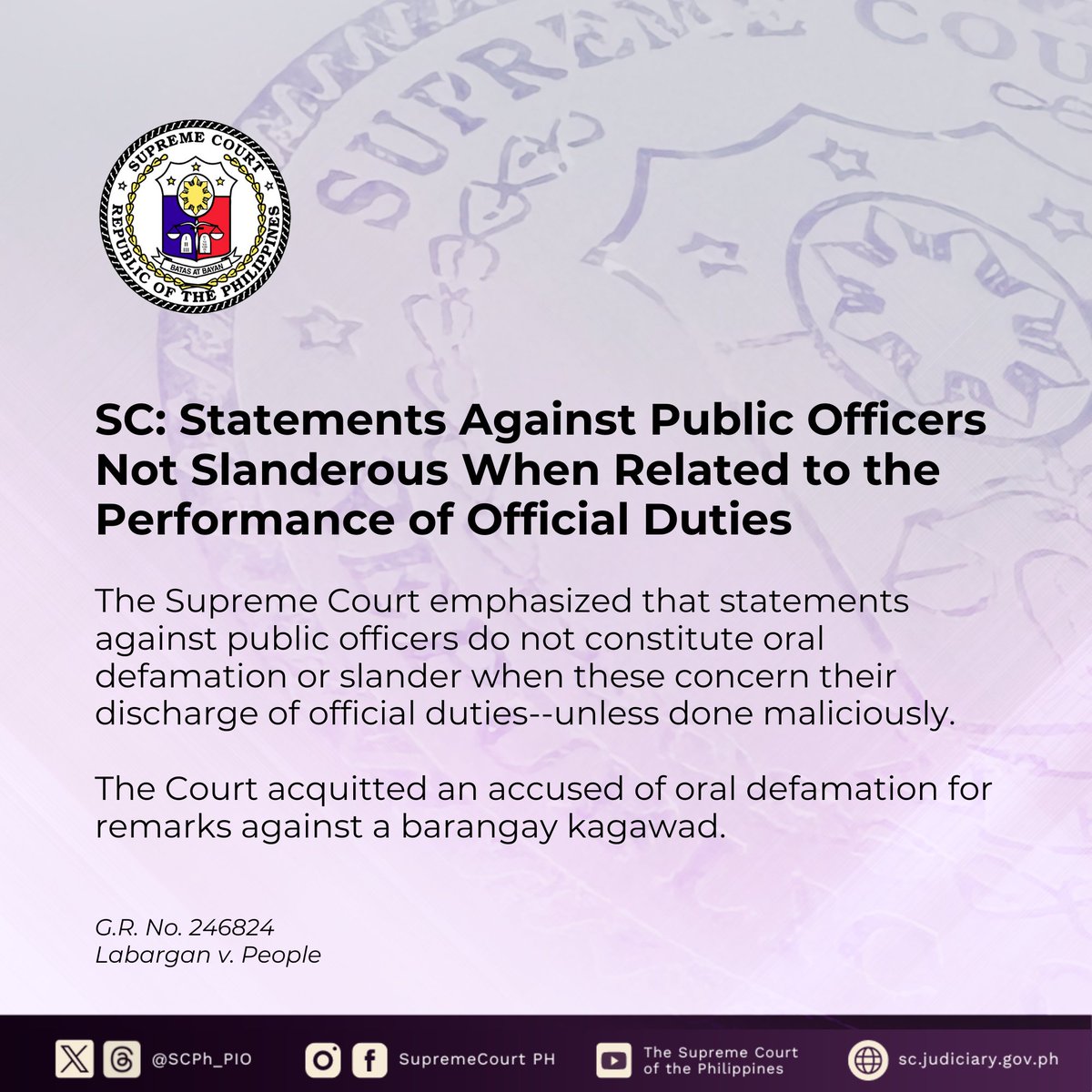
The Supreme Court emphasized that statements against public officers do not constitute oral defamation or slander when these concern their discharge of official duties —unless done maliciously.
In a Decision written by Senior Associate Justice Marvic M.V.F. Leonen, the Supreme Court’s Second Division acquitted an accused of oral defamation for remarks against a barangay kagawad.
The barangay kagawad was walking past the accused’s house, when she yelled from her house’s terrace that the barangay kagawad was uneducated, ignorant, and biased against the accused in their barangay conciliation proceedings. The remarks were heard by many people as the terrace was beside the highway.
Under Article 358 of the Revised Penal Code, there is oral defamation or slander when (1) there is an allegation of a crime, fault, or flaw; (2) made orally; (3) publicly; (4) maliciously; (5) towards a person, alive or dead; and (6) such allegation tends to cause dishonor on the person defamed.
As the law assumes that a defamatory allegation is malicious, or made with knowledge that it is false, the person who made the defamatory remarks has the burden of proving there was no malice.
However, when it comes to defamation against public officers in relation to their duties, the prosecution has the burden to prove there was actual malice in the defamatory remarks. The Court recognizes that the right to free speech empowers citizens to hold public officers accountable because public office is a public trust.
In the present case, the SC said that the prosecution failed to prove there was malice in the accused’s remarks against the barangay kagawad. It stressed that while the statements may be offensive, they are not actionable by themselves: “Being ‘sensitive’ has no place in this line of service."
Read the full press release at: https://t.co/Z2qeUdac3K
Read the full text of the Decision at: https://t.co/gdIQD03Thb
#SupremeCourtPH
The Supreme Court Ph Podcast is now available on Spotify.
Listen to summaries and discussions on significant Supreme Court Decisions, issuances, and programs.
You may also listen to the podcast on the Supreme Court website and the Court’s official social media accounts.
#SupremeCourtPH
#SCphPodcast
The Supreme Court has ruled that it is the Regional Trial Court (RTC) that has jurisdiction over wills proved as valid and allowed in proceedings abroad.
In a Decision written by Associate Justice Jhosep Y. Lopez, the Supreme Court’s Second Division clarified that for reprobate proceedings, a special proceeding to establish the validity of a will proved and allowed in a foreign country, it is the RTC that has jurisdiction regardless of the value.
For probate proceedings, on the other hand, the jurisdiction of the court is based on the value of the estate. If PHP 2,000,000 and below, the first-level courts have jurisdiction; if over PHP 2,000,000, the RTC has jurisdiction.
The Cebu City RTC, Branch 17 dismissed a petition to allow a will probated in Hawaii which covers land in Cebu City worth PHP 896,000. The RTC held it does not have jurisdiction because under Batas Pambansa 129 or the Judiciary Reorganization Act, as amended by Republic Act No. 11576, probate of wills which involve property or estate worth PHP 2,000,000 and below belongs to the first-level courts.
The Supreme Court ruled that the amendments in RA 11576 did not change Rule 77, Section 1 of the Rules of Court which states it is the RTC that has jurisdiction over reprobate proceedings.
Read the full text of the press release: https://t.co/hWGOuVaI7q
Read the full text of the Decision: https://t.co/hWGOuVaI7q
#SupremeCourtPH
@RobbieMeriales@MMDA sadly because they are trying to apprehend abusive "ambulances".
Which seems to be working. If you watch the news, legitimate emergencies are immediately let go, and fraud ambulances at apprehended.