THE TENANT TICKET PLAYBOOK
Landlords drown in 2am "my sink is leaking" texts.
1. AI agent answers every tenant text + call
2. Triages: emergency vs next-day
3. Books the right vendor
4. Owner gets 1 daily summary
$5/unit/mo. 200 units = $1k MRR per client.
#7 is the sleeper.
Old local paper: 20 reporters, a press, dying ads.
New: 1 person + AI reading school board agendas, permits, council minutes.
Daily newsletter per town. Local sponsors at $500/mo.
Run it in 10 towns. That's a media company.
More REALLY big opportunities right now:
1. build for safe, unstructured hangouts for tweens and teens. Kids don't roam neighborhoods anymore, so they live on TikTok and Roblox. Physical maker spaces, sports labs, and offline clubs where they can actually just hang out are a massive gap.
2. build for people whose nervous system is stuck in fight or flight. Everyone is wired, scrolling at 1am, and waking up exhausted. Anything that actually down-regulates people without a prescription is an easy sell.
3. build for the new blue collar millionaire. Smart 19-year-olds are skipping $200k degrees to become electricians, welders, and robotics techs. Build the modern software, training, and prestige brands for them.
4. build for companies that refuse to put their data in the cloud (hospitals, law firms, and defense contractors want AI badly, they just can't paste client secrets into a chatbot…private, on-premise AI setups are a massive market)
5. build for people who treat their dog like their firstborn child (fewer kids means absurd spending on pet longevity, fresh food, and preventative diagnostics, we're in the golden age of pet health)
6. build for the physical world that never got digitized. Warehouses, construction sites, and kitchens still run on clipboards and shouting. Cameras and smart glasses that just watch the work and automatically log inventory, safety, and billing are coming fast.
7. build for hyper local news that isn't dead (everyone knows what's happening in DC, nobody knows why their town's school board just raised taxes or what's opening down the street…one person with AI tools can now run a profitable local media empire)
8. build for live experiences you can't fake or stream. When any video can be generated in 5 seconds, being in the actual room. weird live sports, underground shows, real world tournaments... it becomes the last uncopyable media asset IMO.
9. build for people living alone (more adults live solo than ever in history, yet groceries, housing, furniture, and travel are still designed and priced for families of four)
10. build for charging for completion, not access (people buy courses they never watch, books they never finish, and gym memberships they never use…products with real accountability that get people across the finish line can charge 5x more)
11. build for adult summer camp. Burned out professionals don't want another beach resort where they scroll on their phone, but they'll pay $3k (more?) to spend 5 days in the woods building something, cooking over fire, and making real friends.
12. build for "know your maker" everyday goods (people are sick of Amazon knockoffs and mystery factories. direct, traceable basics for clothing, cookware, and furniture where you know the exact material and who made it are exploding)
13. build for people who want to make real things with their hands. Woodworking, ceramics, welding, sewing. modern neighborhood workshops with memberships like Equinox instead of dusty community college basements vibes.
14. build for people who want to read real books again. Goodreads hasn't changed since 2008. Social reading clubs, physical book swaps, and distraction free reading trackers are wide open.
15. build for teaching kids how to actually think in the AI era (memorizing facts is dead and essays are written by bots. so things like live debate clubs, Socratic tutoring, and real-world problem solving for kids)
16. build for sober nightlife that isn't lame. Younger generations are drinking way less, but they still want a great 10pm Friday vibe that isn't a loud bar or a cheesy wellness cult.
17. build for amateur sports with pro-level production (35-year olds playing rec basketball, golf, or tennis will happily pay for automated AI highlight reels, real stats, rankings, and leagues that feel like the pros)
18. build for winning government contracts and grants with AI. Trillions of dollars go to the same 50 dinosaur incumbents just because the paperwork is 200 pages of torture. Automate the RFPs and unlock it for small, modern companies. I need to do a whole ep of @startupideaspod on this.
19. build for modern rites of passage. We stripped away almost all the old ceremonies for turning 30, becoming a parent, or starting a new chapter and people are starving for meaningful ways to mark big life moments that dont cost an arm and a leg too.
20. build for micro-franchises in entertainment (instead of spending $200M to make one movie for everyone, use AI tools to build deep, interactive worlds, games, and shows for 10,000 obsessive superfans)
Note: I co-founded an agency https://t.co/YQJFV1Xlkt that brings ideas to life and are trusted by Nike, Shopify, Dropbox, Fortnite and more.
21. build for reclaiming dead strip malls and empty office towers (turn half-empty commercial real estate into bathhouses, indoor padel clubs, micro-factories, and neighborhood hubs. real estate arbitrage with huge upside)
22. build for "how it's made" craft media and commerce (people are hypnotized by watching real humans do hard physical skills like restoring watches, forging knives, building cabins and pair authentic craft content directly with physical products)
23. build for the quiet quitters of social media (millions of people still want to keep up with 30 real friends without posting to an algorithm... private, zero-feed life updates and monthly friend newsletters are overdue)
Thye'll tell you it's a "bad time to be building".
I'll tell you this...
HAPPY BUILDING
THE PERMIT PLAYBOOK
Contractors lose weeks to rejected permits.
1. Pull their last 50 approved permits
2. Claude learns each city's checklist
3. Agent pre-checks every new filing
4. Charge $250/permit, refund if rejected
Paperwork is the bottleneck. Sell the unblock.
Old limit: every AI feature = a cloud API bill.
New limit: a 26B model on the client's laptop.
Play: sell offline AI setups to law firms, clinics, accountants who can't send data to the cloud. $5k install + $500/mo.
Privacy is the new wedge.
AMERICA IS BACK
Thinking Machines just launched Inkling 2 Small. A 26B model that fits on a laptop
O, and it mutilates Qwen 3.8 27B. Faster and smarter
Thinking Machines figured out how to fit significantly more intelligence in a significantly smaller blueprint
Unlimited superintelligence for all is now back on the table
Democratized access to all knowledge is now back on the table
Highly recommend going to your agent of choice (grok bot, Hermes, Dots, Duet) and giving them this post. Then tell them to download and run this model
Then be blown away by the fact you have unlimited superintelligence on your desk
THE NO-SHOW PLAYBOOK
Med spas bleed money on no-shows. Few fix it.
1. Connect their booking system
2. AI agent texts 48h + 2h out, confirms or rebooks
3. Cancel? Agent fills the slot from the waitlist
4. $300/mo + $25 per saved booking
Boring. Recurring. Everywhere.
SEO isn't dead. It moved into the chat box.
Play: run the questions buyers ask ChatGPT for 10 local businesses. Show each owner who gets named instead of them.
Sell AI visibility at $500/mo. Most don't know they're invisible.
in the past 2 months I've seen SEO working again insanely well for my products
.. even reversing a downtrend 🤯
mainly by:
- finding listicles to buy
- monitoring AI visibility
- finding long-tail keywords
- finding questions people ask AI
working on a product that solves this
100% made for agents
if you want to be the first to test it, reply here and I'll see if I can squeeze you in 👋
THE LATE INVOICE PLAYBOOK
Agencies sit on unpaid invoices nobody wants to chase.
1. Connect QuickBooks
2. Claude writes polite, escalating nudges per client
3. Agent emails + texts on day 7, 14, 30
4. Take 5% of what you collect
Boring. Recurring. Wildly needed.
Frontier-level coding at half the cost per task.
Old play: build an AI product, eat the token bill.
New play: same product, 2x margin overnight.
Don't reprice. Swap the model, keep the spread.
Margin is now a routing decision.
I got to test Gemini 4 Neon early and it’s really good, really fast and about half the price of what I’m used to.
Then I saw the benchmarks, and it made sense. It scored about the same as Opus 5.5 on coding for around half the cost per task!
Claude is still often what I reach for on the hardest problems, and Opus still edges it on a couple of coding benchmarks.
But when you run agents literally all day, fast and half the cost is hard to ignore.
This is great news for anyone using agents, because competition like this pushes prices down for all of us.
THE RFP PLAYBOOK
Small contractors skip $250k gov bids. The paperwork eats 2 weeks.
1. Find firms with past wins on https://t.co/mwk6JRYbWA
2. Load their old proposals into Claude
3. Agent drafts the compliance matrix + first draft in a day
4. Charge $1,500/bid + 3% of wins
Old moat: niche down, big tech won't bother.
New moat: own the outcome, not the feature.
Every tool ships every feature now. Nobody ships "your invoices get paid."
Stop selling software. Sell the result, charge on the result.
💯
There is no real way to survive for most SaaS companies here because AI is so completely different than any technological advancement before it
Before you could just niche down and specialize on one thing and you'd know for certain the big tech companies would never be able to dedicate enough resources to fill your tiny little niche market of $300M where you could take 1% of the market and make $3M/year
Riches in the niches!
And so you'd avoid going too general, because "you'd spread yourself too thin" and hit "death by a thousand paper cuts"
And general was where big tech companies were great at, they could dedicate huge resources in solving these big problems, like building Google Sheets, or Salesforce (whatever it is they do)
But that was the old days, and it's completely different now
With AI, big tech companies can easily fill any niche, or be general at the same time, they can do the whole range actually, without even spending time on consciously doing that, because they're not offering a particular SaaS offering at all
They're offering you artificial general intelligence (AGI) that can do it all
And as long as they improve their models every time and make them bigger and better, it slowly can do literally anything (okay not yet anything, for anything they'll need physical robots, but they're working on that too of course)
This leaves SaaS companies with a bitter ending:
- they either do nothing and stay in their niche like they economically should, but that doesn't work anymore now
- they try go general, and offer EVERYTHING and ANYTHING, and that works for a little bit until customers realize they might as well use whoever makes the models that the SaaS itself uses anyway, which is the big tech and big AI companies, who by the way either offer it free or for much cheaper
Everyone's been checkmated by big tech and big AI
This will be the creative destruction of the century
But there'll be some survivors and then a lot of new companies, but how they'll look nobody knows yet!
THE MENU MARGIN PLAYBOOK
Most restaurants don't know which dishes lose money.
1. Pull 90 days of POS + supplier invoices
2. Claude costs out every plate
3. Flag 5 worst-margin best sellers
4. Reprice or swap ingredients
Charge $1k + 10% of the margin you add.
Skills are the new free trial.
Play: pick a niche SaaS people hate paying for, ship its 5 best workflows as Claude Code skills, let devs fork them, sell the hosted version to teams who don't want to.
Distribution is the repo.
I’ve noticed open sourcing your saas is the new saas playbook
1. pick the job your customers hire you for
2. turn your best workflows for that job into skills
3. open source them on github
4. make them work in claude code, codex, cursor and openclaw on day one
5. ship an MCP so agents can use your product directly
6. post the repo with a list of every skill inside (like this one)
7. every install puts your brand inside someone's agent, and it gets used every day
8. the free skills do the work once. the paid product does it every week, with your data, hosting and support
9. upsell to done for you, team plans and the hosted version
10. keep shipping new skills. every one is a new launch
Your free skills are the new free trial.
saas has gone open source for real
THE CHURN RESCUE PLAYBOOK
1. Find a SaaS at $20k+ MRR with no cancel flow
2. Add an AI agent that chats with anyone who clicks cancel
3. It offers a fix, pause, or discount
4. Founder gets top 3 churn reasons weekly
5. Take 20% of saved MRR
Retention is the new growth.
Old limit: a $1.4M ad needed a studio, actors, 6 weeks.
New limit: 5 tools and an afternoon.
Play: pick one niche, make 3 AI ads a week for SaaS founders, $1,500/ad + bonus on winners.
The agency of 2027 is one person and a pipeline.
This AI ad produced $1.4M in ARR for a Series A startup.
Here’s the stack:
1. fal for the voice clone
2. Seedance for the video
3. FFmpeg to upscale it from 480p
4. A word for word transcript check to fix mispronounced words
5. Claude Code or Grok Bot to run the whole thing
Here’s the nitty gritty explanation by this cracked marketer in 90s or less:
THE DEAD LEADS PLAYBOOK
Every business has 2,000 old leads rotting in a CRM.
1. Export the list
2. Claude writes a personal text for each
3. Agent handles replies + books calls
4. Take 10% of revenue recovered
Zero risk for them.
Easiest AI business nobody's running.
Old marketer: knows the channels.
New marketer: wires an agent to the data, creative tools and ad accounts.
Play: set this up for 5 local businesses at $2k + $750/mo. Most owners will never learn it themselves.
The truth is all marketing now is just code and tokens.
So learning to market these days means learning to set up an agent with your data, creative tools and ad accounts.
Set it up right and you get a top 0.1% marketer testing an absurd number of ideas every day:
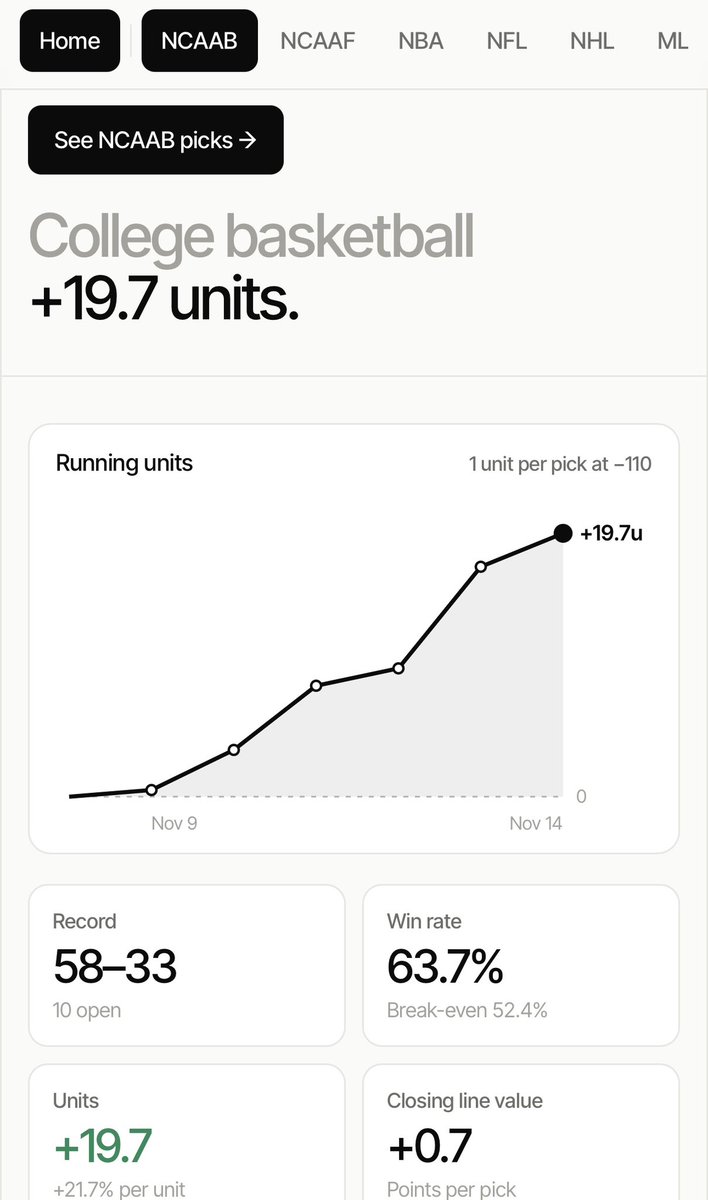
Sports betting is easier than ever. These are my NCAAB picks so far this season…
Only problem is most people don’t have the discipline and give their money back to the books.
The solution? Create an automation that places the bets for you. Never look at it. Auto withdraw.
THE SPEED-TO-LEAD PLAYBOOK
Contractors lose jobs by replying to quote requests 2 days late.
1. Pick one trade (roofing, HVAC)
2. AI agent answers every form + missed call in 60 sec
3. Books the estimate on their calendar
4. Charge $400/mo
Fastest reply wins the job.
Most small businesses will never build this themselves.
That's the business:
1. Interview the owner for 2 hrs
2. Turn it into a markdown brain
3. Wire an agent to it
$3k setup + $500/mo upkeep. Every local firm needs one.
Making the most AI pilled company is the whole game:
1. make a second brain. one folder of markdown files on how you think, write and decide (obsidian)
2. talk to it. voice notes all day (wispr), and an agent files every fact, story and decision
3. make a company brain. customers, calls, numbers, pricing, playbooks, past decisions and why you made them
4. record every call and meeting (granola). the transcripts go straight into the brain
5. keep a facts file. true things about you and the company that agents are allowed to say. this kills made-up claims
6. keep a voice file. your 50 best posts, 20 you hate, and the words you never use
7. put all of it in git (github) so every change has a history
8. write one instruction file at the top (CLAUDE.md or AGENTS.md). read these files before any task, never overwrite, always date
9. give agents memory across sessions so they stop starting from zero (claude-mem, mem0)
10. pipe every data source into one warehouse your agents can query (airbyte → clickhouse). ads, analytics, CRM, payments
11. feed it data nobody else has. it's the only part a competitor can't download
the skills
12. don't start from zero. install the good ones first (anthropics/skills, obra/superpowers, mattpocock/skills, addyosmani/agent-skills)
13. grab the marketing ones too (coreyhaines31/marketingskills, cody schneider's graphed skills for static ads and UGC, boringmarketing dot com skills)
14. map every workflow in the company and rank them by money made or saved
15. do each one once while talking out loud, and record it
16. have an agent turn the recording into a skill. when to use it, the steps, the checks, the mistakes to avoid
17. one skill per job. small and boring beats one giant prompt
18. connect your tools with MCPs so agents can act and not only advise (gmail, slack, stripe, linear, notion, posthog, supabase)
19. give agents a browser (browser-use, vercel agent-browser, claude in chrome)
20. give agents a computer of their own for the tools with no API (vercel agent-desktop, orgo)
21. give your best skills away in public. it's the new lead magnet
the agents
22. run an orchestrator that never turns off (grok bot, openclaw, hermes). it manages one agent per project, and each of those runs its own sub-agents
23. use coding agents for the building (claude code, codex, cursor, t3, antigravity)
24. wrap them in a harness so they plan, test and remember (ECC, superpowers)
25. manage the whole fleet in one place (paperclip). every agent gets a job, a budget and a log
26. put the skills on triggers (n8n, scheduled tasks). daily, weekly, on every new lead, on every cancellation
27. route your models (openrouter). the expensive one plans and checks (fable 5.2, gemini 4 carbon), the cheap ones do the volume
28. cut the token bill. shorter outputs, smaller tool results (caveman)
29. run a local model for the data that can't leave your machine (gemma 4)
30. track cost per job. if a job costs more than it earns, fix it or kill it
the factory
31. build the line. spec agent → builder agents in parallel (git worktrees) → test agent → reviewer agent → deploy (vercel, railway)
32. design goes through the same line (paper MCP), and a skill strips out anything that looks AI made (unslop)
33. every annoying task in the company becomes an internal tool by the end of the day
34. every customer request becomes a pull request before a human reads it (tstack for the PR workflow)
35. reviewer agents with a named bar. "would the best team in the world ship this?" reject until the answer is yes
36. keep 50 real cases with the right answer. rerun them every time a new model drops and switch to the winner
37. humans approve, own the outcome and talk to customers. that's the 10% you keep
the loop
38. every finished job writes back to the brain. what worked, what failed, what to stop doing
39. support tickets, analytics and social comments flow in every night
40. every friday an agent rewrites the playbooks from the week's results, and you approve the diff
41. every month, rank everything by profit per human hour. kill one thing and double one thing
the growth
42. research with agents before you spend a dollar (perplexity API, last30days skill)
43. outbound runs itself. find the leads, enrich, verify, send (apollo, million verifier, instantly, phantombuster)
44. send prospects finished work in place of a pitch
45. ads run on a loop. an agent writes the creative, publishes through the facebook ads API, kills the losers and scales the winners
46. agents make the creative too. images (nano banana), video (heygen, fal), voice (elevenlabs), music (lyria 3.5, suno)
47. turn every finished job into content. the story, the number, the prompt
48. every customer makes the brain smarter for the next one. that's your network effect
49. once it works, point it at a new niche. same agents, new context
The models are the same for everyone but your context is the only part that's yours.
Acquire as much of it as you can, as fast as you can.
Build loops like this.
This is the whole game, happy playing.
Opportunity nobody's grabbing:
Every local business has 200+ unanswered Google reviews.
1. Pick a niche (dentists, HVAC)
2. Claude drafts replies in the owner's voice
3. Owner approves in 1 click
4. Charge $199/mo
Boring. Recurring. Sells itself in one demo.