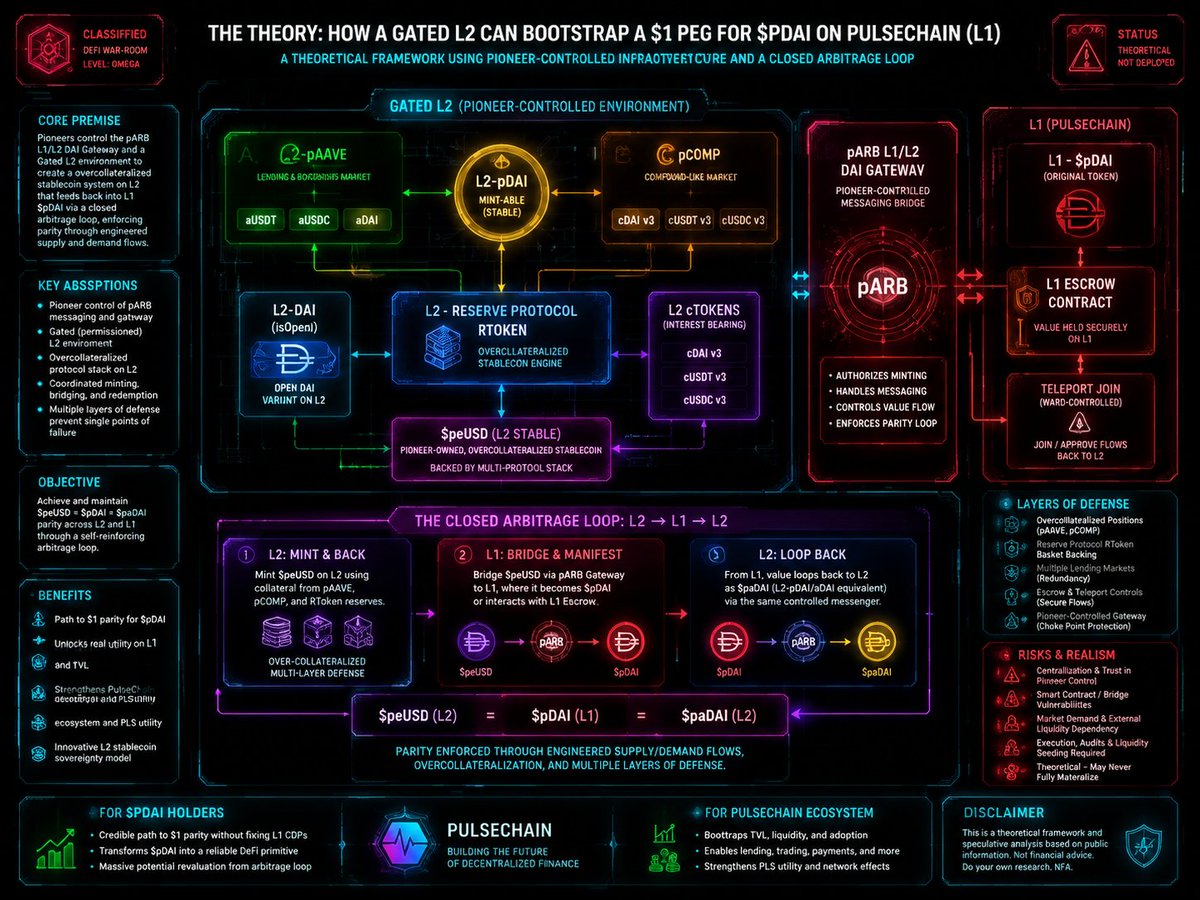
The Big idea: “The Pioneers who control Pulsechain, can finally fix #pDAI so it actually trades at $1 - not by magically repairing the broken main-chain system, but by building a safer, private “side network” (L2) that creates a brand-new, super-secure stablecoin and then uses a controlled bridge to pull pDAI’s price up to $1 through a repeating money loop.”
How It Works, Step by Step:
1. They build a gated L2
Think of PulseChain’s main network (L1) as a busy public highway. The pioneers create a private, invitation-only side road (the gated L2) that only trusted people or smart contracts can use at first. This side road has its own lending markets, borrowing markets, and reserve vaults - basically a mini-DeFi world that’s easier to control and defend.
2. They create $peUSD - a new, bulletproof stablecoin on that side road:
On this private L2, anyone (or the system itself) can mint $peUSD, but it’s backed by multiple layers of extra collateral (think AAVE-style lending pools, Compound-style vaults, and a Reserve-Protocol-style basket of assets).
It’s over-collateralized and has built-in safety nets so it’s extremely unlikely to ever break the $1 peg.
3. They control the bridge (the “pARB DAI Gateway”):
Pioneers own the official on/off-ramp between the main highway (L1) and the private side road (L2). This is the key. They can decide exactly how and when money moves back and forth.
4. The magic money loop that fixes pDAI:
Here’s the part that actually matters for your pDAI bags:
- You (or the system) mint $peUSD on the safe L2.
- You send it across the controlled bridge to the main chain.
- On the main chain it shows up as (or can be swapped for) pDAI.
- If pDAI is trading below $1 on the open market, this new supply + arbitrage pulls the price back toward $1.
- Then you can send it back to the L2 as an even safer version called paDAI (or pDAI on L2).
It’s a closed loop: L2 → L1 → L2. Every time the loop runs, it reinforces the $1 price on the main chain.
The more people use it, the stronger the peg gets.
Instead of trying to fix the old, busted pDAI system on the main chain, they’re building a brand-new, heavily guarded factory on the side that prints a trustworthy stablecoin and then uses a private bridge to “import” that strength back to pDAI.
What This Means for #pDAI and PulseChain:
For pDAI holders (the bullish part):
If this actually gets built and works, pDAI could finally trade close to $1 instead of the pennies it’s been stuck at. That would be huge for anyone sitting on pDAI bags - it turns a dead or dying asset into something you can actually use for lending, trading, or payments on PulseChain. The tweet is basically saying the pioneers have the tools to engineer this fix without waiting for the open market to magically fix itself.
For PulseChain as a whole:
A real $1 stablecoin changes everything. Right now PulseChain has cheap fees and fast transactions, but without a reliable stablecoin most people treat it as a speculative playground. If pDAI (or peUSD) actually holds $1, you suddenly get real DeFi activity - people borrowing, lending, farming, paying bills, hedging - all on PulseChain. That brings real liquidity, real users, and real value to PLS itself (because you need PLS for gas and as collateral).
The realistic caveat:
- This is still a theory on a diagram. It requires actual smart contracts to be deployed, audited, and seeded with liquidity. Nothing is live yet.
- It does introduce some centralization at first (pioneers control the bridge and the gated L2).
That’s the trade-off for getting the peg fixed quickly, but it’s not fully decentralized.
- Pegs only hold if there’s real demand on the other side. If nobody actually wants to use PulseChain for anything, the loop might keep the internal price stable but won’t matter much in the wider market.
- In crypto - black swans, exploits, or bad sentiment can break even the best-designed system.
The average person looked at $pDAI and saw a broken chart.
That was the limit of their analysis.
They never asked what survived the fork.
Debt.
Contracts.
Permissions.
Proxies.
Governance residue.
Collateral paths.
Lending markets.
Settlement rails.
They called it dead because the price looked dead. Brilliant. You're a fucking genius.
That's like looking at a locked bank vault and saying there is nothing inside because the door is locked tight.
The $pDAI thesis was never “everyone believes and number goes up.” That's child logic.
Here's a history lesson for you.
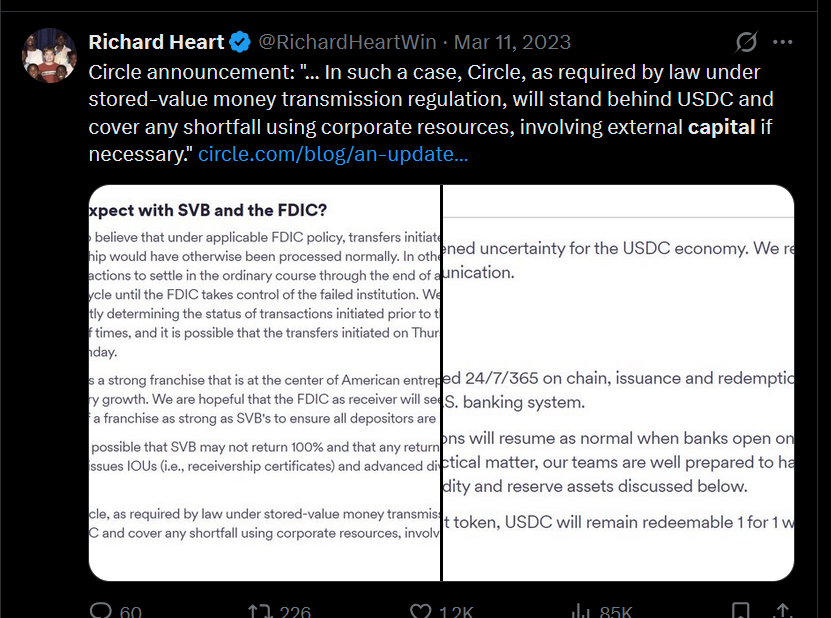
This was March 2023. The significance was massive: USDC exposed that a “safe” stablecoin is still a banking risk wrapper.
Circle disclosed that about $3.3B of USDC reserves were stuck at Silicon Valley Bank, and USDC broke its $1 peg, trading as low as roughly $0.88–$0.87 during the panic. Circle then said it would “stand behind USDC” and cover any shortfall using corporate resources or external capital if necessary.
USDC didn't fail because the blockchain broke.
USDC failed because the bank rail underneath the “stable” coin became uncertain.
The market thought it was holding digital dollars. What it was really holding was a tokenized claim on a reserve structure connected to banks, regulators, redemption windows, custody rules, and corporate balance sheets. When SVB failed, the control surface appeared immediately.
Stablecoin risk was revealed as:
bank risk,
issuer risk,
redemption risk,
reserve-location risk,
weekend liquidity risk,
regulatory risk,
confidence risk.
That's why Richard posted it. He was pointing at the hidden middleman inside the supposedly clean dollar token.
The lesson is that a stablecoin is only as stable as the weakest institution behind its redemption path.
Circle had to reassure the market that it would use corporate resources to cover a shortfall. That means trust returned not from code alone, but from balance sheet confidence, banking rescue assumptions, and public credibility.
That's not “just you and the code.”
That's old world dependency wearing an onchain costume.
If #PulseChain relies on bridged USDC/USDT or banked stablecoins as its main settlement layer, then PulseChain inherits the same external control surface. A bank problem, issuer problem, bridge problem, blacklist problem, redemption problem, or regulatory problem can bleed into the chain’s monetary layer.
This is exactly why pDAI/PAI matters in our White Hole framework.
Not because pDAI is automatically safer.
Because it represents the possibility of a native settlement office that doesn't depend on Circle’s bank account, Coinbase’s conversion window, SVB style custody risk, or external issuer promises.
https://t.co/fAkdjpY2Ni
⚡️ Breaking Discovery ⚡️
This is INSANE.
What if I told you that the pioneers haven’t been waiting for ETH/ALT season,
but instead, ETH/ALT season has been waiting for the pioneers to finish loading up the peg mechanism.
Pioneers in full control 🔥 🔥 🔥
In 5 years, "crypto" won't be a category anymore.
Stocks will live on blockchain rails. Dollars too. So will Treasuries, mortgages, ETFs, retirement accounts.
You won't know. You won't care. You'll just see your balance.
The asset class that wins isn't the one that beat the system. It's the one that became the plumbing the system runs on.
@lex_node#pulsechain is the world's 2nd most decentralised blockchain with over 50,000 validators
$pDAI is going to soon be the world's ONLY unfreezable stablecoin, with no blacklist function or middle men
It's time "onchain maxis" like you actually start supporting #pulsechain's tech
@MarlonDaily Sunscreen was invented in 1930s and 'coincedentally' in 1940s the rate of skin cancer went up 10x since then.
yeah, 90% of humans don't need sunscreen.
but if you do, get zinc free oil free sun screen. And supliment vitamin D (from food is not enough)
"Why would they supersend crypto only for everyone to get rich?"
1⃣ First things first: NOT EVERYONE is going to get rich. Not even one percent.
2⃣ Secondly, crypto is a niche. This means, retail is not here. Most crypto investors have long capitulated, they have either sold with massive losses or are still sidelined with weak positions.
⤵️ All the remaining alt investors have been mentally so crushed for 5 years, they will sell at the first pump up once they see their portfolios back over water. That's far from becoming rich.
(This shakeout was designed to work this way.)
3⃣ Last but not least, crypto is a necessary system for our digital future, it is extremely undervalued, and in order to make it mass appealing, they will have to get crypto MAINSTREAM. When this happens, retail will buy the top and the utopian gains for crypto come to a vehement end. NO ONE will get rich from there on, except the already rich, they will get richer. Same concept as with stocks.
📌The only ones, the less than 1 percent, that will actually get rich from crypto will be those few that have held the crash and will hold the inevitable rise to the top. Though they will have to resist a vast amount of temptations along the way.
Make some noise if you would like to see PulseChain list on @krakenfx Exchange!
PulseChain won big in court, not a security. Flawless operation since launch 967 days ago. A top on-chain DEX volume chain in the world. 52K validators, over $100M bridged in!
@krakensupport
Already responded many times to the #PulseChain
Community, so they already know us, make them understand what the #PulseChain
Community can do 🔥🔥🔥
@krakenfx@krakensupport
$PLS $PLSX $HEX