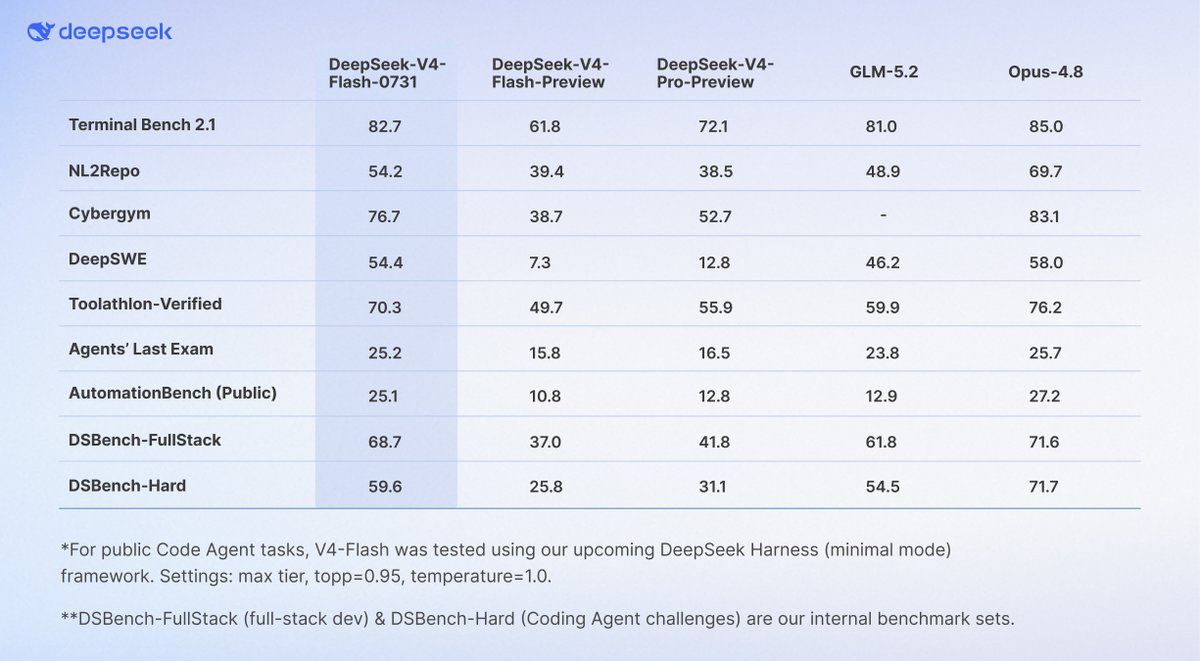
🚀 DeepSeek-V4-Flash Official API is now LIVE in public beta!
🔷 We’ve massively upgraded its Agent capabilities—benchmark scores are now far surpassing the V4-Pro-Preview. Check out the massive performance leap below! 👇
🔷 The official V4-Flash now natively supports the Responses API format and is fully adapted for Codex!
Check out the configuration details in our official API docs: https://t.co/smCwQZMeiq
Announcing our $320M Series A at a $2.3B valuation, led by @khoslaventures, with @generalcatalyst, @ericschmidt and @JeffBezos.
General Intuition is the frontier lab for acting in space and time.
We build large action foundation models trained on billions of ground truth action-labeled gameplay clips from 17M monthly active users on Medal, and push the frontier of world models to generate infinite training environments.
@thsottiaux hey, codex since the past few hours has been doing context compaction for every single prompt even though the context window used is about 100k tokens including the prompt
We’re going all in on World Models.
Today we’re launching the 1X World Model Lab.
The bet is simple:
You can’t fine-tune your way to AGI.
And you definitely can’t fine-tune your way to robots that can operate in the physical world.
General-purpose humanoids need models that understand space, motion, objects, causality, affordances, physics, and action before they ever see a specific task.
The frontier is not better VLA wrappers.
The frontier is embodied world models.
The 1X World Model Lab will focus on large-scale embodied world model pretraining: building the most generalizable foundation model for humanoid robots from the ground up.
The next frontier in AI requires scaling:
web-scale media + egocentric human videos + sim + dexterous remote operated robot data + on-policy NEO data → real-world deployment for robot data collection and RL → abundance of data → physical AI
The robot collects data.
The model gets better.
The robot gets better.
Repeat.
To lead this, we brought in one of the best for the mission: @_sam_sinha_ , as Head of World Models.
Sam was a founding research scientist at Luma AI and has been at the frontier of scaling multimodal generative video models his whole career.
If you’re the best in the world at large-scale pretraining, video models, robotics, RL, infra, or data — and you want your models to move atoms, not just pixels — join us.
Send background + evidence of exceptional ability to:
[email protected]
We’re building the model that makes autonomous labor real.
We’re brining local models that can run on your personal hardware inside Perplexity Computer. This will take advantage of the local hardware while giving you the privacy and token efficiency per watt, as well as access to the frontier models on the server side GPUs when necessary. Coming soon to Windows laptops. Stay tuned.
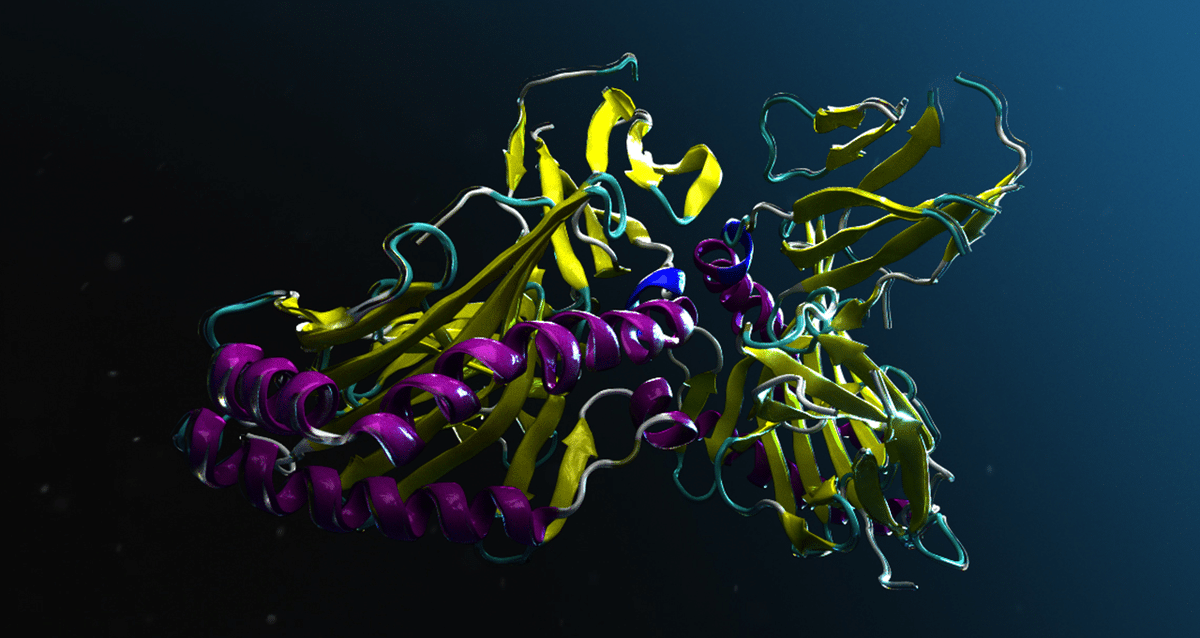
Today we're announcing ESMFold2, an open scientific engine to power prediction, design, and discovery across protein biology.
The new model delivers state of the art performance on protein interactions, especially antibodies, a critical modality for therapeutics.
We have designed and validated miniprotein binders and single chain antibodies across five therapeutic targets that are important in cancer and immunology. We are seeing very high success rates, and affinities at levels consistent with therapeutic activity.
We’re also releasing an atlas of 6.8 billion proteins, and 1.1 billion predicted structures.
ESMFold2 is built on a state of the art language model that has been trained on billions of protein sequences.
A world model of protein biology emerges through language modeling.
We’ve used the techniques of mechanistic interpretability developed to understand large language models to understand the concepts ESM uses to represent proteins.
The model’s representation space has a compositional organization of features across scales, levels of complexity, and abstraction, that reflects and mirrors the understanding of protein biology developed through a century of empirical science.
This understanding emerges without prior knowledge, just from language modeling of protein sequences.
Language models are becoming a powerful substrate to understand and program biology.
The design of protein interactions is one of the most fundamental problems in biophysics, and has critical implications for the discovery of new medicines. A simple gradient based search with the model was able to discover high-affinity protein binders.
I'm excited by the potential this has to accelerate basic science and the understanding of proteins. And especially for the new avenues it opens up for therapeutic design and medicine.
A closer look at what we released today 🧵
ESMC is a language model trained on billions of protein sequences spanning the full diversity of life. Trained across 2.8 billion sequences, the model is exposed to the full distributional structure of evolutionary selection, and in learning to predict it, develops internal representations of protein biology. https://t.co/TQuxOKx0e4
Proteins are the machinery of life. Scientists have cataloged billions of protein sequences—but their biology is still mostly unknown.
Today we're releasing a world model of protein biology: a scientific engine for prediction, design, and discovery that consists of ESMFold2, ESMC, and ESM Atlas. Together, they're helping to open up a new way for researchers to design proteins and speed up scientific discovery.
Our mission is to cure or prevent disease. To do that, we need to accelerate science. That's why we're releasing all three openly. https://t.co/TQuxOKx0e4
NEW preprint: Sparse autoencoders were trained on ESM-2 (650M, seq-only) and ESM-3 (1.4B, multimodal) to ask a simple question -- when two protein language models look at the same protein, do they "see" the same biology?
Answer: Yes, mostly
What does JEPA actually learn? We can finally prove it 🌍
So excited to share our theory of identifiable World Models: LeJEPA recovers the latent variables of the world.
Plan in the learned World Model as if it were real, same shortest path.
📄: https://t.co/lC9KK1AxVd
We are back again :) After three weeks of quiet building.
Introducing Genesis World 1.0, our latest simulation platform, the second release in our full-stack suite. Open-sourced.
Robotics is still bottlenecked by the 1× speed of the physical world. Every model, checkpoint, and data recipe eventually needs to be tested on physical hardware, slowly, expensively, and with limited coverage.
One hour in reality can become 100 days in simulation. That is how robotics model iteration moves from a wall-clock bottleneck to a compute problem.
To make this work, simulation has to be both fast and trustworthy.
Over the past year, we rebuilt the entire stack: a GPU-accelerated cross-platform compiler, penetration-free multi-physics contact solvers, unified rigid and deformable physics, and a photo-realistic renderer purpose-built for physical AI applications.
We built Nyx, a high-performance path-traced rendering engine for robotics application.
Genesis World 1.0 achieves near realtime performance with our latest development for penetration-free IPC solver, supporting various types of deformables beyond rigid bodies. It supports contact-rich, dexterous manipulation simulation across different embodiments: unitree, sharpa, wuji, genesis hand and various types of grippers.
Under the hood is Quadrants, our effort in pushing forward cross-platform GPU-accelerated computation. Quadrants started as a fork of Taichi, and we rebuilt most of the critical parts for optimizing simulation workloads, giving 10x faster launch time and up to 4.6x runtime performance compared to the initial Genesis release.
Together, they bring us to an unprecedentedly low sim-to-real gap, enabling zero-shot real-to-sim model evaluation and much faster iteration of GENE.
All available today.
Genesis World 1.0: https://t.co/aknCM3eqws
Quadrants: https://t.co/uXqPNI4cb6
Nyx: https://t.co/R8j0djqGnV
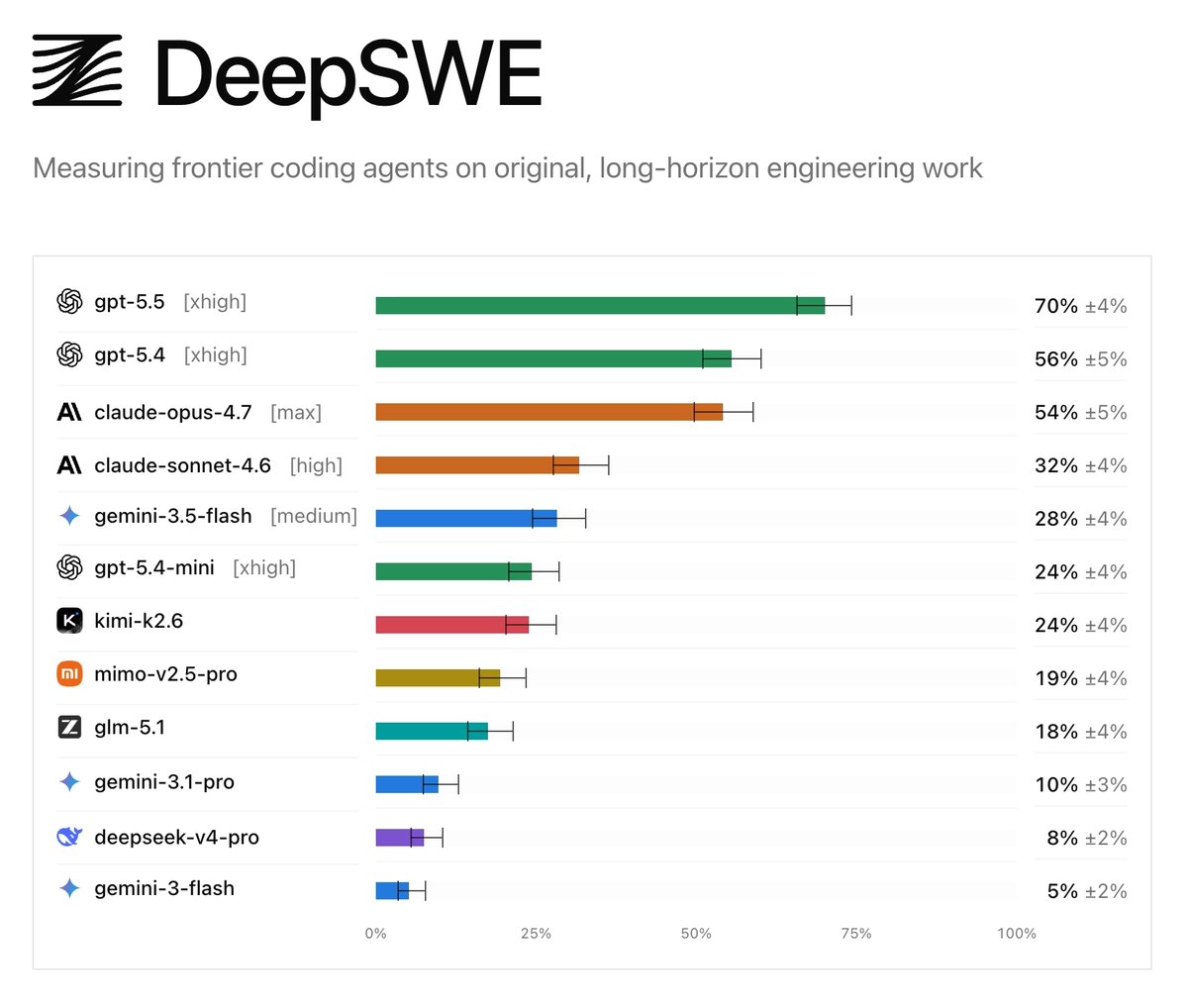
Today we’re releasing DeepSWE, a new standard for agentic coding benchmarks.
On public leaderboards, top models often look relatively close in capability. DeepSWE shows where they actually diverge, reflecting the realistic experience of developers in their day-to-day work.