bamboo doesn’t crack easily. but when it does, it cracks sharp. anthropic dismissed marketing, bled for it in distribution, then made a hard 180. very bamboo.
#anthropic
Automation is not a sector. It is not an industry vertical, not a technology category, not a product roadmap. It is civilization's response to scarcity: the mechanism by which human societies have always tried to expand productive capacity beyond the limits of time, bodies, and demographics.
Every machine ever built, from the first water wheel to the latest industrial robot, represents an attempt to extract more output from less human effort. The gap between ambition and capability has determined the fate of every attempt. That gap is now closing, and this time the ambition is about to become total.
Happy Chinese New Year to those preparing for the imminent automated age.
2026 is 丙午 — fire above, fire below. Sun overhead, horse in motion.
A year of reckoning and acceleration. Momentum for builders. Consequences for extractors.
History is changing gears. Godspeed to those bold enough to cross the threshold.
Reading the Rage at Davos: The Fracture and the Bridge
===
The global order is fracturing violently along fault lines that no summit can bridge. The West has awakened (belatedly) to an inconvenient truth: the tide pulling toward regional multipolarity is not a crisis to be managed but history asserting its will.
America no longer pretends to be the world’s hegemon. It acts now as a regional power, coldly selecting which nations merit inclusion in its narrowing circle of trust. China meanwhile weaves Asia into its orbit through supply chains so comprehensive, so tightly integrated, that dependence becomes destiny.
Between the two giants a third path beckons (and flounders). India, Iran, Turkey, and France explore their own regional gravities, haunted by the fear that alignment with Washington or Beijing could mean exploitation, not partnership.
The anger erupting from Davos is therefore both predictable and profound. The assembled elites see clearly where this transformation leads: back to the world’s original configuration, when great powers ruled and everyone else’s sovereignty was conditional on their proximity to strength. Smaller nations understand their fates will soon rest in the hands of a few. And for the Western delegations, the realization cuts deeper — the decades ahead will likely prove harsher than the decades behind.
Yet within this fracture lies possibility.
The emerging order demands something the old one did not: bridges. A divided world needs connective tissue — neutral ground for capital, standards, arbitration, talent flows, and supply-chain rerouting. Without such middle grounds, fragmentation hardens into permanent rupture, and humanity pays the cost in unrealized collective potential.
Singapore, Malaysia, Thailand, and South Korea are approaching thresholds. History is calling these states to become bridges the new era cannot function without. It is perhaps their only path to survival in the reality now emerging.
At this pivotal moment, history makes its urgent, final call to all nations. Those who adapt proactively will shape what comes next. Those who turn away will be judged with an unforgiving finality that permits no second chances.
The middle grounds must hold, or the world splits beyond repair.
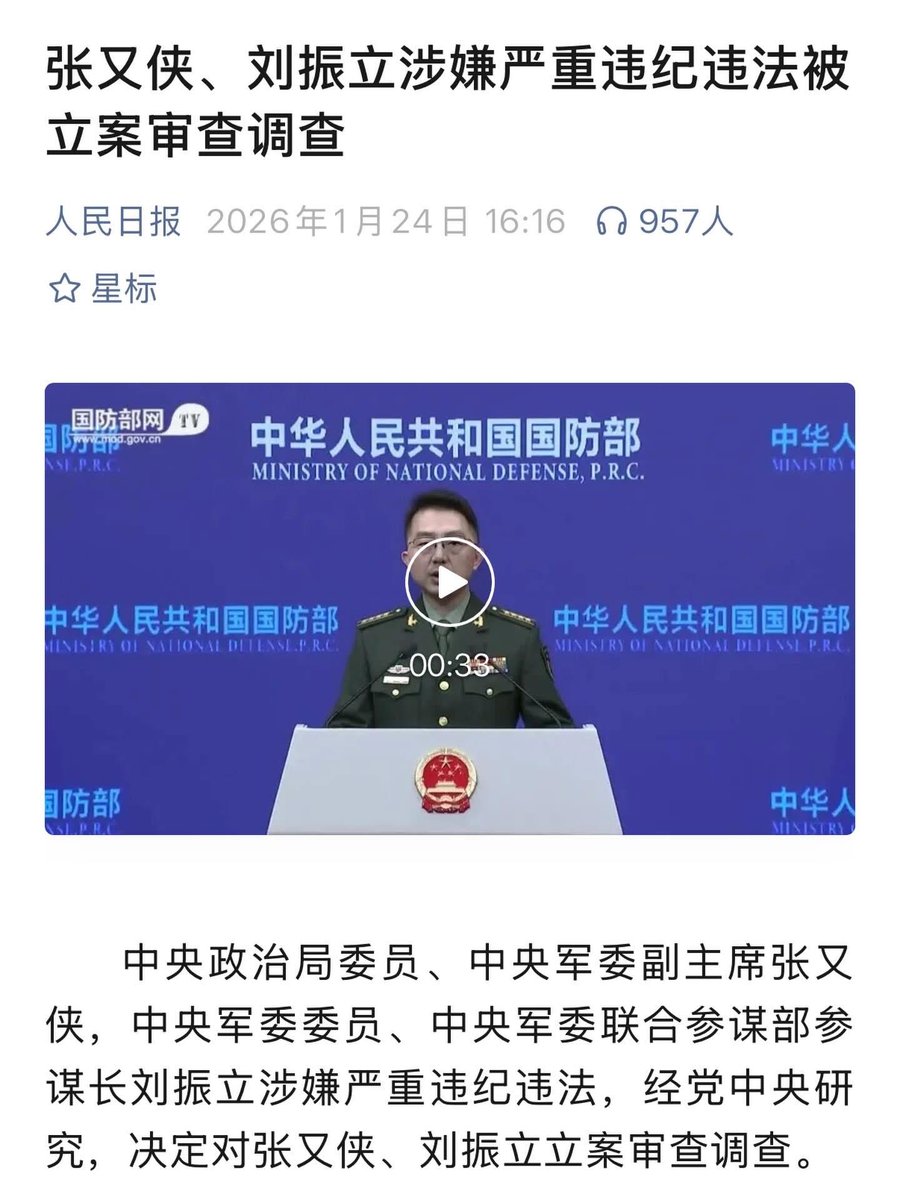
Zhang Youxia — a military head and long-time family frine of Xi — is under investigation.
This is consequential, but not for the reasons many self-styled “China experts” claim. This is NOT a result of power struggle or palace intrigue within Zhongnanhai.
Beijing has made a deliberate strategic decision. Other countries — especially Japan — should pay close attention, as their geopolitical positioning and national security increasingly depend on reading these signals correctly.
Two primordial engines of humanity — technology and geopolitics — now roar simultaneous on the foreground of history. AI and robotics are no longer separate from global power; they now reinforce each other, fueling an inexorable tide toward an entirely new civilizational order.
We stand at a momentus crossroads. The choices made today will determine which side of the looming threshold each individual, enterprise, and nation will find themselves tomorrow.
#china #geopolitics #ai #taiwan #japan #transformation
1. Something big is might happen in Myanmar 2026-2027
2. Beijing may have squandered its first (and perhaps the best) opportunity to gain leverage on Iran in 2025
In the coming months, The Edge of Automation (https://t.co/oQXoot91Ne) will be discussing the crucial concept of "civilizational states" in light of the unfolding saga of comprehensive labor automation.
I'll define what it means here:
Civilizational State: A state that embodies a self-aware, long-standing universe whose core language, institutions, and shared norms persist continuously across changing dynasties and regimes -- in other words, a self-contained stream of human history with its own distinctive arc and continuity.
A "civilizational state" constructed from a unified supply chain -- a vast dependency network integrating every stage of production and distribution under one cohesive system.
Civilizational states are the inexorable outcome of humanity's endless struggle to manage labor scarcity, and the ultimate product of the geopolitical force: one of the two primordial engines that have shaped the course of human history since our ancestors first gathered around fire.
This concept is critical to understanding why the world works the way it does, where it's headed, and how to navigate the coming storm as the Physical AI Revolution advances with the inevitability of tectonic plates shifting beneath civilization's feet.
The twin engines of a new epoch -- technology and geopolitics -- have now converged to create an inexorable tide toward a new era. And just as it did during all major upheavals that alter the grand arc of human civilization, history is making a final call to every individual, industry, and nation.
The collective fate of human race itself hangs in balance. The question is no longer about whether changes will happen but rather about how to navigate the turbulent waters to secure a thriving home in the new world emerging at the end of this long tunnel.
A civilization is constructed upward from the unity of its supply chain.
Internalized values are great but they carry little weight without a unified, verticalized ecosystem even if they are created by coincidence.
Perhaps the downfall of the West was determined when its constituents decided to collectively erase the most critical truths of human civilization from their memory:
1. Power comes from dependencies, not money or voters;
2. Supply chain sovereignty is national sovereignty;
3. Revolutions happen only when the two primordial forces — technology and geopolitics (supply chains) — align.
A civilization is built on a set of internalized values. Numerous civilizations have developed radically different visions of how to organize societies, and these have competed in process akin to Darwinian selection in establishing which civilizational ethos permits for maximal flourishing. American exceptionalism is one such system and it has yielded the greatest society that the world has ever known. Suicidal empathy is going to destroy it because Western tolerance is its fatal Achilles tendon. Remember my words.
A civilization is constructed upward from the unity of its supply chain. Internalized values are great but they carry little weight without a unified, verticalized ecosystem even if they are created by coincidence. Perhaps the downfall of the West was determined when its constituents decided to collectively erase the most critical truths of human civilization from their memory: (
1. Power comes from dependencies, not money or voters;
2. Supply chain sovereignty is national sovereignty;
3. Revolutions happen only when the two primordial forces — technology and geopolitics (supply chains) — align.
japan’s paralysis stems from a systemic underestimation of its geopolitical leverage.
korea’s downfall stems from a dangerous overestimation of its geopolitical power.
neither is sovereign. one dares not reach for sovereignty, while the other lives in its illusion.
both nations walk the same precarious path, for precisely opposite reasons.
1. the way jensen treats samsung ceo reminds me of the old chinese saying “a great man’s revenge can wait a decade (君子报仇十年不晚)”.
2. korean stocks are meme coins that even the most desperate crypto traders wouldn’t touch.
crucially, (1) most people just see the $$ figures to judge politicians’ performance, and (2) japan set high benchmark at half a trillion by striking the deal first.
so other countries who negotiate after japan have to give up something else to lower that number, or risk getting blamed by their people and see their support numbers drop.
4/4
this deal was struck in early aug, don’t know why the news is rolling out now. the deals japan and korea made with trump were structured differently because their politicians had divergent agendas (and trump took advantage of it).
1/4
https://t.co/iSr8wbGbdM
korea on the other hand, has a different situation. they have the political need to protect their domestic rice & beef markets, so sacrificing other core industries like shipbuilding was natural. korean citizens are far more rebellious than the japanese counterpart, and their new president can’t afford to lose support within the first 100 days.
3/4