@behrouzKaram No, this is still very recent. We have a paper in preparation on the immersed boundary + wall model. If you have interest in the GPU/AMR code send me a message
Here’s a new result hot off the press we’ll be presenting at APS-DFD in (collab w/ Cornell). Large eddy simulation of a NACA0015 wing at Reynolds number 1.4M combining immersed boundary + wall model + adaptive mesh refinement
It took us years of development to get to a point we can perform simulations like this. Big shoutout to PhD student Jaehyeon Song. High-fidelity simulations of patient-specific biological flows represent an exciting new direction for my group.
Always a pleasure to listen to @stevenstrogatz wax poetic on math (or any subject really). These are some interesting times we are living in https://t.co/j60GoigcsD
@WillioHydro@stevenstrogatz@NSF Most endowments are restricted to how they are spent. At Michigan, if the liquid portion of the endowment covered all research expenses, it would run out in about a year! But alas, universities are self paying for research at an increased amount
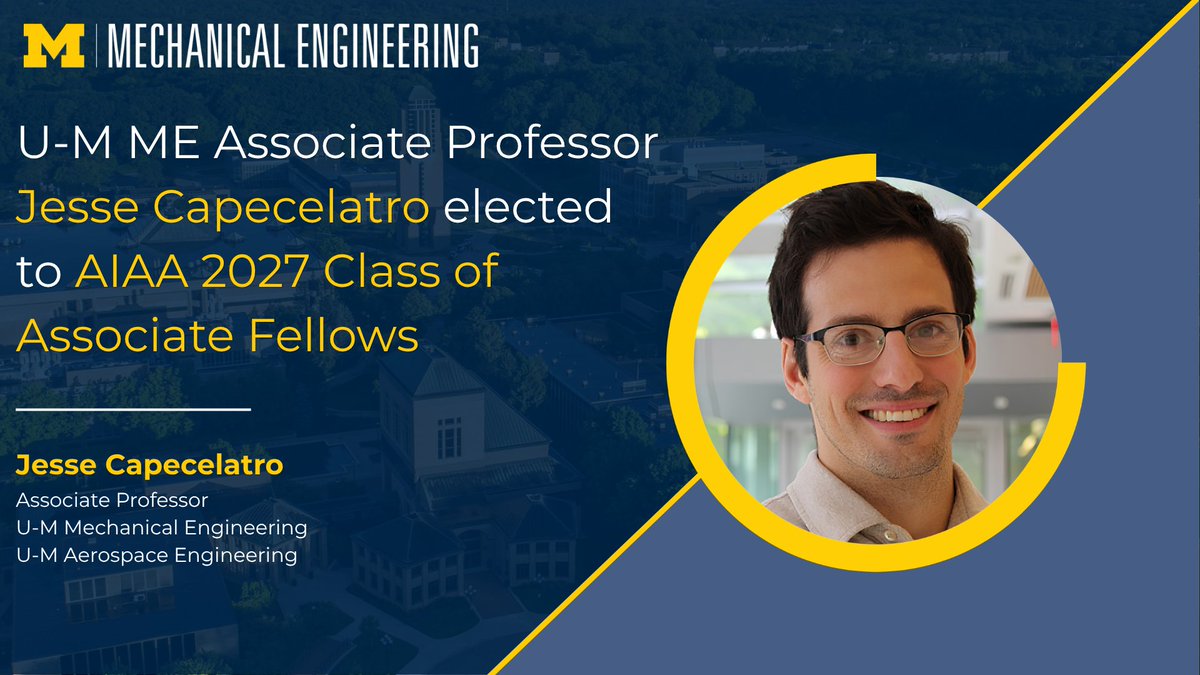
Jesse Capecelatro, University of Michigan associate professor of mechanical engineering and aerospace engineering, has been elected to the American Institute of Aeronautics and Astronautics (@AIAA) Class of 2027 Associate Fellows.
👉🔗 Learn more: https://t.co/PjLA49RVDa
Anyone interested in running/visualizing OpenAI's "quirky vortex" that's been getting all this attention, my colleague Ivan Christov at Purdue put together this Python demo: https://t.co/dEOgEnQyri
@perrymetzger No, my guess is that the scales at which these singularities occur are well below the continuum limit and Navier-Stokes breaks down anyway