One of the first things I check when opening a new Meta ad account is 30-day Frequency
And the relationship between CPM and CPMr.
CPMr ÷ CPM ≈ Frequency.
It won’t tell me exactly what’s wrong.
But it tells me very quickly whether the account is in a healthy state.
If account-level Frequency is above 5 over the last 30 days, I treat it as a red flag.
It usually means one of two things:
- You’re overpaying to reach a small audience segment, often engaged users or existing customers.
- You have a major problem acquiring new reach.
That sends me straight to:
- Account structure
- Attribution settings
- Exclusions
- Creative volume and strategy
- Product and offer development
- Landing pages
Repeatedly hitting the same people could also mean you’ve reached your TAM.
But unless you’re in a very niche category or spending at serious scale, that’s usually the least likely explanation.
Frequency doesn’t diagnose the problem.
It tells you where to start looking.
--
Note: Shared with the client’s explicit permission.
🧪 CRO Hack No. #60
If I could only optimize one page on your entire site, I would pick checkout every time.
Nobody talks about this shit:
Right before clicking "Pay Now," your customer's reptilian brain goes into full panic mode.
"Is this site safe?"
"Will my card get stolen?"
"Can I return this?"
"Do I actually need this?"
All of that. In 3 seconds. Right before the money hits your account.
Your job isn't to sell them again. They already bought.
Your job is to shut the panic down and scream "IT'S SAFE" without saying a word.
We've tested checkout more than any other page. It moves the needle every single time.
It's the biggest lever on your entire store. And most brands ignore it completely.
El verdadero motor del SEO son los enlaces internos. Los enlaces externos generan autoridad y los internos la distribuyen.
Audita tu web hoy: ¿enlazas tus productos estrella desde tus páginas clave?
https://t.co/9rmYPM6Z6O
El marketing móvil no se reduce a los anuncios: conexión en tiempo real, lugar exacto, mensaje personalizado. Ignorarlo es condenar tu marca a la invisibilidad. ¿Juegas en esa liga?
https://t.co/ahf2cuDCze
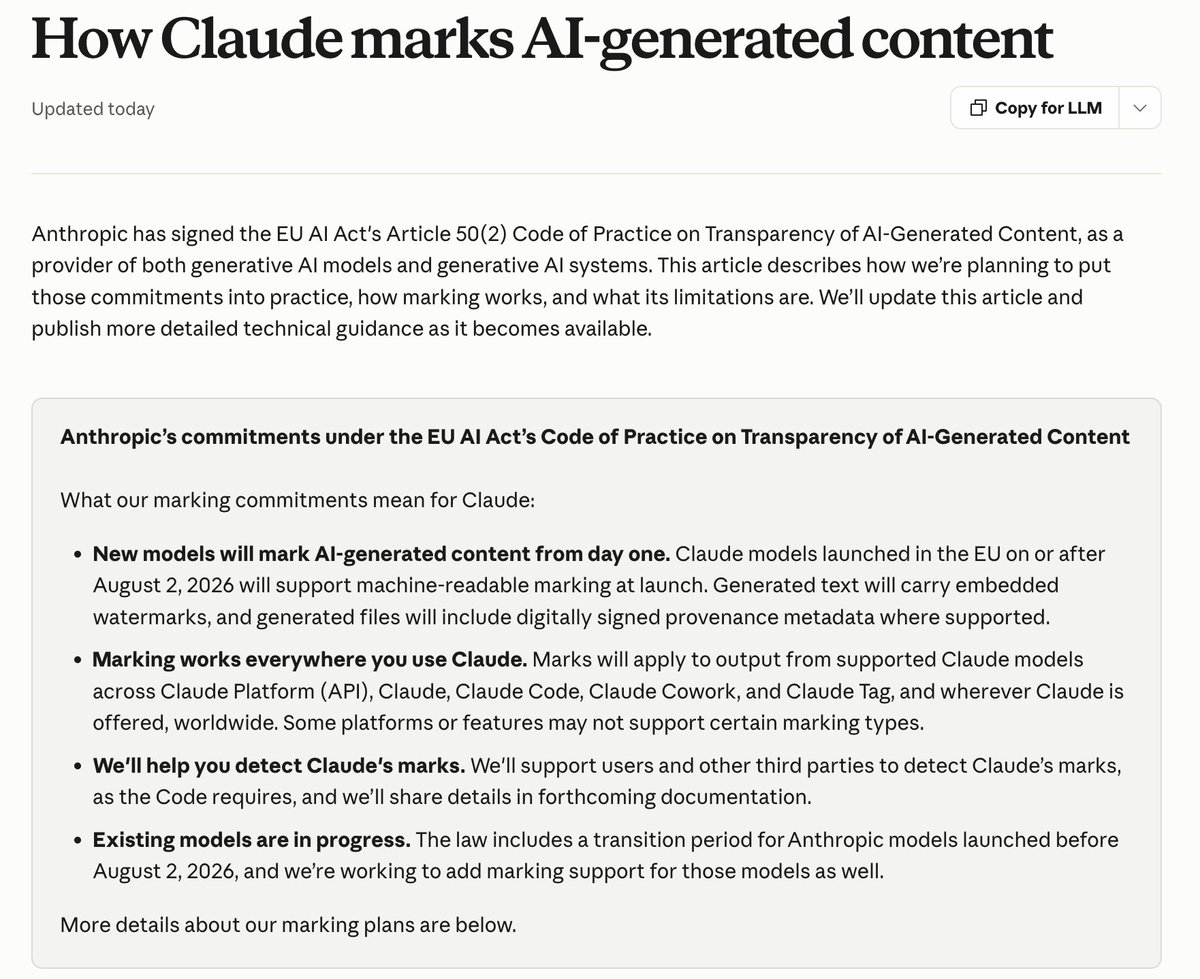
🤖 Claude will start marking AI generated content by adding an imperceptible watermark directly into the text itself as part of @AnthropicAI commitments after signing the EU AI Act's Article 50(2) Code of Practice on Transparency of AI-Generated Content 👇
* Claude models launched on or after August 2, 2026 support marking at launch.
* Claude markings cover output from supported models everywhere you use Claude, worldwide
* They're also working in ways to allow and 3rd-parties to identify Claude’s embedded watermarks
Read more: https://t.co/knJ10n6Olf
Backlinks won't save you. Rankings won't save you. What gets you cited by AI is reputation: real names, real case studies, real reviews, original research people actually reference. I'm not optimizing for one platform anymore. I'm building a system machines can't ignore. When AI writes its four sentence verdict about your brand, you want to have engineered it, not left it to chance.
#SEO #AISearch #Reputation #DigitalMarketing #ContentStrategy
Native ads are one of the hardest ones to make actually work.
The image part is easy, just create a batch of 20 variants. Done. But the hard part is the storytelling and taking a reader from unaware to fully aware.
My ideal set up for the copy is:
1. Hook -> STOP the scroll + create curiosity
2. Problem -> Make them recognize themselves
3. Failed solutions -> WHY what they tried didn't work
4. Mechanism -> Explain what's ACTUALLY causing the problem
5. Solution -> Introduce your product naturally
6. Proof -> Reviews / authority / results
7. Offer -> Give them a reason to take action
The magic happens in the storytelling. Make it personal so someone from your ICP can literally think: “this is me.”
Talking in the same language as your ICP makes the storytelling actually stick (so research the keywords/language your audience uses in FB groups, Reddit etc).
We often see that a PDP works best in these cases when the copy is good. Bc the long-form primary text basically works as your prelander.
Elegir bien tu plataforma de comercio electrónico no solo te permite vender en línea, sino que marca la diferencia entre escalar con automatización e integración o quedar atrapado en tareas repetitivas. ¿Ya la estás aprovechando?
https://t.co/qhe0PvuuRA
FLO has too much to say in one ad.
Hormones, bloating, daily support, bottle formats.
These concepts test different angles while keeping the brand recognizable:
One leads with the core benefit headline.
Another focuses on specific symptom relief.
The pink anchors the brand, while the hook shifts from ad to ad.
1-star reviews make your best ads
The brain processes negative info faster than positive, so a 1-star stops the scroll where a 5-star gets glazed over
A brand putting its own worst review at the top of an ad also breaks expectation, the viewer has to figure out why, and that starts the read
Then the complaint becomes the feature.
"It doesn't cover the phone" gets answered with "that's the point."
You name the buyer's reservation before they frame it themselves, which collapses resistance instead of triggering it.
And showing the wrong-fit complaint signals right-fit buyers exist, so the 1-star quietly works as a testimonial.
How to run it:
- mine 1-stars from your site, Amazon, Trustpilot, competitor ad comments
- tag every complaint that reads like a feature to the right buyer
- pair each with a reframe: complaint sets tension, reframe resolves it, visual closes it
- test static first, build motion variants on the winners
🚀 4 pasos para potenciar tus anuncios en LinkedIn:
1. Optimiza tu página.
2. Define objetivos por etapa.
3. Segmenta a tu cliente ideal.
4. Prueba y ajusta continuamente.
¿Cuál te resulta más difícil?
https://t.co/ErQ5Vf8Eqv
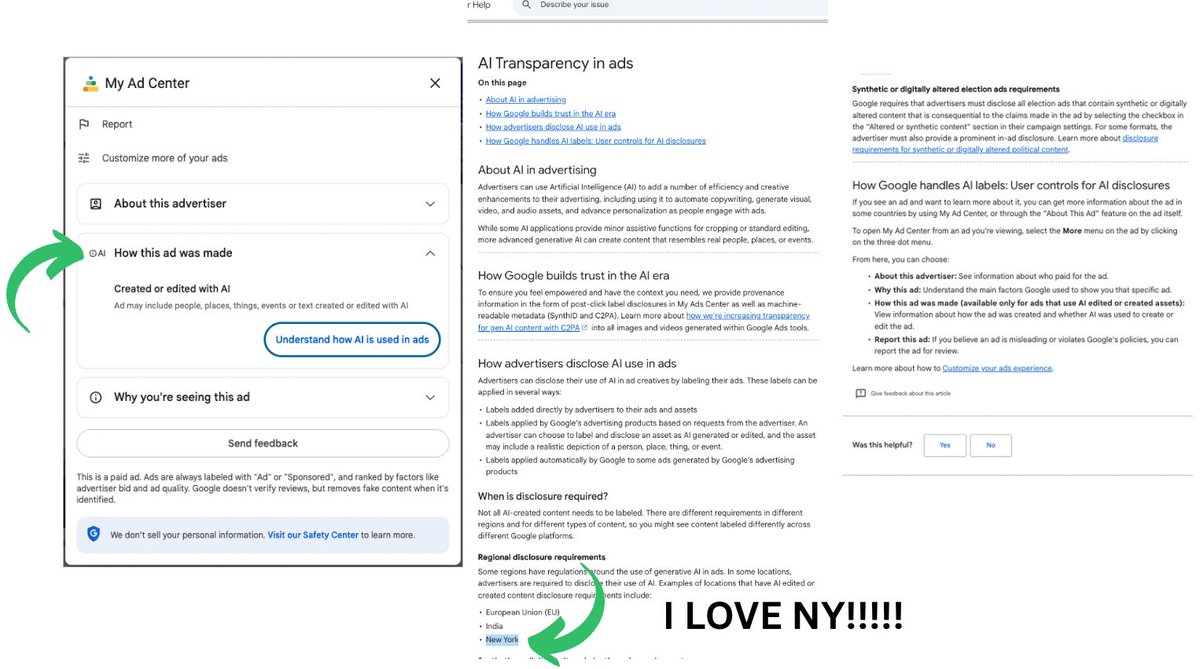
Google's AI ad products read your whole digital footprint now, not just the ad you submitted. Website, landing pages, product details, creative. To the machine, it's all one document. Every inconsistency between your channels reads as noise, and noise gets you matched with the wrong audience.
#AIMarketing #SEO #GoogleAds #BrandConsistency
The content you put out on YouTube Shorts is feeding the Gemini LLM, which is gonna allow your product to show up in AI search.
The content you make today on YouTube Shorts will protect you in 24 months to show up on generic AI results.
I tested 60 ads in 1 ad set to stop my client's account from bleeding out
When things are in a death spiral, you can't afford to just test each concept in it's own ad set
So a quick way to find a working ad is sometimes large batch tests.
Meta will of course pick only a few ads to spend on, and you're trusting Meta to make the decision - which means it will miss out on potential winners.
BUT
You'll also potentially find a working ad quick, and you can get that into your scaling campaign.
Sometimes when things are tough you have no choice but to do things a little recklessly.
When to use this:
→ Your account is broken and you need a winner NOW
→ You don't have time for clean, organized testing
→ You're willing to sacrifice some potential winners to find one that works fast
When NOT to use this:
→ Your account is stable and you want clean data
→ You have time to test properly
→ You want to build a playbook of what works
Speed vs accuracy.
Sometimes you need speed 🔥.
Trend I'm seeing: landing pages are starting to get produced and tested like creatives on Meta.
Anyone can make 1000 ads now. What's slightly more complex is building tailored LP experiences, and Meta is rewarding those who can do it.
The brands that can launch 25 ads to 25 unique LPs are not only seeing better CR, but lower CPMs as well.
The traditional testing methodology for this is also getting thrown out the window: No more strict 50/50 URL Redirect tests in Intelligems. No more stat sig.
Advertisers are just launching them with Flex ad units and letting them run head-to-head in ads manager. May the best LP win.
Fortalece tu marca en línea en 4 pasos:
Define palabras clave.
2. Gestiona tu sitio web y tus perfiles.
3. Supervisa las menciones.
4. Responde rápido.
Escucha y actúa.
https://t.co/4lHDtSG5cq
Just like with Google, LLMs constantly adjust their algorithm.
So if you optimize for what worked with GEO a few years ago, it may not work as well today.
Here are some of the signals that matter right now with GEO based on what 1000 marketers are seeing.