Don't "work harder." Instead:
Cut away distractions.
Stop doing fake work.
Ask for help.
Plan.
Solicit criticism.
Automate what can be automated.
Engage your mentors.
Exercise.
Get more sleep.
Whatever you do, don't "work harder." It's pretty much never the answer.
Onchain finance has a transparency problem.
every single balance, transfer, & protocol interaction you make is permanently broadcasted for anyone to track.
@murkfinance is tackling this by introducing a privacy layer that lets you interact with mainstream DeFi without exposing your financial footprint.
Instead of forcing you into a closed mixer or a separate siloed ecosystem, Murk bridges privacy with real execution rails.
core Infrastructure details:
• zero-knowledge notes: balances are hidden using ZK proofs, keeping your activity completely private from public ledger surveillance.
• compliance guardrails: all incoming deposits are screened against risk and sanctions providers natively, separating protocol-level privacy from illicit mixing.
• native DeFi integration: execute different live private swaps via Matcha and Uniswap, or access lending and borrowing markets on Morpho & Aave directly from a shielded balance.
• network rollout: built as a single self-custody account launching first on Monad, with expansions to Ethereum and Base later.
Early adopters stand to gain complete self-custody where only you hold the keys as well as the ability to deposit once, operate privately, and withdraw back to any public wallet whenever you choose.
Formal verification already completed on their privacy circuits and smart contracts.
You get the utility of the protocols you already use, minus the public exposure.
be sure to add this to your watchlist.
ps: this is not a paid advertisement.
Onchain finance has a transparency problem.
every single balance, transfer, & protocol interaction you make is permanently broadcasted for anyone to track.
@murkfinance is tackling this by introducing a privacy layer that lets you interact with mainstream DeFi without exposing your financial footprint.
Instead of forcing you into a closed mixer or a separate siloed ecosystem, Murk bridges privacy with real execution rails.
core Infrastructure details:
• zero-knowledge notes: balances are hidden using ZK proofs, keeping your activity completely private from public ledger surveillance.
• compliance guardrails: all incoming deposits are screened against risk and sanctions providers natively, separating protocol-level privacy from illicit mixing.
• native DeFi integration: execute different live private swaps via Matcha and Uniswap, or access lending and borrowing markets on Morpho & Aave directly from a shielded balance.
• network rollout: built as a single self-custody account launching first on Monad, with expansions to Ethereum and Base later.
Early adopters stand to gain complete self-custody where only you hold the keys as well as the ability to deposit once, operate privately, and withdraw back to any public wallet whenever you choose.
Formal verification already completed on their privacy circuits and smart contracts.
You get the utility of the protocols you already use, minus the public exposure.
be sure to add this to your watchlist.
ps: this is not a paid advertisement.
Setting up a murk account takes less than a minute.
Then you can swap, earn, borrow, and more on @monad while keeping your onchain activity private.
Need an access code? 👉 https://t.co/4qk09W3isj
Most blockchains work like a public bank account.
Anyone can look up your wallet and see your balances, transactions, and activity.
Murk changes that.
When you deposit funds into Murk, they enter a shared pool. So no one can see which funds belong to which person.
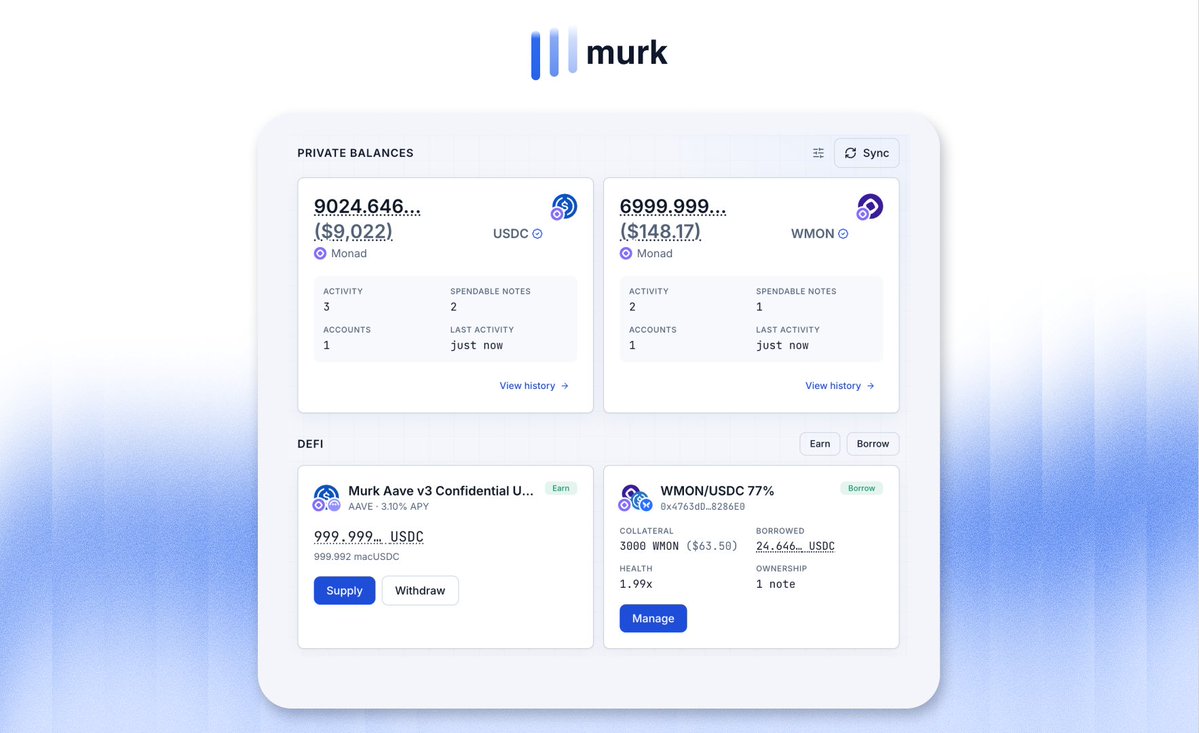
Instead of exposing a balance onchain, Murk stores your funds as a collection of private “Notes.” Think of these as digital cash that only you can see and access.
Your private balance is simply the total value of all your Notes.
When you spend money, Murk spends one of your Notes instead of deducting from a balance. If you send 30 USDC from a 100 USDC Note, Murk creates a new 30 USDC Note for the recipient and returns the remaining value to you as a new Note (minus any fees).
This is similar to paying with a $100 bill at a store. You hand over the whole bill, the cashier keeps the amount you spent, and you receive change back.
Behind the scenes, Murk uses zero-knowledge proofs to verify that every transaction is valid without revealing your balance, which Notes were spent, or who owns them.
The result is simple: you get the same self-custodial experience as DeFi today, but without exposing your financial activity for everyone to see.