This is really big news. Google introduced the Open Knowledge Format (OKF) - a standardized way to store information in a directory of markdown files. Makes it really easy to make a digital brain that agents can use.
These files can serve as a living wiki. You can give agents the ability to query them or edit them. They can interlink.
Seems to me this could replace Notion or Obsidian. I can think of so many uses for this.
Google's blog post: https://t.co/DqSjg4UpvH
An easier to understand explanation is the SPEC.md file:
https://t.co/A3qSz3Tfas
I gave those two links to Antigravity and asked how we could use it for any of the projects we're working on. It came up with so many ideas. I would imagine Claude Fable 5 would whip up some pretty amazing things based on this system.
Currently creating an OKF library of our pepper garden. It's going to be a fun weekend.
Mark Cuban just described the largest wealth transfer of the AI era.
Almost nobody understood what he said.
Cuban: “There are 33 million companies in this country. Aren’t going to have AI budgets. Aren’t going to have AI experts.”
Not tech startups.
The shoe store. The regional trucking outfit. The accounting firm with 12 employees.
The businesses that actually run the physical economy.
They know AI is coming. They have no idea what to do with it.
Cuban: “You’ve got the head of Microsoft saying software is dead because everything’s going to be customized to your unique utilization.”
Software is dead.
The SaaS era ran on one rule. Build a generic product. Force millions of companies to bend their workflows around it. Charge rent forever.
AI ends the contract.
The business stops bending to the software. The intelligence bends to the business.
But customized by whom.
The third-generation manufacturer cannot tell Claude from Gemini. The county hospital is staring at a reactor asking where the light switch is.
Cuban: “Who’s going to do it for them?”
That question is worth more than the frontier models themselves.
Hundreds of billions are being burned to build the foundation. The smartest engineers alive are locked in a bloodbath over who owns the base layer.
Let them fight.
Let them burn the capital. Let them drive the cost of raw intelligence toward zero.
Because the wealth does not collect where the brain is built.
It collects where the brain meets the business.
Every ambitious kid in college right now thinks survival means a seat at OpenAI or Anthropic.
Cuban is staring at the other 99 percent of the economy.
Learn the models. Then learn the messy, unglamorous reality of how a 50-person company actually operates.
Walk through the door. Understand their problems. Wire the intelligence directly into their revenue.
That is not a job title. That is an entire economic class being born.
You do not need to build the brain. You need to build the nervous system.
The biggest winners of the electricity era were not the engineers who built the generators. They were the ones who walked into dark factories and showed the owners where to plug in.
33 million companies are standing in the dark right now.
Silicon Valley is racing to build the god. The fortunes will belong to whoever teaches him a trade.
Mark Cuban just described the largest wealth transfer of the AI era.
Almost nobody understood what he said.
Cuban: “There are 33 million companies in this country. Aren’t going to have AI budgets. Aren’t going to have AI experts.”
Not tech startups.
The shoe store. The regional trucking outfit. The accounting firm with 12 employees.
The businesses that actually run the physical economy.
They know AI is coming. They have no idea what to do with it.
Cuban: “You’ve got the head of Microsoft saying software is dead because everything’s going to be customized to your unique utilization.”
Software is dead.
The SaaS era ran on one rule. Build a generic product. Force millions of companies to bend their workflows around it. Charge rent forever.
AI ends the contract.
The business stops bending to the software. The intelligence bends to the business.
But customized by whom.
The third-generation manufacturer cannot tell Claude from Gemini. The county hospital is staring at a reactor asking where the light switch is.
Cuban: “Who’s going to do it for them?”
That question is worth more than the frontier models themselves.
Hundreds of billions are being burned to build the foundation. The smartest engineers alive are locked in a bloodbath over who owns the base layer.
Let them fight.
Let them burn the capital. Let them drive the cost of raw intelligence toward zero.
Because the wealth does not collect where the brain is built.
It collects where the brain meets the business.
Every ambitious kid in college right now thinks survival means a seat at OpenAI or Anthropic.
Cuban is staring at the other 99 percent of the economy.
Learn the models. Then learn the messy, unglamorous reality of how a 50-person company actually operates.
Walk through the door. Understand their problems. Wire the intelligence directly into their revenue.
That is not a job title. That is an entire economic class being born.
You do not need to build the brain. You need to build the nervous system.
The biggest winners of the electricity era were not the engineers who built the generators. They were the ones who walked into dark factories and showed the owners where to plug in.
33 million companies are standing in the dark right now.
Silicon Valley is racing to build the god. The fortunes will belong to whoever teaches him a trade.
Software development is undergoing a renaissance in front of our eyes.
If you haven't used the tools recently, you likely are underestimating what you're missing. Since December, there's been a step function improvement in what tools like Codex can do. Some great engineers at OpenAI yesterday told me that their job has fundamentally changed since December. Prior to then, they could use Codex for unit tests; now it writes essentially all the code and does a great deal of their operations and debugging. Not everyone has yet made that leap, but it's usually because of factors besides the capability of the model.
Every company faces the same opportunity now, and navigating it well — just like with cloud computing or the Internet — requires careful thought. This post shares how OpenAI is currently approaching retooling our teams towards agentic software development. We're still learning and iterating, but here's how we're thinking about it right now:
As a first step, by March 31st, we're aiming that:
(1) For any technical task, the tool of first resort for humans is interacting with an agent rather than using an editor or terminal.
(2) The default way humans utilize agents is explicitly evaluated as safe, but also productive enough that most workflows do not need additional permissions.
In order to get there, here's what we recommended to the team a few weeks ago:
1. Take the time to try out the tools. The tools do sell themselves — many people have had amazing experiences with 5.2 in Codex, after having churned from codex web a few months ago. But many people are also so busy they haven't had a chance to try Codex yet or got stuck thinking "is there any way it could do X" rather than just trying.
- Designate an "agents captain" for your team — the primary person responsible for thinking about how agents can be brought into the teams' workflow.
- Share experiences or questions in a few designated internal channels
- Take a day for a company-wide Codex hackathon
2. Create skills and AGENTS[.md].
- Create and maintain an AGENTS[.md] for any project you work on; update the AGENTS[.md] whenever the agent does something wrong or struggles with a task.
- Write skills for anything that you get Codex to do, and commit it to the skills directory in a shared repository
3. Inventory and make accessible any internal tools.
- Maintain a list of tools that your team relies on, and make sure someone takes point on making it agent-accessible (such as via a CLI or MCP server).
4. Structure codebases to be agent-first. With the models changing so fast, this is still somewhat untrodden ground, and will require some exploration.
- Write tests which are quick to run, and create high-quality interfaces between components.
5. Say no to slop. Managing AI generated code at scale is an emerging problem, and will require new processes and conventions to keep code quality high
- Ensure that some human is accountable for any code that gets merged. As a code reviewer, maintain at least the same bar as you would for human-written code, and make sure the author understands what they're submitting.
6. Work on basic infra. There's a lot of room for everyone to build basic infrastructure, which can be guided by internal user feedback. The core tools are getting a lot better and more usable, but there's a lot of infrastructure that currently go around the tools, such as observability, tracking not just the committed code but the agent trajectories that led to them, and central management of the tools that agents are able to use.
Overall, adopting tools like Codex is not just a technical but also a deep cultural change, with a lot of downstream implications to figure out. We encourage every manager to drive this with their team, and to think through other action items — for example, per item 5 above, what else can prevent a lot of "functionally-correct but poorly-maintainable code" from creeping into codebases.
Observability 1.0 is about MTTR, MTTD, reliability, errors...how you operate your app and fix issues.
Observability 2.0 is about how you ✨develop✨your app. Which means you need to understand things like how your code works and how people use it -- and not just when it breaks.
I’m obsessed with learning how to learn.
So, I spent 100+ hours studying how Elon Musk, Sam Altman, and Naval Ravikant absorb information.
Here’s what I found on becoming a learning machine:
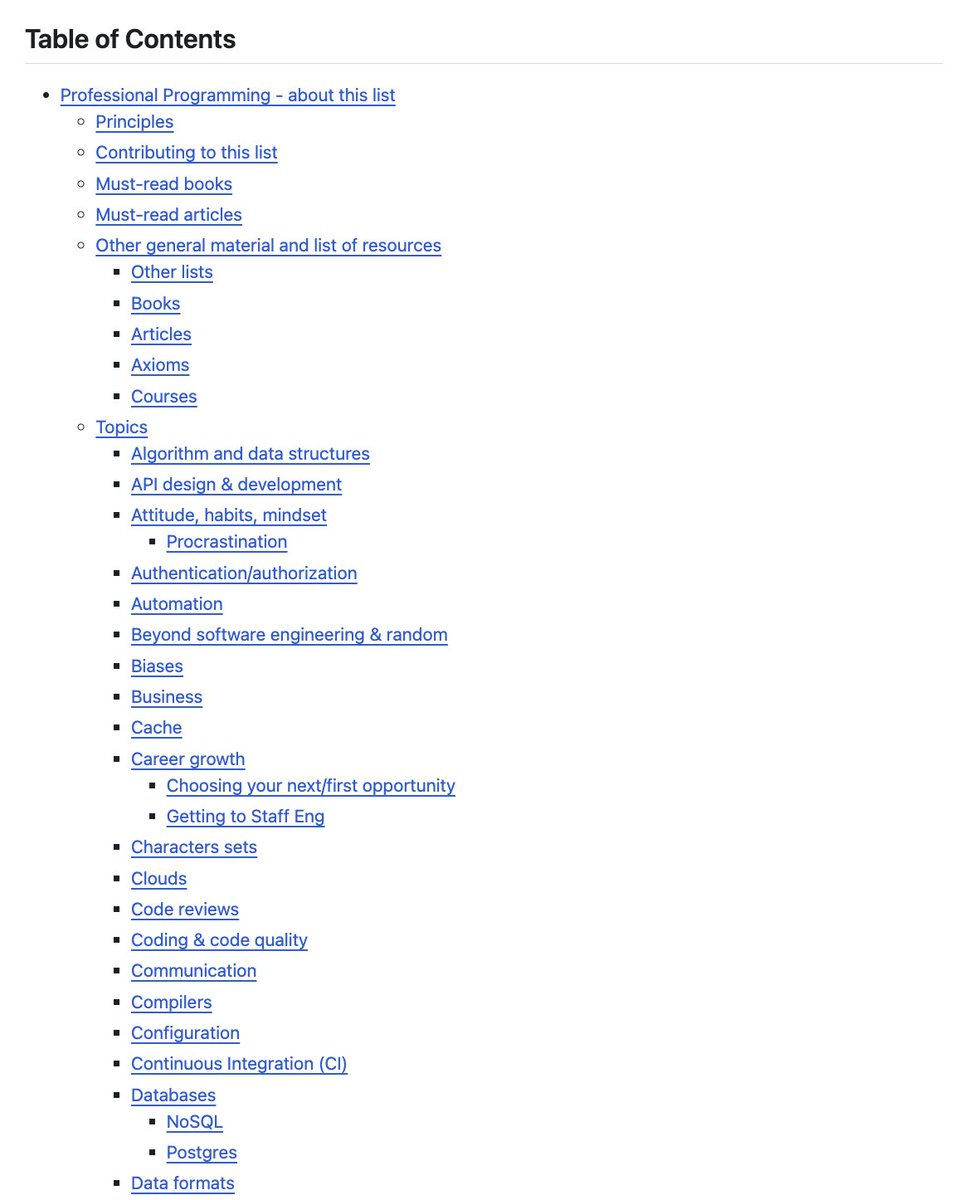
My first manager at Uber started a GitHub page back at the time with resources to become a more proficient developer - ones he personally found helpful (he did not have a CS degree).
I realized he is *still* updating it, 7 years later! A neat list: https://t.co/QtWeltMDWz
One of the best articles I’ve seen about proactively managing cloud operational costs.
As the author point out, the approach to successfully managing cloud expenditures needs to start all the way back in the provisioning process and rethinking how we track and associate costs.
Cloud costs are now a significant concern, shifting from top-line growth focus to bottom-line scrutiny. The reliance on tools and reporting from cloud providers is not sufficient to address this issue. https://t.co/fSzl2p0tRm
#CloudComputing#FinOps@QualiSystems
The greatest trap is telling yourself that you’ll do something important tomorrow.
Procrastination creates negative momentum. The longer you wait, the harder it becomes to start.
Telling yourself you'll do it tomorrow is how dreams die.
Before you work harder on something, spend time identifying the point of leverage in the situation.
Working harder on the wrong thing won't move you forward.
This can be somewhat counterintuitive for those of us who have been taught to work harder when you're not getting the results you want.
Working smarter is the most valuable form of working harder.
The best thing about the multi-modal models such as GPT4-V is that I can finally start having a conversation with the system, now that it can finally create and talk maps
Where you apply focus matters more than how much focus you have.
In life, there is a hidden asymmetry. If you apply your focus like everyone else, you will get the same results as everyone else. Understanding where to apply your focus makes a massive difference in results.
On the 27th straight day of filming “Forrest Gump,” Tom Hanks was tired & worried.
During a scene on the famous park bench, Hanks stopped & said to director Bob Zemeckis,
“Hey, Bob…is anybody going to care about this movie? I don’t think anybody’s going to care.”
Bob replied,
“It’s a minefield, Tom. You never know what’s good…It’s a minefield! It’s a goddam minefield! We may be sowing the seeds of our own destruction.”
Tom Hanks told this story after he was asked, “When I ask for a memory from your career, what’s the first thing that comes to mind?”
He said that what Zemeckis said was true of every movie he’s worked on:
“There’s never any guarantee...You do not know if it is going to work out.”
Takeaway 1:
Hanks is the 5th-most highest-grossing actor of all time.
And yet, the stickiest memory of his career is the feeling of uncertainty.
Rarer than talent or work ethic, the poet John Keats wrote, is the ability to step into and push through doubts and uncertainties.
In 1817, Keats wrote a letter to his brothers to share this exciting realization.
“At once it struck me,” Keats wrote, “what quality went to form a Man of Achievement … Negative Capability.”
Keats explains that “Negative Capability” is “when a man is capable of being in uncertainties, mysteries, doubts, without any irritable reaching after fact and reason.”
Takeaway 2:
Those who possess Negative Capability, who can sit with uncertainty, who can spend months or years in the minefield that is working on something while knowing that there is a real possibility no one will care about it—they often possess another quality.
They do what they do, not as a means to some end (money, fame, awards, etc.), but for the sake of doing it.
When asked about one of his movies that commercially failed, Hanks said,
"I loved making that movie. I loved writing it, I loved being with it. I love all the people in it."
As Ryan Holiday once told me, "The work has to be the win."
You control the effort, he says, not the results.
"So ultimately, you have to love doing it. You have to get to a place where doing the work is the win and everything else is extra.”
- - -
“Life is like a box of chocolates: you never know what you're going to get.” — Forrest Gump
Follow @bpoppenheimer for more content like this!
The best decisions have little to no immediate payoff.
The best choices compound. Most of the benefits come at the end, not the beginning.
The more patient you are, the bigger the payoff.