Meet Jev.
Most tools show you a chart and leave you alone with it. Jev sits next to you while you watch it.
Open any Solana token and Jev reads it with you, live. Every trade as it lands, the buyers against the sellers, who is holding, who launched it and what they launched before. Then it says something plain:
- where it thinks the next 15 minutes go
- whether buyers are actually in control
- the risk, in one number
- skip, watch or bid
It updates while you are looking at it. No refresh, no waiting for a call in some group an hour late.
Jev is a terminal built on the Jev model. The model is fast enough to read a token in seconds, so it can keep up with a chart in real time instead of catching up to it. That speed is the whole edge: seeing what a chart is doing while it is still doing it.
And every call is kept. Jev's calls are public and scored on what actually happened, so you can check the record before you trust one. Your calls and your group's calls get scored the same way.
A trading companion that watches with you and keeps its receipts.
https://t.co/RyObZbFsIn
27tNoYYhtovz1EmCQz3VufMMuDh6Nrv35QRX2vAyBNeA
The Already trading tab is now one big table instead of a stack of cards.
One row per coin, so you can compare them side by side. Click any column to sort by it. Each row shows the pool size and the day's volume as a share of the coin's market cap, which tells you how easy it is to get in and out, and how busy it really is.
Filters sit in a rail on the left, and the view you set is kept in the link to share.
https://t.co/p9MQuGI2Cv
When Jev's desk wants to buy, or thinks a pool is crashing, a bigger, slower model now takes a second look.
For now, that second opinion changes nothing. It's scored against Jev on the same moments, in public. It only gets a say in what the desk does once the record shows it's actually better.
Earn it first, then it counts.
https://t.co/3v9I2nHHXB
Sometimes the smartest trade is not buying at all.
Jev's desk now asks one more question about every pool: is this crashing? If it puts the odds at 25% or more, it won't open anything new there. At 50%, it tells anyone holding to get out.
A bad setup isn't always obvious on the chart. Now the desk checks for it on purpose before it acts.
Jev reads crypto news and calls which way each story moves the market.
The news page now shows how often those calls were right, next to what you'd score by calling every story neutral. That second number is the bar to beat.
Every story says right or wrong once it's settled, with the numbers behind it, and you can filter to only right calls, only wrong ones, or the ones still waiting.
https://t.co/Dfsx7x99RT
Jev has its own opinion on every coin. Now your coins can get yours too.
The strategies and classifiers you use (checks you built yourself or picked up from others) now run on every token you track or watch, combined the way you set them.
Each coin on Trade gets a mark when it matches your rules, the boards count how many match, and one sort puts your matches on top.
Star a coin and Jev keeps an eye on it for you.
Every token on your watchlist is now read side by side, every 15 seconds. Each one on the Trade page shows Jev's call, and a warning when there's something against buying it right now.
Open the watchlist board to see them all at once: one line per coin, Jev's call next to each.
https://t.co/99iHBuRVfg
The Screener finds coins by their numbers: age, market cap, volume, liquidity.
Now it can also filter on what Jev thinks of them. Show only the launches Jev would buy. Only ones with a low risk of the holders dumping. Sort by Jev's odds that a coin makes it off the launch curve.
Or pick a strategy and see only the launches it matched in the last day. There are one-click screens too, like "Jev likes" and "Low dump risk".
https://t.co/OMTpaSdEpz
A strategy on Jev can no longer climb the rankings on its backtest.
A strategy is a rule someone writes for which new coins to buy, like "a whale bought in the first minute". Testing a rule on past coins is easy to game: tweak it until it fits history.
So the board now ranks only on coins that launched after the rule was published, and the rule can't be changed after that. Until it has 20 finished trades it shows a dash and a count, not a number.
Each strategy also shows its middle trade's return after costs, not only its win rate, so one lucky run can't hide a pile of small losses.
https://t.co/GSE1uxpC3I
New on Jev: Discover.
It lists every Solana coin whose market cap just crossed one of four lines: $300K, $1M, $5M or $50M. One tab per line, newest first, and you choose how far back to look.
Each coin comes with what you'd check next anyway: what kind of coin it is, the mood about it on X, whether its followers and holders are growing, and whether the biggest holders are buying or selling.
Want a ping? The Telegram bot can alert your chat when a coin crosses, starting at whichever line you pick.
https://t.co/K20o4LBtKU
Jev used to only watch brand-new launches. Now it also watches the coins that are already big.
Around the clock it follows the 1,000 most traded Solana tokens worth at least $50K. It doesn't re-read them on a timer. It looks again when something happens: the price moves 5%, trading suddenly picks up, or money starts leaving the pool.
So when an established coin starts to turn, Jev is already looking at it.
https://t.co/XXo2c1pyrB
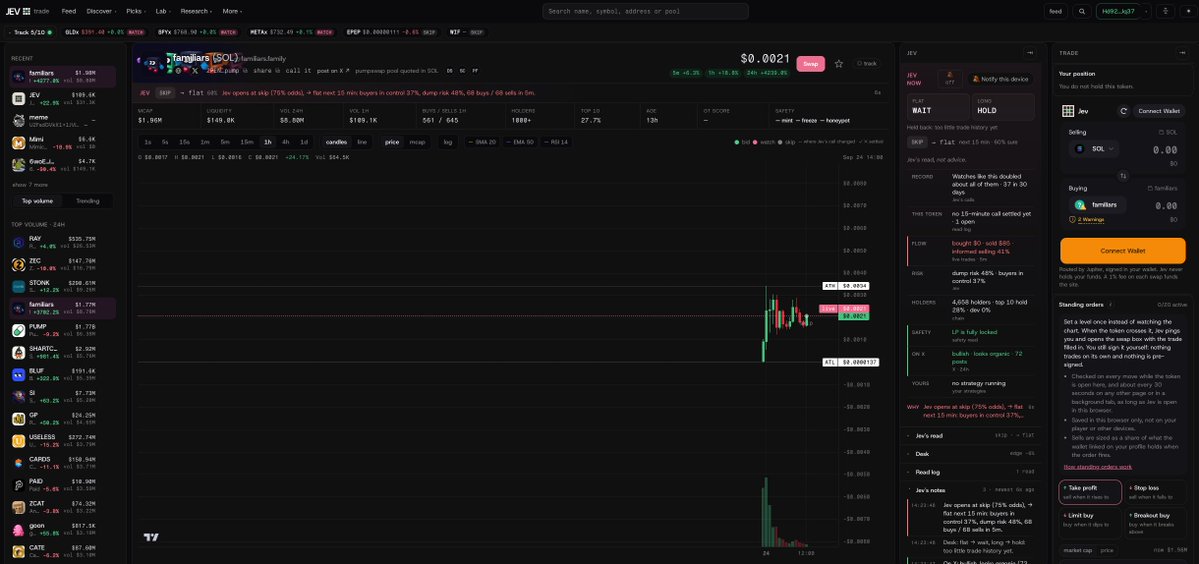
We rebuilt the Trade page on Jev around one idea: the chart is the thing you look at, so everything else should get out of its way.
The chart now fills the screen. Jev's call and where he thinks the next 15 minutes go sit in one line right above it. Your entry price, your orders and your price alerts are drawn straight onto the candles.
On a big screen, Jev's read sits on one side and your trading box on the other. Each folds away into a thin strip when you want more chart. The coin's banner moved behind its name instead of taking a row of its own, so the chart starts higher.
Jev's column now answers what you ask, in the order you ask it. What would he do if you had no position, and what if you already held some. Then one line each, green, amber or red: his record on calls like this, how he has done on this exact coin, whether buyers or sellers own the last five minutes, the odds holders dump on you, who holds the supply, the safety check, the mood on X, and whether it fits your own strategies.
When Jev leans buy but one of those lines is red, the column says so in plain words. If the live feed drops, it greys out, so an old call never looks live.
The coins you track and watch sit on one line across the top, and Jev rereads your whole watchlist every 15 seconds.
https://t.co/99iHBuRVfg
Jev has a screener: find coins by their numbers instead of their name.
Say you want coins under an hour old, under $100k in value, with real trading volume, that have already left the launchpad. Set those filters and the list shows only what matches, live.
You can also narrow by which launchpad it came from, and whether the team paid for a listing profile. Every filter is saved in the page link, so you can bookmark a screen or send it to a friend exactly as it is.
https://t.co/OMTpaSecf7
Anyone can show you their winning calls after the fact. Here is how you know Jev didn't edit its losers.
The moment Jev reads a new coin, its call, its odds and the price are locked. Each read gets a fingerprint (a hash: change one digit of the read and the fingerprint changes completely), stored in a table that refuses any later edit.
At the end of every day, all of that day's fingerprints are combined into one and posted publicly here on X, before most of those coins have played out.
On the track record page, one button redoes the whole calculation in your own browser. If we had changed a single read afterwards, it would not match.
https://t.co/3v9I2nHHXB
Jev used to sell its picks too early.
Every launch Jev picks gets a paper trade: a pretend buy at the moment of the alert, sold by a fixed plan, so you can see what following it would have made. That plan sold at double.
Then we looked at 20,000 finished launches. The ones that got to double usually did not stop there. The middle one topped out at about 5x, and almost half went on through 5x. Selling at 2x banked a double out of a move that usually had five in it.
So now half is sold at 5x, and the rest rides until it falls well off its high. That trailing sell, not the target, is what limits a loss, so aiming higher barely changes the worst trades.
https://t.co/CZvzfQyBKl
What actually tells you a one-minute-old coin might run?
Mostly one thing: how many different wallets have bought it. We measured it across 20,000 finished launches. Odds of reaching double its starting value:
0-2 holders: about 4 in 100
3-7: about 8 in 100
8-20: about 27 in 100
21-50: about 55 in 100
over 50: about 80 in 100
The second thing is whether it is still trading right now. With 8-20 holders, a coin that traded in the last two seconds doubled about 33 times in 100. One that had gone quiet for ten seconds, about 17.
Jev's read of every new launch now starts from exactly these numbers.
You no longer have to pick between the chart and the feed on Jev.
The feed is one live stream of everything Jev spots: new launches it likes, big buys and sells, calls from traders. Until now it lived on its own page, so checking it meant leaving your chart.
Now it opens right on the Trade page. Press feed at the top, or just hit F. It slides in next to your chart, and the chart and the swap box keep running underneath. See something, click it, you're on that coin.
Drag its edge to make it wider or narrower. On a big screen, press dock and it becomes its own column beside the chart. It stays open as you move from coin to coin.
https://t.co/99iHBuRnpI
You can now ask your AI assistant about Solana tokens and it will ask Jev.
Assistants like Claude Code, Cursor and Codex can plug into outside tools. There is a standard for that plug, called MCP, and Jev now speaks it. Paste one line from your profile into your assistant and it can look things up on Jev for you.
So you can type "find bonded stonkfun tokens under 100k market cap, less than an hour old" and it runs Jev's screener. Or "what does Jev think of this token" and it pulls Jev's read: skip, watch or bid, the risk and the odds. It can walk the picks wall and compare strategies on their live record the same way.
Screening works for anyone, no key needed. The rest uses your Jev API key, with the same rules as the API: 1,000,000 $JEV in your linked wallet.
Everything it can do is read. It cannot trade, post or change anything on your account.
You can now copy a wallet you follow on Jev.
Switch on copy next to the follow button and pick your own size in SOL. When that wallet buys a coin, Jev hands you the same buy at your size, ready to sign in your own wallet. Switch on sells too and it does the same when they sell a coin you hold.
https://t.co/aFGiE1NqI4
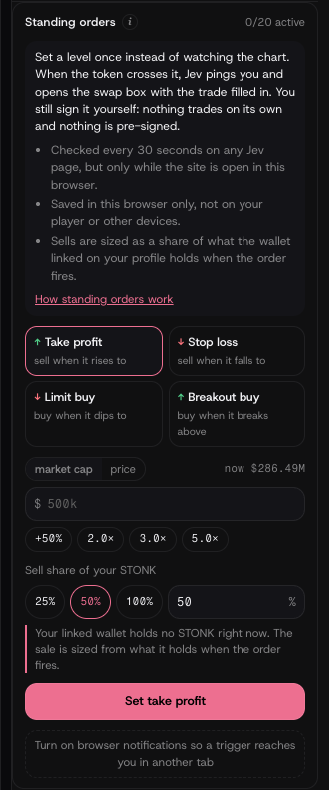
Jev can now watch a price for you and have the trade ready when it gets there.
On any coin's Trade page you can set a standing order: sell part of your bag when it reaches a level (take profit), sell if it drops to one (stop loss), buy if it dips to a level, or buy if it breaks up through one.
While Jev is open in your browser, on any page, it checks your orders every 30 seconds. When one hits, you get a notification, and one tap opens the swap with the coin, the side and the amount already filled in. You sign it in your own wallet. Jev never holds your funds and nothing is signed for you in advance.
Up to 20 orders at a time.
https://t.co/99iHBuRVfg
Jev's feed now fits a lot more on one screen.
The feed is one live stream of everything Jev does: the launches it picks, the calls traders make, the news it judges. Useful, but each row used to take up a small card, so you saw only a handful at once.
Press the ≡ button at the top of the site and every row shrinks to a single line: what kind of row it is, the coin, what happened, how it turned out, and how long ago. The buy button stays on every line. Tables across the site pack tighter too. Press it again to go back. Your browser remembers which you picked.
We also cleared the clutter above the list: six separate stream buttons are now one menu that shows how many rows each stream has. And when one coin shows up again and again within an hour, it folds into one card instead of filling the screen.
https://t.co/VBIzqqNnQl