Skepticism like this is well warranted - at first. However, I think Jim’s objections reveal something deeper than just picking at the architecture of Strategy’s offerings and any vulnerabilities that might be associated with products stacked on top of them.
Jim, like many I’ve seen, has imputed his worldview to his analysis and that’s the real takeaway. It’s not necessarily a bad thing! Key phrase: “Oh and some BTC, mostly flowing away from the individual into STRC”. This kind of zero-sum thinking that pits individuals and entities like corporations against each other pollutes a lot of big-picture economic thinking today. Yes, Bitcoin is finite, so there is a sense in which it’s zero-sum, but:
1) Strategy is accumulating Bitcoin ON BEHALF OF ITS THOUSANDS OF SHAREHOLDERS. It’s not one person that now magically gets to activate covenants, drive chains, or post-quantum scheme X because of this accumulation.
2) Just because I don’t go to my personal oil well and pump out some unrefined oil doesn’t mean I’m cut off from the benefits of fossil fuels. The extraction and refining happens at industrial scale all over the world. Market participants then benefit from that infrastructure & the distribution that results. Something analogous is burgeoning here with digital credit.
Stay curious, Jim - maybe you’ll remain skeptical but I encourage you to look again from a new perspective down the road!
@Strategy@Strive@HODLBarbarian@RichLassiterMD
Saylor is promoting Ethereum.
Saylor is promoting the Runes protocol on the Bitcoin network.
Saylor is promoting issuance of stablecoins on the Bitcoin network.
Saylor is promoting issuance of staking tokens on the Bitcoin network.
Saylor is promoting the use of the Bitcoin network to support tokenized synthetic bitcoin tokens on L2s.
Saylor is telling folks to exchange their BTC for stablecoins, in part so they can earn yield on those stablecoins. That yield is provided by STRC, which is purchased by entities within the stablecoin ecosystem described above.
Saylor/Strategy then takes the proceeds from those entities buying STRC and buys a boatload of BTC themselves.
Saylor use to tell folks to buy and hold BTC, there is no second best.
Saylor now tells folks to buy a security or a stablecoin instead.
Here's what's involved in the stablecoin money flow. Two different stablecoins, one riding on Ethereum, one riding on Bitcoin. Two different staking tokens, one on Ethereum, one on Bitcoin. One synthetic bitcoin token riding on an L2, which uses the Bitcoin network. One security, and last, but not least, some actual bitcoin. What could possibly go wrong?
Here's the kicker, in that whole process, the only entity not buying and holding BTC is the individual customer.
It's an unbelievably complex thing. I'm almost hesitant to even post this out of fear I'm going to look like an ass because there's no way this monstrosity could exist, and I'm just making shit up. Who knows maybe I've misunderstood it all, but I don't think so.
Taproot and OP_RETURN are the two key aspects of the Bitcoin protocol enabling the Bitcoin network to be used for all this non-bitcoin stuff.
All except Strategy are VC-backed.
Here are all the entities, protocols, outputs and tokens involved for the privilege of exchanging your BTC for a yield bearing stablecoin:
Hermetica (USDh, sUSDh) enabled by Runes/OP_RETURN on Bitcoin. Saturn (USDat, sUSDat) on Ethereum. Stacks (sBTC) on bitcoin L2, enabled by Taproot on Bitcoin. Strategy (STRC, MSTR) - securities.. Oh and some BTC, mostly flowing away from the individual into STRC.
Unbelievable. No way this will turn into another FTX, BlockFi, Celsius, Voyager, Three Arrows Capital, etc.. No way. This time is different.
How do you sleep at night Saylor?
Strategy has their largest Bitcoin sale EVER, and Bitcoin is up on the day just 4 hours later.
"Death spiral" nerds in shambles.
Market fully inoculated.
Bottom is closing in.
Let's go 🫡
Craziest chart in Bitcoin: look at the aggressiveness of the time to long term holder supply being in loss in 2026 versus other bear markets.
7.5 million Bitcoin are underwater right now.
Long-term holders, sitting in the red on a record number of coins.
Here's the part your financial advisor won't mention... this is what the bottom looks like.
Every time. 2015, 2018, 2022 - each cycle low was carved at the exact moment a third of the entire supply went into loss and the people who bought the top finally gave up believing.
The metric spikes because the marginal seller is running out of coins to sell.
It's the sound of weak hands quietly transferring their Bitcoin to patient ones, right on schedule, for the fourth time.
We're sitting at 37% of supply in loss - the same neighborhood that ended every prior bear market.
“The chain is dying” they said.
Bitcoin daily transactions, last 5 years:
2021: ~268K
2022: ~255K
2023: ~379K
2024: ~525K (ATH: 927K in April)
2025: ~421K
2026 YTD: ~534K up 90% YoY in June alone
June 23, 2026 was the 3rd busiest day in Bitcoin’s entire history.
The chain isn’t dying. It’s more active in 2026 than almost any point since the 2024 peak.
Check the data before you repeat the narrative.
@Mayhem4Markets The ability to store and transfer debasement-resistant value globally without centralized permission.
And among the ways to do that, it’s the protocol with the best liquidity and decentralized track record. Network effects.
@jfhksar88@LynAldenContact@Mayhem4Markets Explain…? Oh wait it’s a no-face pseudonym account, I should just take it at face value and change my worldview on the basis of this (asenine) comment
Bitcoin is presenting an opportunity of a lifetime.
For every person panic selling $BTC, someone else is getting a generational entry.
I know which side I'll be on.
Bitcoin is going to win.
Karl Marx wrote the communist manifesto 7 years before the creation of Limited Liability Companies.
Before then, if you wanted to set up a business you have to be seriously rich because anything the business did could impact your entire net worth. If your business got sued, you could lose your entire estate. Only the very rich had businesses and they ran their businesses like every decision could be financially catastrophic.
Then in 1855, the Limited Liabilities Companies Act was passed into British Law and the game changed.
Suddenly anyone could set up a business, raise investment and trade. There was separation between ownership and control.
This wasn’t lost on Karl Marx either. He wrote good things about this change. He was even a company director at one point.
Essentially, it means that under capitalism you can be a socialist if you want to.
A socialist can set up a company, give shares to all the workers, put workers on the board, pay executives the same as everyone else and if there’s any profit remaining they can freely donate it to the government.
There is absolutely nothing stopping any socialist from living according to these values under a capitalist system.
Nvidia is the most valuable company in the world and most of the employees own shares. Many are millionaires. In the UK, John Lewis and Waitrose are owned by their workers and are much loved successful businesses. Capitalism has no problem with workers owning the means of production.
Under capitalism, anyone with an idea can set up a company, pitch to investors and launch it. Starting with nothing, they can be a millionaire (on paper) within a month.
Socialists can lead by example; the fact that they almost never do this tells you a lot about socialists and human nature.
The same is not true under socialism. It is not possible for a capitalist to live according to their values. Under socialism, if I believe in small government, self-sufficiency, low regulations I must leave the country - if it’s even possible to do so. It’s not enough for a socialist to live their values, they need everyone to do it too.
MSTR DILUTION FUD DEBUNKED IN ONE CHART:
The dilution FUD is dead.
Strategy raised capital all year, issued common, bought Bitcoin, and STILL added roughly 24,029 sats/share of incremental CEBE using BASIC shares.
That is the whole game.
Bears saw the share count go up and started screaming like a raccoon trapped in a Chuck E. Cheese ball pit.
Meanwhile, common equity Bitcoin exposure per share went up.
They counted shares.
They forgot the Bitcoin.
John Lennon wrote a beautiful song about socialism.
“Imagine no possessions” he told us.
He also:
– helped write his band’s anti-tax anthem, Taxman
– incorporated his IP holdings
– moved to a lower-tax country
– fiercely protected his royalties
- drove two Rolls Royce’s and had multiple luxury homes.
– made sure even the royalty cheques for Imagine were kept safe for his estate so his family would remain wealthy in perpetuity.
If he believed it, he’d have lived it. The trouble with socialism is that even the people who love the idea won’t run the experiment on themselves.
John Lennon writing Imagine while owning two Rolls Royce Phantoms and later having a law suit to protect his royalties tells you all you need to know about socialism in practice.
It doesn’t work outside of the imagination.
I've always liked Kratter's Bitcoin University content, especially early in Bitcoiner life, but this take is correct. Bitcoin is many things - a P2P payments network, a system of delicately balanced tradeoffs & incentives, etc. The native token needs to appreciate enormously from here for Bitcoin to deliver on its best, highest purpose(s).
The self importance behind this is staggering.
As if Bitcoin needs him, or anyone else, to police who is allowed to participate in the network.
The constant need to define an in-group, gatekeep who is a real Bitcoiner and talk shit about anyone integrating Bitcoin into the existing financial system is genuinely embarrassing.
"Toxic" Bitcoin maximalism was never about gatekeeping the network, it was about recognising that Bitcoin is the only "crypto" asset with genuine value and utility.
Somewhere along the way, these guys appointed themselves the authority on correct and incorrect use of a network explicitly designed to need no authority.
Oh the sweet irony.
Bitcoin becomes more useful, not less, when it is worth $10 million a coin and millions of businesses worldwide hold it as a corporate treasury asset.
Self custody, corporate treasuries, ETFs, nation state reserves. All of it strengthens the network.
Unfortunately for people like Kratter, they will need to accept that most of the Bitcoin in existence will end up in the hands of capital allocators.
It's time to grow up and recognise the world for what it is, not for what we want it to be.
For the record, Saylor has done more for Bitcoin adoption than any of you.
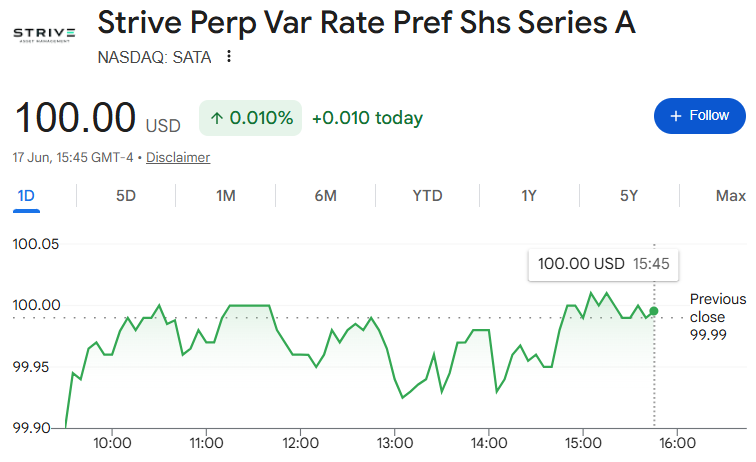
Congratulations to the team at @Strive. They seem to have found the perfect market fit for retail with $SATA.
13% annual yield + dividends paid daily = $100 par
This is really impressive, particularly in the midst of a bear market.
$ASST is a $150 stock, trading at $15.
When Bitcoin runs, SATA is going to print & ASST is going to fly! 🚀
The shorter the liability duration, the more CEBE matters. The longer the duration, the more BPS matters. If claims came due today, CEBE BPS would be the more relevant metric. If BTC outpaces dividend obligations, BPS better captures common equity upside.
Picture yourself as an individual running your own company. One individual. One company.
Should you buy Bitcoin?
Imagine getting a business partner. You now have an entity of 2 people. Should you buy Bitcoin?
Image you are successful and expand. You now have 10 people. Should you buy Bitcoin?
Imagine the business is doing incredibly well and you scale to 100 employees and they all have private ownership of your company. Should you still be buying Bitcoin?
Imagine you do so well after a few years, you get listed on the NASDAQ and go public with Bitcoin on your balance sheet. You have 500 employees and public company shareholders.
Should you still be buying Bitcoin?
At what point should you be expected to hold Bitcoin via a custodian rather than a hardware wallet/seedplate in someone's sock drawer?
Think of the fiduciary duty for security.
Imagine you are so successful, you now have a public company of thousands of public shareholders, and you hold billions of dollars of Bitcoin via a custodian and your financials are audited by regulated Big 4 entities.
Should you still be buying Bitcoin?
To the Strategy haters... at which point in this progression of events did buying Bitcoin become a bad thing, and if it ever did, would you rather have your company stack fiat instead?
When exactly did buying Bitcoin become immoral, irrational, or bad?
Please, let me know. I'll wait.
🚨 It's not just ZCash.
Opus 4.8 also found a vulnerability in $USD that allows for unlimited issuance which could theoretically enrich insiders at the expense of all holders
huge breaking
The most important final regulatory hurdle for Bitcoin is Basel risk weightings.
If this changes, the door to rating agencies & institutional capital holding BTC gets kicked open.
$MSTR
Bitcoin will go back above $100,000.
$STRC will go back to $100.
“With every minute you do change a mind. And call him noble that was now your hate, him vile that was your garland.”
Shakespeare wrote that about a crowd.
The crowd that cheers the king one day and calls for his head the next.
He could have written it about a Bitcoin market day.
For newer investors in this space, days like today might make you question the authenticity of the asset.
It might make you question whether you made the right decision.
It might make you want to exit and save yourself from a falling knife, as the voices around you will certainly encourage you to believe.
Volatility is not a pleasant experience for people who have not yet built the resilience for it.
But before you do anything, ask yourself one question.
What has fundamentally changed since you bought?
Nothing has changed about Bitcoin.
Not from when it was at $80,000.
Not from its all time high of $126,000.
Nothing has fundamentally changed about @Strategy or its products either.
In fact, one can argue they are stronger than they have ever been.
Over the past year, despite the continued pressure on Bitcoin’s price, the company has continuously found ways to raise capital, accumulate, and create value.
The ones I empathize with most today are $STRC holders.
$STRC was not designed for volatility.
It was designed for people who did not want it.
So if you are experiencing it today, I understand why it does not feel good.
But before you press the sell button thinking you are saving yourself, remember what you are actually invested in.
The company behind this instrument holds over $55 billion in Bitcoin.
It has 6 months of dividend payment coverage.
It has 31 years of Bitcoin dividend coverage.
And it is targeting a $300 trillion pool of yield seeking capital that has barely been touched.
$STRC is not immune to volatility.
It is resistant to it.
History backs that up.
On February 5th, $STRC hit its lowest point at $93.67.
The very next day it was at $98.76.
Six days later it was back at $100 flat.
Six days.
That is the recovery window for short term capital in this instrument.
Bitcoin does what it always does.
It moves when you least expect it, in either direction.
The skeptics are loudest right now.
This is precisely the moment where you should not be driven by opinion.
If you think you have made a mistake, dig deeper.
If you are considering selling, understand the balance sheet first.
Understand what is backing it.
Understand why this company has continued to do what it does year after year.
Every year is the same story.
Bitcoin is a freedom virus.
And freedom does not always come without resistance.
You just have to decide which side you stand on.
And understand why this company has chosen to stand there with you.
$BTC $MSTR $STRC
If Strategy sells MSTR to pay the dividend, it's a ponzi.
If Strategy sells Bitcoin to pay the dividend, it's a death spiral.
If Strategy sells STRC to buy Bitcoin, the common stockholders are being "diluted".
If Strategy uses the USD reserve to pay off the debt, it's a "fatal error".
At some point you have to realize the bear thesis has become a Choose Your Own Adventure book for people who hate the ending.