I discussed open inquiry and academic freedom with the amazing Nadine Strossen, with focus on the recent @harvardmed open inquiry report. The event was sponsored by @HAFFS_Harvard https://t.co/mPm7ViLZNa
Read Noah Eckstein's Senior English Address @Harvard's 2026 commencement. A wonderful example of what a great commencement address can be. Thank you Noah!! https://t.co/qTVhu9sSY4
How to think about viewpoint diversity? This discussion today at 4pm ET between Cass Sunstein of @Harvard and John Tomasi of @HdxAcademy should be very illuminating. Tune in!
🔎 The current debate about viewpoint diversity only skims the surface.
Legal scholar Cass Sunstein and HxA President John Tomasi will discuss common misconceptions about this hot issue.
She didn’t agree with my recent @GlobeOpinion oped arguing that commencement speeches shouldn’t be used to make political arguments. Harvard Medical School graduate dedicates speech to Lebanon and Palestine https://t.co/Ydlag5zWc4 via @AJEnglish
And if you really want to come prepared, you can read their reform proposal, published in the Journal of Controversial Ideas as part of its special issue on Censorship in the Sciences.
https://t.co/XzTsRmFzuJ
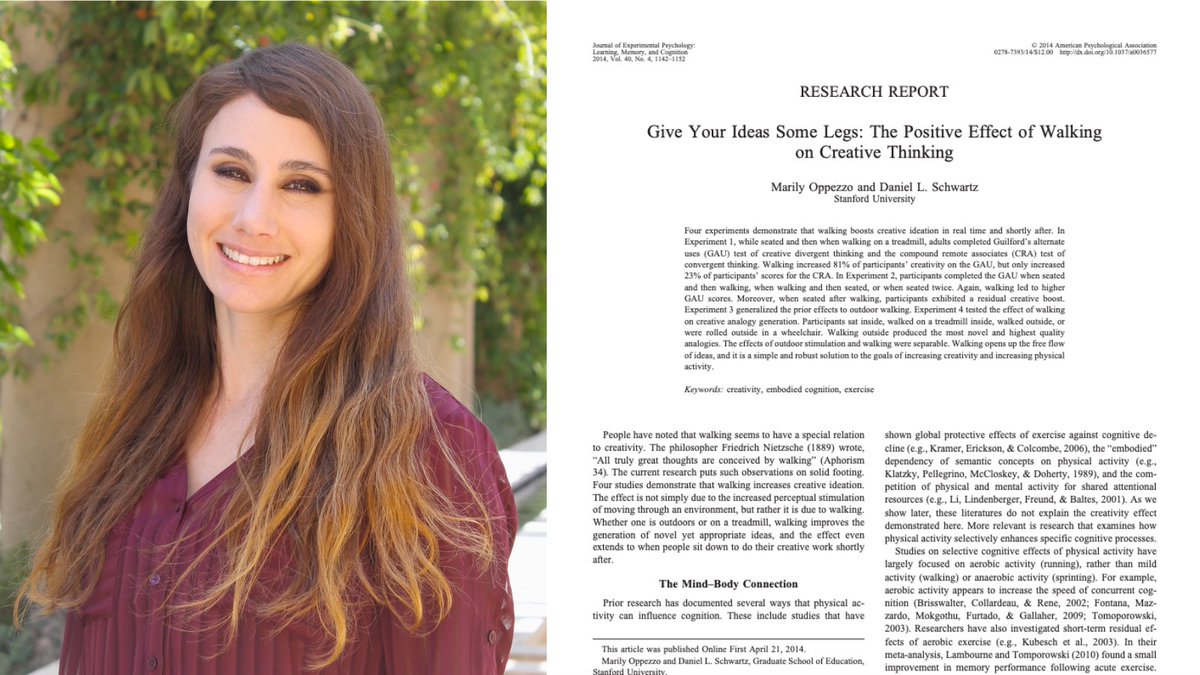
A Stanford psychologist spent 4 years proving that the simple act of walking generates 60% more creative ideas than sitting, and the experiment she designed to kill every alternative explanation is one of the most decisive findings in modern psychology.
Her name is Marily Oppezzo.
She got the idea for the study while walking with her advisor at Stanford to discuss her thesis topic, and the paper she eventually published in the Journal of Experimental Psychology in 2014 is sharp enough that it should have ended the seated meeting on the day it came out.
She ran 4 experiments on 176 people. Same person tested twice. Once sitting, once walking. The creativity tasks were the standard ones psychologists have used for decades to measure how good a brain is at generating novel useful ideas.
The result was almost too clean to publish.
81% of participants in the first experiment produced more creative ideas while walking than while sitting. In the second experiment, 88%. In the third, 100%. Every single person walked into a more creative version of themselves.
On average, people generated 60% more novel useful ideas the moment their legs started moving.
The skeptical question is the obvious one. Maybe it was the fresh air. Maybe it was the scenery passing by. Maybe it was the change of environment doing the work, not the walking itself.
Oppezzo killed every one of those explanations with one experimental decision.
She put people on a treadmill facing a blank wall. No scenery. No fresh air. No environmental change. Just legs moving in place while staring at white drywall. The 60% boost held.
Then she ran the experiment that closed the case completely. She took participants outside in two conditions. Half of them walked through a Stanford courtyard. The other half were pushed through the exact same courtyard in a wheelchair. Same outdoor stimulation. Same scenery passing at the same speed. The only difference was whether the legs were moving.
The walkers produced dramatically more novel high-quality ideas than the wheelchair group. The outdoors did almost nothing on its own. The walking did everything.
This is the part of the study that hit hardest when I read it the first time.
She also tested the opposite kind of thinking. Convergent thinking. The kind where there is one right answer and you have to narrow down to it.
Word puzzles where 3 words share a hidden fourth word that connects them. The seated participants did slightly better on these. Walkers got slightly worse.
Walking is not a general intelligence enhancer. It does one specific thing. It opens up the divergent search inside your brain. The part that generates options. The part that produces unexpected connections. The part that takes a problem and finds five ways into it instead of one.
When you need to converge on the single right answer, sit down. When you need to find the answer in the first place, get up.
The mechanism is now well understood. Walking selectively activates what neuroscientists call the default mode network, the system inside your brain that runs when you are not consciously focused on anything. The DMN is where mind-wandering happens. Where memories cross-reference each other. Where ideas that have been sitting in separate folders inside your head finally bump into each other.
When you sit at a desk and force yourself to concentrate, you suppress the DMN. When you walk at a natural pace, the executive part of your brain gets just busy enough handling the walking that the DMN comes online and starts doing the work that focus was blocking.
The most useful finding in the entire paper is the one almost nobody quotes.
The boost did not turn off the moment people stopped walking. Participants who walked first and then sat back down stayed elevated. Their next round of seated creativity work was still significantly better than people who had been sitting the whole time. The rest lingered for at least several minutes after the legs stopped moving.
You do not need to do creative work while walking. You need to walk before the creative work. The brain holds the state.
The history of this is the part that should haunt anyone who still does meetings in chairs.
Charles Darwin built a gravel loop behind his house in Kent called the Sandwalk and walked it 3 times a day for the rest of his life. The theory of evolution was developed one lap at a time on that path.
Nietzsche walked up to 10 hours a day during the years he wrote his most important books and openly said the work was conceived on his feet.
Beethoven composed for the morning and walked for 5 hours every afternoon with a pencil in his pocket for when something landed.
Kahneman said the best thinking of his Nobel Prize-winning career happened on leisurely walks with Amos Tversky. Steve Jobs refused to take important conversations sitting down. He held them on foot.
Every one of them was using the system Oppezzo would not measure until 2014. They just did not know what to call it.
The question worth sitting with is the one almost nobody asks.
Every meeting you have ever attended sitting around a table was a meeting held at a fraction of the brain power that was actually available to the people in the room. Every brainstorm that got stuck inside a conference room. Every problem you tried to solve at a desk and gave up on. Every idea you could not quite get to.
The intervention is the easiest one in modern science. No supplement. No app. No subscription. No training program. Just a pair of legs and 15 minutes.
The Stanford lab proved it. The philosophers knew it. The neuroscience explains it.
And almost everyone reading this is still trying to think their way out of problems sitting completely still.
🔎Harvard Medical School took a hard look at its own culture of open inquiry.
The findings have implications well beyond Harvard. Nadine Strossen and @jflier will unpack what the report reveals and what it'll take for change. Hosted by @HAFFS_Harvard.
Free speech is a legal right. It is also part of a larger inheritance, protected by people who paid costs most of us can barely imagine.
On Memorial Day, we remember those who gave their lives in service to that inheritance.
They did not die so Americans would fall into a dreary consensus on all things.
They died helping preserve a country where disagreement is possible without bloodshed, where dissent is not treason, and where citizens can argue, worship, protest, publish, persuade, offend, forgive, and begin again.
That is not a small thing. It’s the inheritance we are obliged to protect.
Here is the full text -- and the video -- of my Commencement address at NYU last week. I drew on the Flourishing class I teach at @NYUStern to offer advice for success in our digital future.
Main thing: "treasure your attention."
https://t.co/924R6J9C9W
If it's unconfirmed, why share it with your 1.8M followers, especially considering the source, which is committed to the destruction of the Jewish state? Have you bothered to ask any Israelis about this? Have you done any reporting? Do you know what reporting is?
I had a great discussion today with John Tomasi of @HdxAcademy on the value and purpose of university commencement addresses, and why their use to deliver politicized messages is not good. Many great audience questions. https://t.co/L4pIdwMjyB
Look forward to reading How to Rule the World by Theo Baker @tab_delete out this week. He and I corresponded about research misconduct when, as a freshman reporter for @StanfordDaily he broke the story that brought down @Stanford president.
Books have always been a huge part of my life.
Never did I think I’d have the chance to publish one of my own at age 21.
HOW TO RULE THE WORLD comes out on Tuesday and I’m so excited to share this dream, years in the making, with all of you. (cc: @penguinpress!)