Econ PhD candidate @upsediliman / Para sa Diyos at Bayan / Has eclectic taste in music, fond of fantastical tales, and drawn to space and the prehistoric
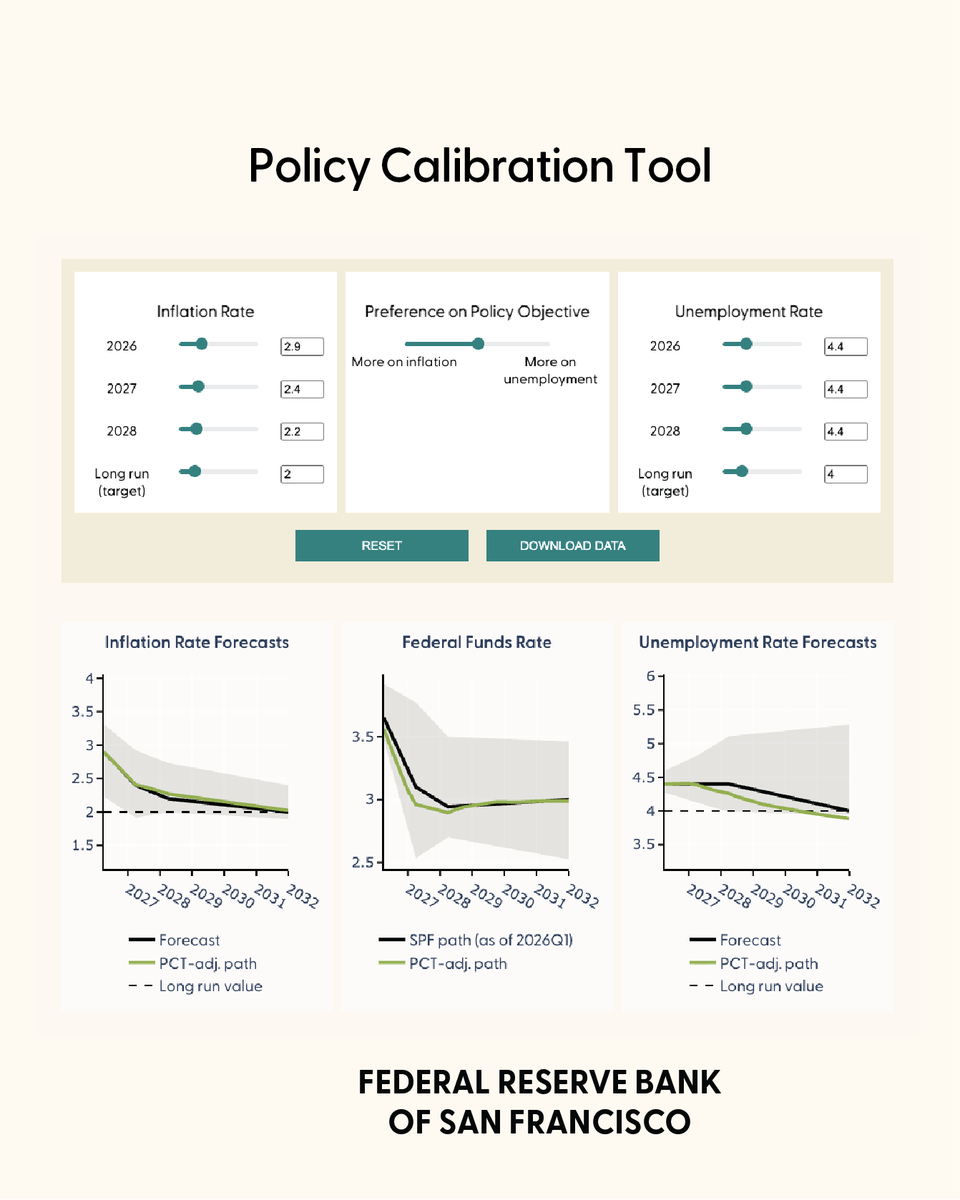
The San Francisco Fed’s Center for Monetary Research just released a new tool that lets users calibrate the hypothetical monetary policy rate path based on their own views of the economy and interpretation of the dual mandate. https://t.co/cY1EVRnvN8
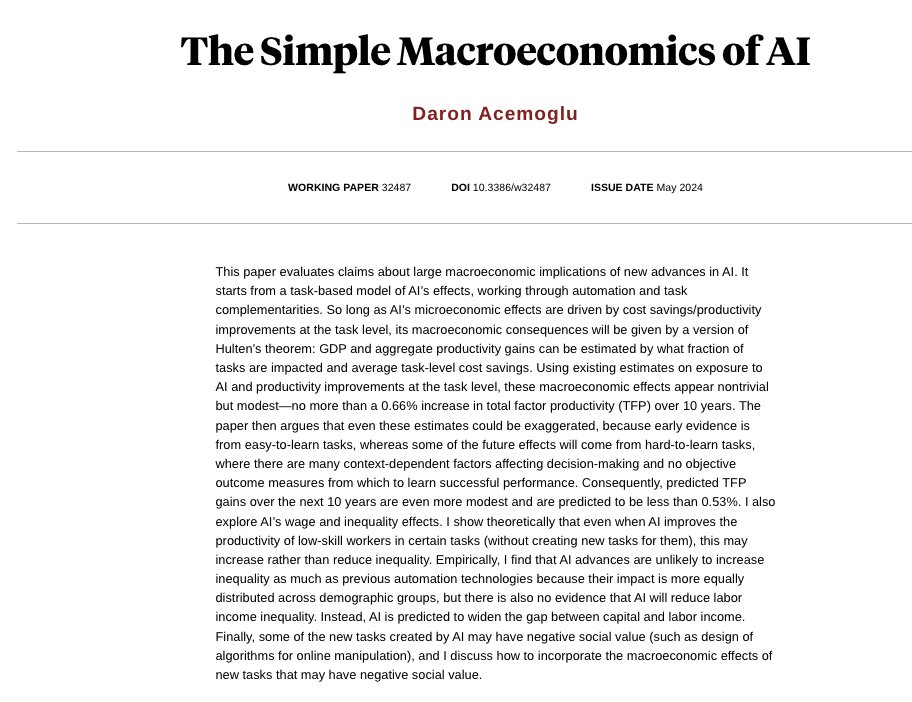
O Nobel de Economia Daron Acemoglu calculou o impacto REAL da IA no PIB com rigor matemático.
Resultado: enquanto Goldman projeta +7% e McKinsey fala em US$ 25 trilhões, o número do Acemoglu é... 0,53% em 10 anos.
Thread sobre o paper mais contrarian de 2024 sobre IA:
New in @AEA_Journals' American Economic Review: migration doesn't hollow out the home economy — it builds it up.
More than 75% of the long-run income gains from migration are domestic. The home economy itself grows.
Here's what we found: 🧵
Okay, I have read this paper and it is horrible. The obvious reply, that many economists have made, is that there is no causality in there.
The problem is that I have not seen many replies that cite actual empirical research, so let me plug this in. On five grounds.
Carney is right that cooperation is the only viable equilibrium in a world without an enforcer.
But cooperative orders are structurally fragile — the Cold War’s “third way” failed for a reason.
I tried to think through whether this time could be different.
https://t.co/uPehYZFJzb
On the subgame perfect Nash eq. of a bargaining game:
"If α=1 and β<1, then player A receives the entire payoff, in accord with the principal expressed in the Gospels: 'Let patience have her [subgame] perfect work.' (James 1:4)."
-Hal R. Varian, Microeconomic Analysis (1992)
Hiked the well-known Mt. Daraitan last month in the rain, so it was very muddy and slippery. This particular hike is surely NOT for the faint of heart, but I give it a 10/10 for the experience and the people. This is my fifth hike for this year. Mobility is truly liberty.
Let me explain why I believe modern economics is such a powerful tool for understanding the world. I’ll do this by discussing a great paper by Simone Cerreia-Vioglio, @UncertainLars, Fabio Maccheroni, and Massimo Marinacci, “Making Decisions Under Model Misspecification,” published in the Review of Economic Studies a few months ago.
Imagine I want to drive from UC San Diego to UCLA, but I’ve never driven that route before. I need to build a “model of the world” to guide me, which we usually call a map. Maps are simplified representations of reality. They can’t include every detail if they’re to be useful. Borges, in his short story On Exactitude in Science, makes this point beautifully. (In practice, I don’t draw the map myself—I use an app—but someone still had to make it.)
Because maps simplify, I can’t fully rely on them. Maybe last night’s storm knocked down a tree and closed a street, or there’s construction and the ramp off the highway in LA is shut down.
This uncertainty matters. Suppose I’m driving to UCLA for an important talk at 11 a.m. If the ramp is closed, I might need 15 extra minutes. When should I set my alarm to arrive on time, while still getting enough sleep to give a good talk?
The problem is that I can’t assign precise probabilities to all these contingencies. How likely is the fallen tree? Or new roadwork? Even the best traffic apps can’t capture every disruption, and some might happen after I’ve already left.
In economic terms, my “model of the world” (the map) is misspecified—and no matter how hard I try, I can’t fully fix that.
But sitting down and crying about misspecification doesn’t answer my basic question: when do I set the alarm? Too early, and I’m exhausted. Too late, and I’m late.
Simone and his co-authors offer a way to think about this. They start from the idea that we often hold several structured models of an economic phenomenon, grounded in theory. For example, a central bank might use a standard New Keynesian model and a search-and-matching model of money.
Yet, aware that each model is misspecified by design, the bank adds a protective belt of unstructured models—statistical constructs that help it gauge the consequences of misspecification.
The beauty of the paper is that it provides an axiomatic foundation for this protective belt (and even generalizes it to include a Bayesian approach). It shows that if a decision-maker’s preferences meet certain conditions —reflecting both rational and behavioral features— then those preferences can be represented by an augmented utility function that formally accounts for misspecification.
Crucially, we don’t assume that augmented utility function; we derive it. We start with general, plausible properties of preferences and prove that they imply such a representation.
That’s real progress. Instead of writing endless critiques of expected utility or rational expectations (as many have done for decades, with little to show), we now have a formal way to reason about misspecification—precise definitions, clear boundaries of validity, and awareness of what we still don’t know.
Take, for instance, a brilliant Penn graduate student on the market, Alfonso Maselli
https://t.co/rl2gu95V7t
His job-market paper pushes this frontier further. He studies cases where a decision-maker not only faces model misspecification but is also unsure which model best fits the data and can’t assign probabilities to them—what we call model ambiguity. In my example, the central bank is unsure whether the New Keynesian or the search-and-matching model fits better, and it worries that both might be incorrect.
If you read Simone et al. or Alfonso’s paper, you’ll see how misguided—and, frankly, cartoonish—many of the recent criticisms of economics on X have been.
First: the idea that economists don’t understand math or have “physics envy.” The math in these papers is subtle and advanced—utterly different from what physicists do (neither better nor worse, just distinct). An engineer transitioning into economics would find these tools unfamiliar.
Second: claims of ideological bias are unfounded. I have no idea about the political views of the authors, and I’d be surprised if anyone could infer them from the analysis—beyond vague guesses about typical academics.
Third: This has almost nothing to do with what one learns as an undergraduate, or even in first-year graduate school. If your knowledge of economics stops at an intro textbook, it’s best not to pontificate on the field’s frontiers.
Fourth: Is this science? Debating that word’s boundaries is pointless; every definition of “science” breaks down somewhere.
The Germans solved this long ago with the idea of Wissenschaft—the systematic pursuit of knowledge, whether of nature, society, or the humanities. By that measure, modern mainstream economics is clearly a Wissenschaft: a disciplined, cumulative, and highly useful effort to understand how the world works. Simone and his co-authors have demonstrated that beyond any reasonable doubt.
Fiscal rules are not new—but they’re more important than ever. With record debt and rising spending demands, countries need clear anchors, correction mechanisms, and oversight to keep public finances on track. Read the new IMF report on fiscal guardrails: https://t.co/1A4N0cnOHm
Super interesting!
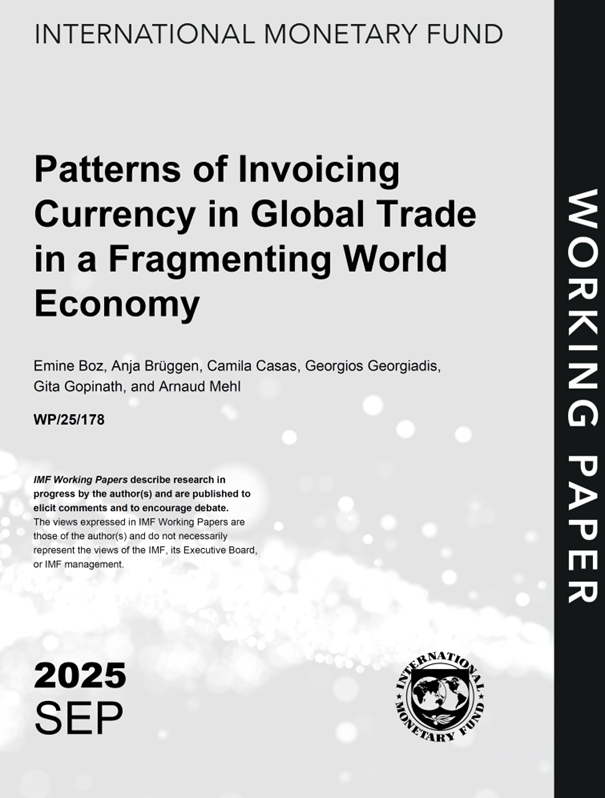
"Patterns of Invoicing Currency in Global Trade in a Fragmenting World Economy" by Emine Boz, Anja Brüggen, Camila Casas, Georgios Georgiadis, Gita Gopinath, and Arnaud Mehl.
"This paper presents the most comprehensive and up-to-date panel dataset on global trade invoicing currency and examines recent pattern shifts with a focus on geopolitical alignment. Using data for 132 countries from 1990 to 2023—including new coverage of the Chinese renminbi—we document five key findings. First, the US dollar remains dominant, with global invoicing shares broadly stable. Second, renminbi use has grown steadily and expanded beyond Asia, though it remains modest. Third, countries not geopolitically aligned with the US continue to rely on the dollar, though this reliance has declined in a few key economies. Fourth, since 2021, the correlation between the use of a given invoicing currency and the geopolitical distance to its issuer has become more negative, reflecting growing polarization. Fifth, there is no robust evidence consistent with effective policy initiatives to reduce dollar reliance in oil exports. These findings highlight the resilience of dominant currencies and suggest emerging fragmentation in invoicing patterns along geopolitical lines."
https://t.co/uxKG5zZnTw
HISTORY HAS ITS EYES ON YOU 🇵🇭
It’s a moment forever etched in history as Filipina tennis ace Alex Eala secures her first-ever WTA title after outlasting Hungary’s Panna Udvardy in the 2025 Guadalajara 125 Open!
#GuadalajaraOpen#AlexEala
🎥 Instagram | gdlopen





![Insane_Econ's tweet photo. On the subgame perfect Nash eq. of a bargaining game:
"If α=1 and β<1, then player A receives the entire payoff, in accord with the principal expressed in the Gospels: 'Let patience have her [subgame] perfect work.' (James 1:4)."
-Hal R. Varian, Microeconomic Analysis (1992) https://t.co/Mc3WPk9rC1](https://pbs.twimg.com/media/G-4OyJzXkAAT6W2.png)








![Insane_Econ's tweet photo. On the subgame perfect Nash eq. of a bargaining game:
"If α=1 and β<1, then player A receives the entire payoff, in accord with the principal expressed in the Gospels: 'Let patience have her [subgame] perfect work.' (James 1:4)."
-Hal R. Varian, Microeconomic Analysis (1992) https://t.co/Mc3WPk9rC1](https://pbs.twimg.com/media/G-4OyJ9WwAAtbcJ.png)