@elonmusk congrats on $SPCX!
If you want to own agentic AI you should take a close look at https://t.co/bdSDn4W72P - look at their IP in particular and who is involved. Whoever owns that IP will have a major advantage in my opinion.
Everyone always talking about “talent density” in Silicon Valley when we really should be talking about how 80% of pretzels in America come from a small region of Pennsylvania
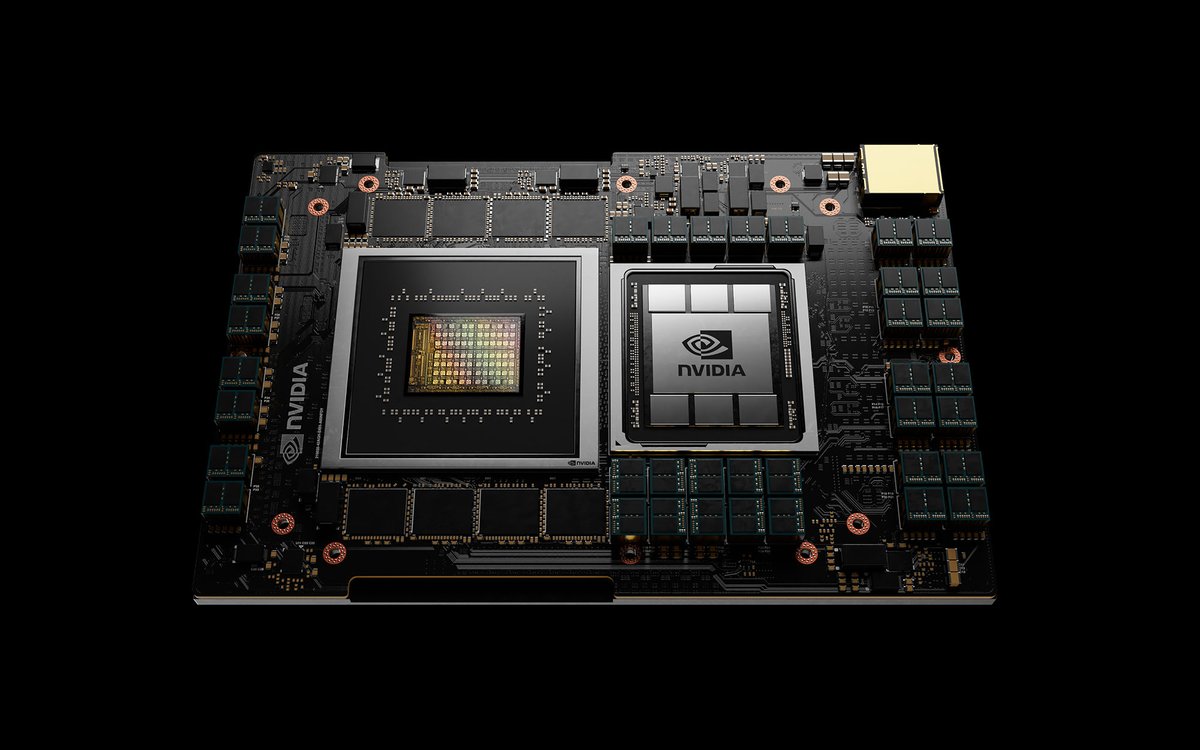
$DELL delivered the world’s first $NVDA Vera Rubin NVL72 rack to $CRWV marking the first confirmed shipment of Nvidia’s next-gen AI rack system.
The system includes 72 Rubin GPUs, 36 Vera CPUs, 3.6 exaFLOPS of FP4 inference, 75TB of fast memory and 260TB/s of NVLink bandwidth.
THIS IS GOING TO BE MASSIVE, JUNE 1st⚠️
$NVDA is set to release their NEW chip with $ARM. The levels COULD not be more clear setting up for a MAJOR move over the next few days. Names like $AMD are also poised for their move into ATH
THIS WILL SHOCK MARKETS👇
$NVDA Mark your calendar.
Tonight. 11 PM ET.
Jensen Huang. Computex. N1X.
“A new era of PC.”
Their words. Not mine.
🔴 Live on Nvidia’s YouTube
https://t.co/CHTq7wH3Zd
Three of the most powerful tech ecosystems on earth just synchronized a cryptic payload across X—and it points directly to the moment $NVDA and $ARM dismantle the legacy x86 computing monopoly.
The simultaneous teasers from the official $NVDA, $ARM, and Windows accounts were not a routine marketing stunt. Dropping the phrase “A new era of PC” alongside the exact geographic coordinates of Jensen Huang’s Computex 2026 keynote venue in Taipei was a calculated shot across the bow for Intel, AMD, and Qualcomm. The leaked specifications for the upcoming N1 and N1X Systems-on-Chip (SoC) reveal a total restructuring of client-side computing.
~Data Center DNA in a Laptop~
For years, the consensus assumed Nvidia would enter the consumer space with a modest notebook processor. Instead, $NVDA downscaled the architecture of its enterprise Blackwell superchips to bring data-center-grade acceleration straight to premium notebooks.
The architectural specs of the flagship N1X chip reveal why legacy silicon vendors face a multi-year deficit:
• The Core Compute: A 20-core ARM v9.2 configuration split between 10 performance and 10 efficiency cores, custom-engineered on TSMC's 3nm node.
• The Memory Subsystem: Up to 128GB of unified LPDDR5X memory running on a wide bus for seamless shared bandwidth.
• The Graphics Engine: An integrated Blackwell GPU pushing 6,144 CUDA cores—matching the exact shader count of a standalone desktop RTX 5070 inside a mobile power envelope.
~The CUDA Choke Point~
Competitors have pitched heavy on NPU metrics, but hardware is irrelevant without developer gravity. AI developers write natively for CUDA, not isolated, proprietary NPUs.
By embedding a full Blackwell GPU into a client processor, $NVDA brings its entire software ecosystem to portable hardware. The N1X delivers enough local AI throughput to run heavily quantized large language models locally on a commercial machine without relying on continuous cloud round-trips.
This matches Microsoft’s massive client-side agentic software pivot. Microsoft needs hardware that can handle continuous, local inference cycles for task automation without obliterating battery life. The $NVDA and $ARM alliance delivers the exact computational muscle required to turn Windows-on-Arm into a true agentic operating system with native Copilot+ support.
~The Ecosystem Takeover~
The commercial transition is moving at a speed Wall Street models fail to capture. Supply chain trackers confirm that tier-one manufacturers like Dell, Asus, and Lenovo are already prepping premium lineups around the N1X silicon for the holiday cycle.
The broader investment community still structures its models under the assumption that Nvidia is strictly a cloud data center monopoly. They are completely missing the terminal value of client-side vertical integration.
If a single enterprise controls the training clusters in the data center, the inference factories in the hyperscale cloud, and the localized consumer engines sitting inside millions of laptops, they have built the ultimate closed-loop toll booth on modern computing. The desktop bottleneck has arrived.
NFA, do your own DD.
Jane Street just showed the inside of their AI training data center in Texas.
4,032 GPUs. 56 racks. 8,000 km of fiber. liquid cooling running through every server because air cooling can't handle the heat anymore.
but the part that got me was the origin story.
Ron Minsky, who co-heads their technology group. said their first compute cluster was literally six Dell boxes stacked on top of each other at the end of a desk row. they called it "the hive."
the trading systems sat out in the room with the traders because they wanted to be able to unplug them if something went wrong.
at one point, someone vacuuming the office unplugged a live trading system in the middle of the day.
from six Dell boxes and a vacuum cleaner incident to a liquid-cooled GPU data center processing trades in under 100 nanoseconds.
that's a 20-year arc.
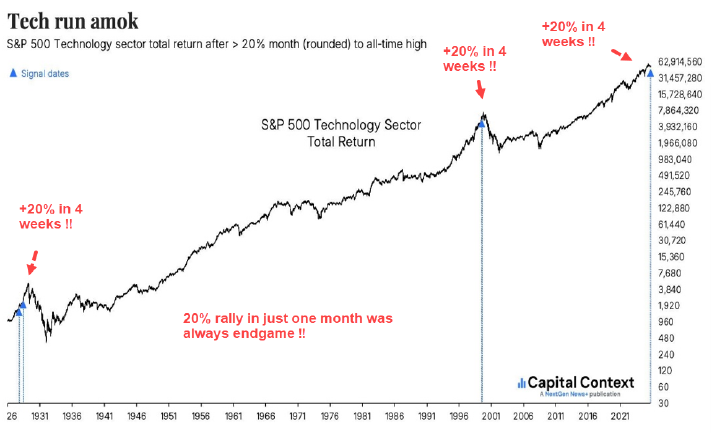
A 20% gain in the S&P 500 tech sector in four weeks has happened only three times in 100 years.
1929. 2000. 2026.
The first two times ended badly.
The third just happened.
The market is a great teacher. It just charges very high tuition for the same lesson.