Preprint alert🚨This one is special, as I am happy to share our latest work on the genetic history of my native Portugal!
Led by postdoc @XavierRocaRada, we use aDNA to uncover dynamic interactions between migrant and local communities across millennia!
https://t.co/alOPnbUOMI
I was hoping this would come out soon. Great work!
"We assembled 137 ancient genomes from the Neolithic to the Iron Age with an emphasis on the Bronze Age period".
Ancient DNA from Belarus shows first contact between Yamnaya and Corded Ware ca. 5075 BCE
https://t.co/KevmJ5dMc4
Found a shared genomic segment (IBD) of a modern genome with a Medieval individual? It does not imply an exceptional genealogical connection, really!
Read more in our short @ConversationUK piece (inspired and led by @ShaiCarmi) ⬇️
https://t.co/Q0bJjAB6PC
Breaking news 🎉🎉🎉A brief story on the the Archaeology of the Canary Islands and our project’s results!! 🏝️🏝️🌋🌋How did humans survive alone for 1000 years on desert islands off Africa? | Science | AAAS https://t.co/3TyCs7mI4e @ULPGC@DUlpgc@ulpgcresearch
Our latest paper now published @PNASNews!
High coverage genomes and stable isotope data of some of the last hunter-gatherers in western Europe revealed social dynamics that helped avoiding inbreeding as well as absence of farmer-related ancestry in HGs
https://t.co/3oru8VLbxp
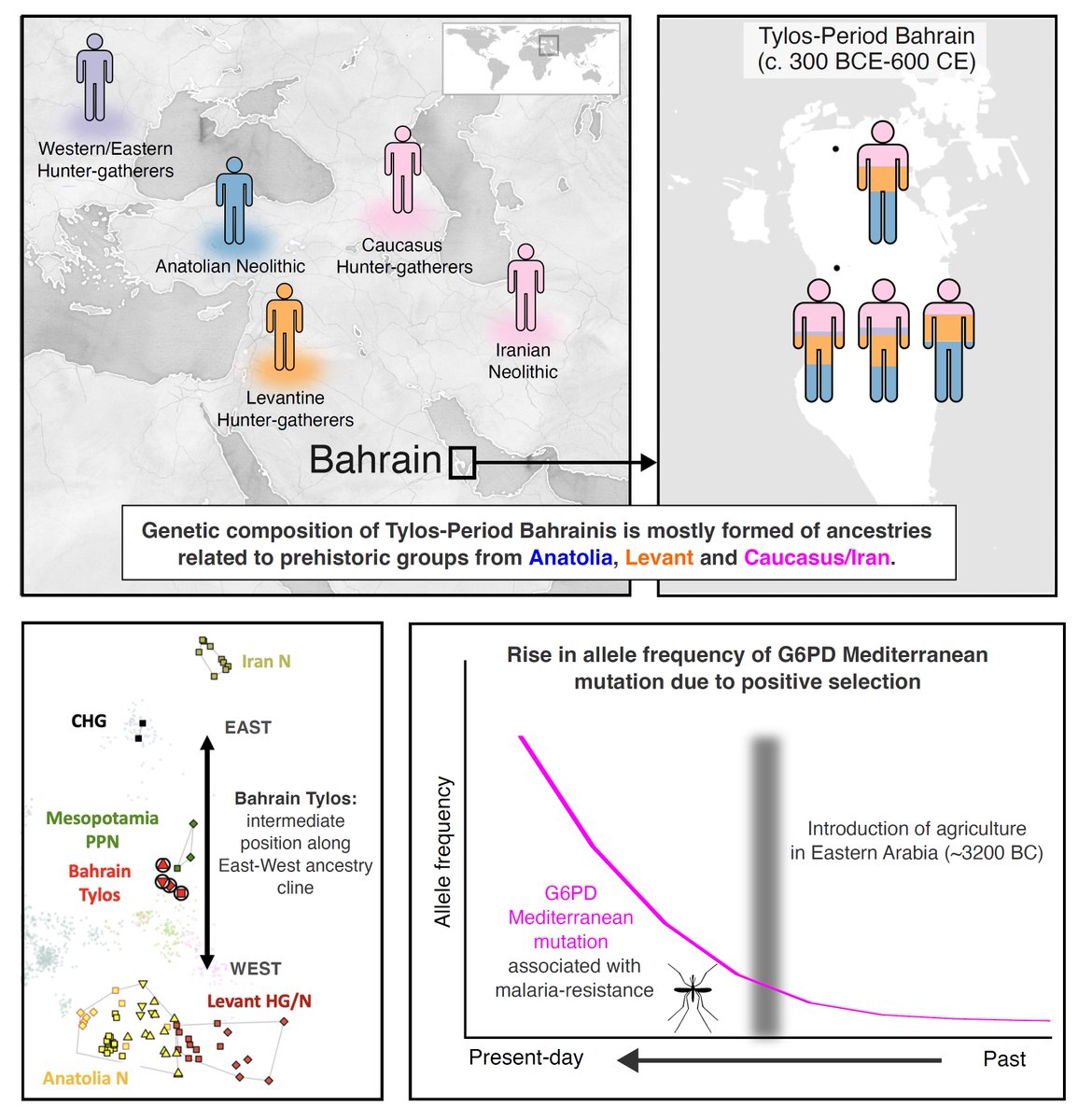
We publish today the first ancient whole-genome sequences from Arabia and show how they inform on ancestry and disease in the Middle East 🧬☠️ #aDNA#MiddleEast#Bahrain https://t.co/HjZQnMW1a1
El SEARQ está que arde! 🔥
En la segunda sesión de este año hablaremos sobre las últimas novedades sobre los estudios de ADN en Canarias 🧬🔬 con @jgserrb
Viernes 16 de febrero a las 5pm
Aula 22 del Edificio Millares Carló ‼️
🚨New paper alert! We report #ancientDNA data from 39 people who lived on island of #Soqotra 650-1750CE and provide new evidence that there was not complete population replacement between the Pleistocene and Holocene throughout the Arabian Peninsula (1/n).
https://t.co/3xnuuX34aO
We are excited to release READv2, a new version of the popular tool for detecting biol relatedness in aDNA data. @masterolojist made it faster and more precise than v1 while adding features for telling apart sibs and parent-offspring + 3rd degree
🧵(1/5)
https://t.co/dv6arxDwih
Our latest paper is out in @NAR_Open: Reconstructing DNA methylation maps of ancient populations. In the past, we devised methods to reconstruct premortem DNA methylation from ancient DNA, leveraging differential degradation patterns of methylated and unmethylated cytosines. 1/9
🚨🧬New paper tracing genetic changes across the rise/fall of the Roman Empire, showing the genetic impact of people w/Anatolian-, Cent/North European- & Steppe-, and Slavic-related ancestry. This is a seriously beautiful synthesis of arch + genetic data.
https://t.co/6vNkpsO1o8
Este año celebramos la XVII edición de las Jornadas de Genética ULL, el día 28 de diciembre. Podrás inscribirte a través del código QR del cartel o bien en la web de la ULL (eventos). Serán presenciales, Aula 1 de la Sección de Biología. Te esperamos! @ULL@CienciaULL@mnhdez
Happy to share our latest on @CurrentBiology@CellPressNews !
🧵Our study, coordinated by @CNRsocial_ and @SapienzaRoma, proposes a new scenario for the population history of the Fulani back to the last Green Sahara.
Free access article: https://t.co/ZjoU8vUaZ8
1/n
Mañana @JudithLopezLuis defenderá la tesis doctoral Ribosomal RNA methylation controls the cell cycle through protein synthesis dirigida por @Sblancolab
Course alert! @SkourEirini@AnthiTil and I are planning an aDNA course in Athens (May 2024) with a fantastic lineup of guest lecturers! Consider applying if you are not currently working with aDNA but wish to get acquainted with topics and methods in the field for future research
DENTRO HILO 🧵 | ¿Sabías que 3 impresionantes volcanes ‘flotan’ en medio del océano? Están en la Macaronesia (región de 5 archipiélagos en el Atlántico Norte a la que pertenece Canarias) y te van a dejar así: 😮. Mira sus siluetas 🌋⤵️. Dime que no es increíble cómo se parecen.