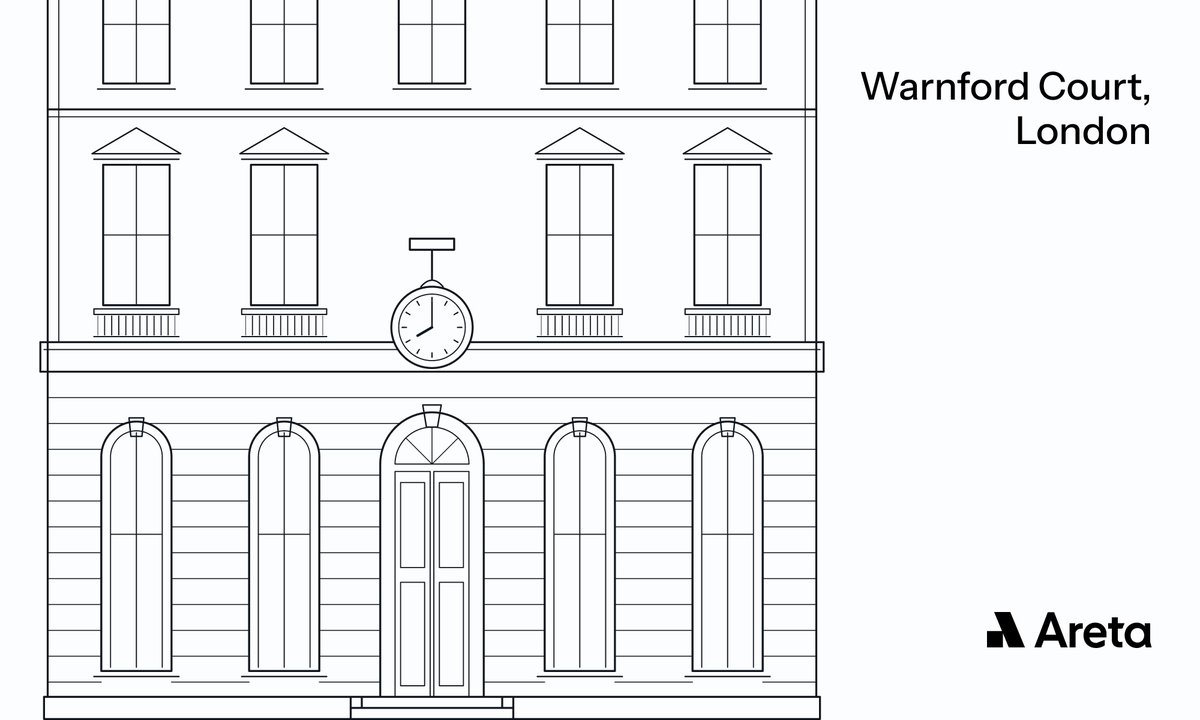
When you’re a founder building in emerging technology sectors, one of the biggest hurdles is finding advisors who understand every nuance of your business, and that’s why we started @areta_io.
At the time, most of those founders were building in digital assets. The space is now far more established, but technology doesn’t stand still, and neither do founders and investors.
The clients we work with today are building at the technological frontier, across AI, digital assets, trading and other new sectors, often right where they overlap.
That’s why at Areta we’re used to dealing with “firsts”:
- The 1st private equity buyout of a digital assets business
- The 1st large-scale prop trading firm acquisition
- The 1st acquisition of a retail blockchain security firm
To be honest, almost every situation we face feels a bit like a “first”.
That’s what we’re proud of: we don’t need a framework or structure in place; we often create them. The market we operate in keeps changing, but the job stays the same: to understand the business almost as well as its founder, often before anyone else does.
London is a home base for Areta. Over the next weeks, the city welcomes the digital asset industry for DAS London (@blockworksDAS) and Solana Breakpoint.
Our Co-Founder Jan-Philip (@jp_grabs), Vice President Harish, and Analysts Josh (@jh016crypto) and Owen (@OwenYan11) will be at both, meeting founders, investors, partners and friends.
If you’re attending and would like to connect, reach out.
The clock above our London office entrance has kept time for The Stock Exchange’s offices since 1892.
Today, Warnford Court is home to the Areta team, at the centre of the City’s financial district. The building’s purpose, in many ways, continues.
Industry update, the Binance security incident:
What happened?
Yesterday Binance, the world’s largest crypto exchange, suffered a security breach. More than $6B in digital assets was moved out of its operational wallets across several blockchains. By value, it is the largest incident of its kind on record.
Industry response
The industry reacted quickly. Within three hours, stablecoin issuers including Tether and Circle had frozen over $2.4B of the affected assets, and lending protocols paused markets to limit spillover. Binance has temporarily halted withdrawals, says client funds are safe, and has committed to covering all losses.
My view
So far the situation appears contained and well within Binance’s capacity to resolve. The speed and coordination of the industry’s response is a strong signal of how far market infrastructure has matured. The second- and third-order consequences remain yet to be seen over the coming weeks, but we are hopeful that the situation can be resolved swiftly. It is another test for our industry with the chance to come out even more battle-tested than ever before.
We wish the Binance team and everyone affected all the best as this gets resolved.
Areta is pleased to have advised Saber Money (@Sabermoney), a stablecoin payment infrastructure company for emerging markets, on securing strategic investment from Tether (@tether) and CMCC Global’s Titan Fund (@CMCC_Global) to scale stablecoin-powered payments.
Tokenized gold (PAXG and XAUt) tradable via Wintermute’s OTC desk
‣ Deep liquidity in leading gold-backed tokens, 24/7
‣ Trading via chat against any quote asset
‣ Gold price exposure while staying onchain
HyperCore will support outcome trading (HIP-4). Outcomes are fully collateralized contracts that settle within a fixed range. They are a general-purpose primitive that are useful for applications such as prediction markets and bounded options-like instruments. There has been extensive user demand in both of these areas, and builders will likely think of novel applications as well.
Outcomes bring non-linearity, dated contracts, and an alternative form of derivative trading that does not involve leverage or liquidations. The outcome primitive expands the expressivity of HyperCore, while composing with other primitives such as portfolio margin and the HyperEVM.
Outcomes are a work in progress and currently only being tested on testnet. Canonical markets based on objective settlement sources will be deployed once technical development is complete. Canonical markets will be denominated in USDH. Pending user feedback, the infrastructure will be extended to permissionless deployment.
We are working on znode v2.2.4, which will further harden our decentralized Monero bridge.
We are currently focusing on the following:
-Smart transaction routing between clusters
-Cluster ledgers
-Merkle root verifiable transaction history
-Continuous multisig state sync
And much more
$XMR is coming to $ETH 🌉
Calling current Hyperliquid users “exit liquidity” conflates the token with the infrastructure - which is wrong.
It is a perps platform - it functioned before any token and there’s no need to hold $HYPE to trade on it. Thus, trading is not investing in the token, it is infrastructure usage, so framing “users” as exit liquidity is incorrect - +rewards are a byproduct and should never be the end goal for any trader.
Meritocracy does not mean equal outcomes, it’s equal risk-weighted outcomes - since early users took on additional risk (protocol risk) they bagged higher rewards. It’s true of almost every system - the early users bear the highest risk and tend to be the most heavily rewarded. Less rewards in the future is not invalidation of meritocracy, it is diminishing marginal risk - hardened system already established.
Further, I believe you have misunderstood “credible neutrality”. It is not flat distribution forever - instead it is rules being known, non-discretionary, and applied consistently. The team at Hyperliquid never promised perpetual parity between users in S1 and S5 (an example); by same logic, BTC is unfair.