The threat of NATO’s break-up, easing sanctions on Russia, a massive energy crisis in Europe, halting aid for Ukraine and blocking the loan for Kyiv by Orbán - it all looks like Putin’s dream plan.
Crypto is an environmental disaster and a playground for scammers.
It enables criminals and helps dictators evade sanctions.
Its downsides far outweigh its benefits.
The politicians pushing it hardest are often pro‑Russian traitors.
If it crashes, good riddance
Donald Trump’s name appears more times in the Epstein files than the names “God,” “Jehovah,” “Lord,” “Jesus,” and “Christ” do in the entire Bible.
Combined.
The media is still missing the biggest story in the Epstein emails.
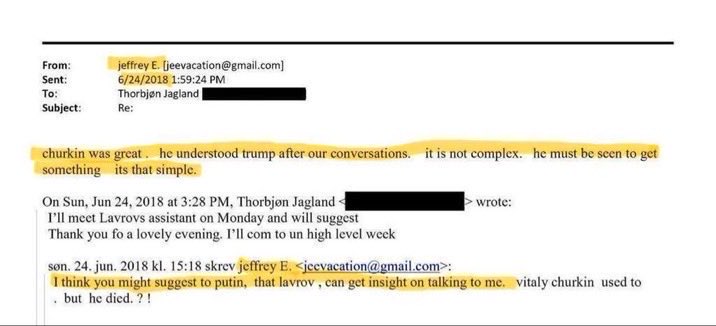
The emails show Epstein helped Russia blackmail Donald Trump. He was advising Putin's circle on how to control the US President.
Trump is compromised.
We need to make sure everyone sees this:
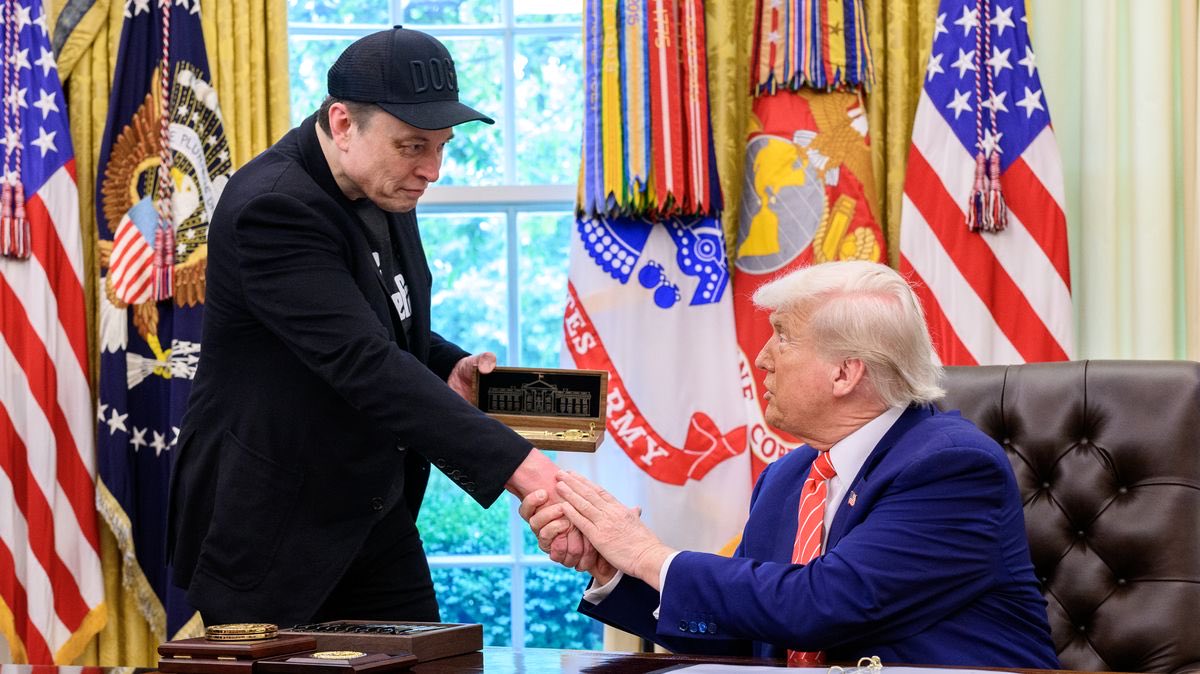
It’s deeply disturbing that those named in the Epstein Files, many of the world’s most powerful, including the US president and the richest person alive, still move freely in society and retain their positions of power.
What a horrible world we live in
The Moment America Touches Greenland
If the United States were to invade Greenland, we should be honest about what follows. This would not be a bargaining tactic, a property deal, or a limited show of force. It would be a geopolitical point of no return.
The moment American troops seize territory from Denmark—a fellow NATO member—the post-war Western order collapses. Not weakens. Ends.
NATO cannot survive an internal attack. Article 5 would be rendered meaningless the instant it is violated by the alliance’s most powerful member. Europe would not debate this for months; it would act. The alliance that anchored transatlantic security for 75 years would dissolve, and the United States would instantly transform from guarantor of European stability into its primary threat.
The military consequences would be immediate. U.S. forces would lose their political legitimacy on European soil. Bases across Germany, Italy, the UK, and beyond would face closure or expulsion. America’s ability to project power into Europe, Africa, and the Middle East would be crippled—not by enemy fire, but by loss of access. The U.S. would retreat behind oceans, not by choice, but by isolation.
The economic fallout would be even more severe. The European Union, the world’s largest single market, would respond decisively. Market access would vanish. Financial cooperation would freeze. Dollar reserves would be reduced, confidence shattered, and the U.S. economy—still dependent on global trust in the dollar—would absorb a shock unlike anything in modern history. Inflation, capital flight, and market collapse would follow.
American corporations would be collateral damage. Operations in Europe would be frozen, seized, or expelled. Trillions in valuation would disappear almost overnight. This would not be a recession; it would be forced de-globalization, cutting U.S. industry off from its wealthiest and most technologically advanced partners.
Airspace would close. U.S. airlines would be grounded across Europe. Boeing aircraft would be sidelined. Transatlantic movement—of people, goods, and supply chains—would fracture. The practical effects would hit ordinary Americans faster than any sanction regime ever has.
Diplomatically and culturally, the U.S. would become a pariah. Sporting bans, visa restrictions, and political isolation would follow—just as they have for other aggressor states. Americans abroad would lose protections they once took for granted. The passport that opened doors would instead trigger suspicion.
Most importantly, the trust would be gone permanently. You do not invade a democratic ally and reset the relationship later. Europe would not wait for the next election cycle. It would rebuild its defense, finance, and alliances explicitly without—and against—the United States.
The West would survive. But America would no longer lead it.
Invading Greenland would not demonstrate strength. It would announce the end of U.S. leadership, U.S. credibility, and U.S. centrality in the world order—traded away for a frozen territory and resources that offer no strategic return worth the cost.
It would not be conquest.
It would be national self-destruction.
A Secret Too Dangerous to Hide: Intelligence Must Expose the Trump–Russia Reality Before It Destroys Transatlantic Unity
European and American intelligence agencies can no longer turn away from the question casting a widening shadow over the West. What truly unfolds when the president of the United States enters Moscow’s orbit, and why does he answer a hostile power with a level of weakness and deference that defies every strategic instinct the West has relied on for decades?
If intelligence services already understand the forces shaping this behavior, then silence is no longer simply a failure. It becomes a direct risk to the stability of the free world. The time for withholding the truth is gone. It is about the survival of the alliance that has protected Europe and North America since the ashes of the Second World War.
A sitting president who repeatedly aligns himself with a regime at war with Europe, a regime dismantling the postwar order and stripping away the safeguards of democratic stability, represents a danger that transcends any partisan frame. The transatlantic alliance cannot navigate this darkness without knowing what lies at its center. The truth must be revealed before the consequences become irreversible.
We are confronting the most volatile threat to global security in generations. If the United States hesitates because its own president is compromised, pressured, or unwilling to stand against Moscow, then both America and Europe are left undefended at a moment of historic peril.
This is the final moment for truth. The intelligence community must disclose what it knows before silence becomes the fracture that shatters the alliance and opens the door to a world slipping deeper into authoritarian control.
🚨Important thread: The YouTube algorithm actually changed, for the worse. (+Data)
I’ve been thinking a lot about whether I should or shouldn’t address this publicly. I’ve already talked to some people within YouTube, but I don’t believe the word of a single person, meaning me, will be enough to encourage change. At least not quick change.
Before I begin, a direct note to all my friends at YouTube, I truly respect what you’ve been doing in the past year, and I know you’ll take this problem seriously, but I’m also aware that you’ll often have your hands tied and there isn’t much you can personally do. I won’t reveal any sensitive information that people can’t find out by themselves.
Let’s begin.
A few months ago, creators of all sizes started noticing a significant change in the overall performance of their channels. Usually this is related to the overall behavior of audiences, however, this one felt different. It wasn’t just one or two channels, it was every single channel I was working on (and more). These are channels that pull 100 million to 1 billion views per month at times.
At first, I was like: alright, let’s find out where we’re going wrong. Maybe we’re missing something. However, after weeks and months, no answers were found. This is very frustrating, not only for myself but also for the creators who are relying on these answers to maintain their channel, business and livelihood.
But that’s when we made a breakthrough, a way of looking at data that we had missed.
You see, this entire time we were analyzing the channel as a whole, new and old videos combined. However, we weren’t focused on isolating older content, specifically content with a publish date older than one month.
That’s where, for the first time, we noticed something unusual. We saw a complete crash in short form views on content older than one month. (see image)
What we found was that somewhere in the middle of September, YouTube had pushed a significant change in their short form algorithm which impacted nearly every short form creator across the platform. Why is this a problem? Because it affects every creator we all care about. It didn’t matter if you were a smaller creator or one of the top ten creators, we haven’t found many people who were spared. I’ll leave a brief explanation at the bottom so you can check your own channel.
And these weren’t just entertainment or educational creators, it was both.
What we found is that YouTube seems to have implemented a change that strongly prioritizes content uploaded in the last month, roughly 28 to 30 days, we’re still unsure.
But what impact does this have, and why do I believe this is something that should be brought to light?
The first impact is that we’re seeing a shift away from quality to quantity. Often, creators live off the revenue generated, not just Adsense, from these bigger content pieces. A strong portion of this revenue comes from their back catalog, meaning older content. With this change, you’re increasing the importance of high volume uploads in the first 30 days.
What do I believe is happening, and why is this change going through?
I believe there are two reasons why YouTube is pushing this change.
First, to hit certain targets with Shorts. Plain simple, I don’t believe this is a “what’s best for the creator” type of play, it feels more like a “we want to compete with TikTok” type of play. Not unreasonable, even if the creator gets hurt by it short term. I’m just trying to think from a corporate point of view.
The second reason, which I believe to be the actual leading reason, is a push for recency, freshness or novelty, whichever term they would choose to use. But if this is the reason, there’s a massive overcorrection happening. Some content needs that freshness: news, streaming highlights, medical information. However, this isn’t true for all types of content. Some content from years ago is just as good today.
We have noticed that certain top content pieces, individual videos, still get a significant amount of views, so it looks more like prioritization than anything else.
Regardless, while in private I find it fun to refer to this situation as “the flattening”, in reality this is a very concerning moment where simple ideas turn into a massive hit toward the creator economy. And this is just the tip of the iceberg of changes that have been affecting people.
It’s important that changes on the platform aren’t just focused on the consumer, but the preservation of a healthy creator economy that allows creators to grow their business, teams, and create better content. Without a focus on both the creator and the consumer, you’ll quickly run into an issue of low quality slop that makes people want to go elsewhere.
If there’s any call to action here for you, whether you’re a creator or a viewer, I strongly encourage you to leave your thoughts here to encourage YouTube to rethink this decision, or at least optimize it so that it’s also regarding the importance of keeping a healthy creator economy. Share your thoughts, and even data from your own channel, because this will be seen by people who have the power to make change.
Disclaimer: I’ve left out some sensitive information. However, if you want to check this for yourself, go to Analytics, click on Advanced Mode, filter by Content Type (Shorts), filter by Publish Date (for example any short published from Jan 2025 to Jun 2025), set the data to Last 365 Days and take a look at the change happening around September. I think you can imagine why it took so long for us to find out where the issue began.
Thanks for reading this post.
@MarioJoos As a content consumer I noticed the same change: it felt like the algorithm wasn’t recommending any new-for-me content to watch (regardless whether the new-for-me content was actually new or older)… it was just offering the very same uninteresting videos to watch from day to day
Kaikille teille, jotka ulisette siitä, että kelalaiset ulisevat lähityön lisääntymisestä 4 pv/kk, lopettakaa yhteiskunnalle tärkeiden ja kunnollisten työntekijöiden demonisointi ja käykää lukemassa faktat täältä
https://t.co/kZ9pOffULa
This is the #1 climatologist in the world: James Hansen.
He’s spent 50 years studying what humans are doing to the climate.
He's gone out on a limb time and time again - and been proven right.
His message? It’s far worse than they’re telling you. 🧵
This is phenomenal. Whoever convinced the board “No seriously, this is how you play it” is an all star
I want to know:
-Who was the agency that pitched it?
-Was the board all in or did it take work?
-Did they already have Coldplay Ex-wife Paltrow onboard when they pitched?
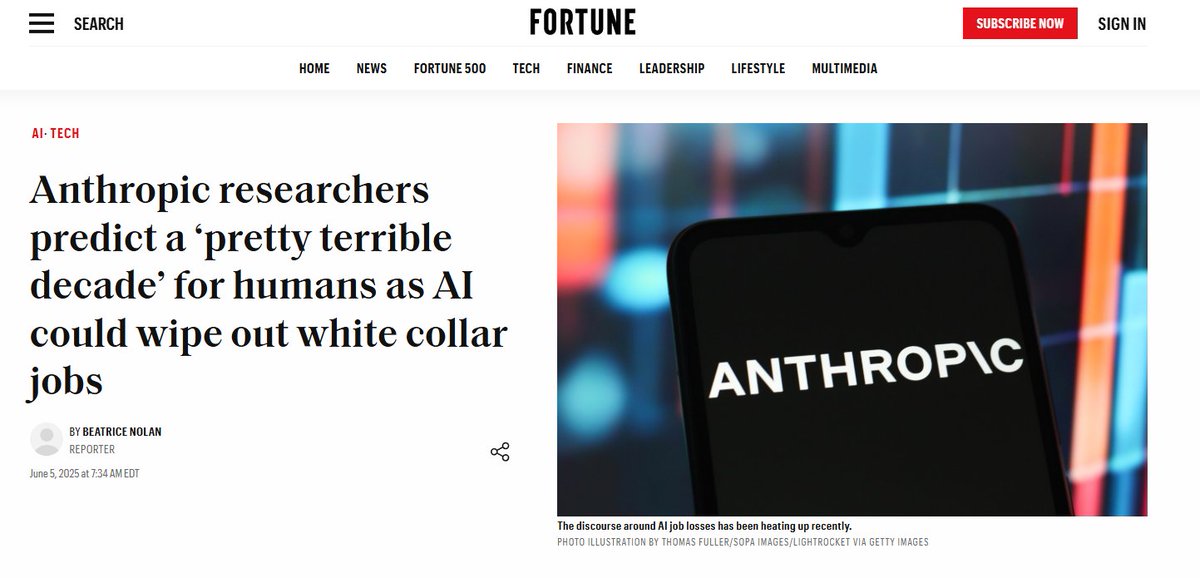
Dario Amodei never tires of outlining the serious impact on AI. Many now see him as an AI doomer, but he is simply trying to warn us about what is coming.
Why is this so important? Let me explain:
I studied the entire video (50 minutes) of the #Trump and #Zelensky meeting to determine when things started going off the rails.
For those who don't have time to watch the entire meeting (the CSPAN YouTube link is at the end of this post), here is what happened.
Zelensky quietly sat and listened as Trump made numerous wild claims and false statements, such as the war wouldn't have started if he was president (and that October 7 wouldn't have either), that Europe has spent much less money to help Ukraine than the US has (fact check - by the end of 2024 the US had spent around $120 billion and Europe had spent around $139 billion), that WWIII would happen if it weren't for Trump, comparing himself to George Washington and Abraham Lincoln, and repeatedly calling rare earth minerals "raw earth" for some reason.
Trump also said that security for #Ukraine would only be discussed after the deal was done, and then a journalist asked Zelensky a stupid question about why he wasn't wearing a suit and if he owned one.
The meeting started to fall apart at 23:20 in the video, when Zelensky answered a question about a ceasefire, saying it would never work without security guarantees. He explained that #Putin had broken 25 signed agreements with Ukraine since the war began in 2014.
At 23:50, Trump interrupts and says that Putin never broke an agreement while Trump was president. Zelensky corrects him, saying that broken agreements happened during Trump's first term.
Trump's facial expression changes. Trump is visibly angry that anyone corrected one of his many untruths. His demeanor for the rest of the meeting changed after that.
Trump continued to lie about the US spending far more on Ukraine than Europe, insulted Biden repeatedly, and bizarrely claimed he had stopped many wars including ones that people never heard about, and wars he stopped before the wars started.
At 33:00, Trump said that many Ukrainian cities were destroyed without a building left standing (as if people weren't in cities anymore.) Zelensky corrects him, saying that Trump needs to come see Ukraine for himself because there is still life in Ukraine, that people are working and children are going to school, despite the difficult conditions. Zelensky explains that Ukraine is fighting but is also living, and that Putin hasn't destroyed Ukraine. Trump stares at the floor as Zelensky speaks.
A journalist asks Trump what will prevent #Russia from invading after a ceasefire, and he says the agreement will stop Putin, and then tries to divert the conversation by talking about CNN having low ratings.
At 40:30, after #JDVance has just finished attacking Biden's Ukraine policy, Zelensky asks if he can say something, and then talks about Putin not being stopped since 2014. Trump interrupts and says 2015, and then Zelensky and JD Vance correct Trump.
Zelensky explains why diplomacy doesn't work with Putin. Vance gets angry at 42:10 and says that Zelensky is being disrespectful, and then questions Zelensky on conscription in Ukraine. Zelensky asks JD Vance to come to Ukraine once and see for himself what is happening in Ukraine.
JD Vance then tries to quickly pivot away from his lack of experience in Ukraine by accusing Zelensky of attacking the administration.
Zelensky says that America is secure because of the ocean separating it from Europe, but that someday in the future America will feel the influence of the Russia problem.
Trump, emboldened by JD Vance having just attacked Zelensky, talks over Zelensky, telling Zelensky not to tell them how to feel, and that Zelensky is in no position to dictate how they're going to feel.
Trump starts yelling at Zelensky. Zelenksy stays calm. Trump keeps talking above him and not letting him speak, telling him that he doesn't have the cards. Zelenksy says I'm not playing cards, I'm very serious. I'm the President in a war.
Trump accuses Zelensky of gambling with WWIII and says that what Zelensky is doing is very disrespectful to America. JD Vance asks Zelensky if he has said "thank you" once in the entire meeting (fact check - Zelensky had said thank you earlier in the meeting, and many times over the past three years).
Zelensky asks JD Vance if he thinks that speaking loudly about the war... Trump interrupts him, saying that JD Vance isn't speaking loudly. Zelensky asks if he can answer, and Trump tells him no and that he's done a lot of talking.
Trump falsely claims that $350 billion was given by America to Ukraine (fact check - around $120 billion has been spent on support for Ukraine). Trump starts yelling about how much Ukraine owes America. JD Vance tells Zelensky to just say thank you, and that he's wrong. Trump tells Zelensky that he needs to be thankful.
Trump complains about Zelensky not wanting a ceasefire. Zelensky says he wants a ceasefire, but with security guarantees.
Trump attacks Biden, and then Obama. He tells Zelensky that he needs to be more thankful, and that he doesn't have the cards, with America he has the cards, but without America he doesn't have any cards.
A journalist asks what will keep Putin from breaking any agreement. Trump says Russia broke agreements with Obama and Biden (he later added Bush to the list) because Russia didn't respect them, but that they respect Trump.
Then it gets crazy.
Trump then bizarrely rants about the Russia election interference investigation, saying that he and Putin went through it together, and throwing Hillary Clinton, Joe Biden, Adam Schiff, and Hunter Biden (and Hunter Biden's laptop, bathroom, and bedroom) into it. Trump professes Putin's innocence and feels sympathy for Putin having been accused of election interference.
Trump tells Zelensky that he's empowered Zelensky to be a tough guy and that he doesn't think he'd be a tough guy without the United States. Trump says that Ukraine will make a deal with the US or the US is out, in which case the war will continue to be fought.
Trump again accuses Zelensky of not being thankful, and then says this will be great television.
#StandWithUkraine #UkraineWillWin #Zelenskyy
https://t.co/fIooakSx3d