Dear @DukesMayonnaise
Your classic Real Mayonnaise lists soybean oil as the very first ingredient. While I understand it’s been part of the formula for a long time, a growing number of health-conscious consumers are actively avoiding highly processed seed oils (soybean, canola, sunflower, etc.) due to concerns about their high omega-6 content, processing methods and potential inflammatory effects.
Not including sugar in your recipe is great but including seed oils is still a deal-breaker.
Many of us have switched to mayonnaise made with avocado oil, olive oil or other more traditional fats and if you wish appeal to us, you should develop a product that is seed oil free.
There is so much untapped potential in the seed oil free market and many of us look forward to you putting your hat in the ring.
🤯 They told us high cholesterol is a death sentence. The medical machine keeps lowering the numbers and handing out statins like candy…
But a massive Swedish study tracking over 800,000 people for 35 years just dropped this bomb: Every single centenarian had HIGH total cholesterol. The higher the LDL… the longer they lived.
This video breaks it down even harder: High cholesterol isn’t the villain — it’s actually critical for:
• Glucose control
• Mitochondrial energy
• Libido
• Strong immunity
• And yes… longer life Lowering it?
No surprise you feel worse. There’s literally a war on cholesterol happening right now. The “normal” range keeps getting pushed lower… while a $22B+ statin industry keeps growing.
Maybe the problem was never the cholesterol. Maybe it was the war against it.
I do not care what you call it.
Keto. Carnivore. Paleo. Ancestral. Mediterranean. Low-carb. Animal-based. Whole food.
The food wars on this platform are exhausting. Everyone fighting over a label while missing the point entirely.
Your great-grandmother did not follow a diet. She did not count macros. She did not read a nutrition label. She did not subscribe to a food tribe.
She ate meat. She ate eggs. She ate fish. She ate vegetables that grew in soil. She cooked with butter and lard and tallow. She ate whole-fat dairy. She ate fruit when it was in season. She ate nuts and seeds.
She did not eat bread from a factory. She did not eat pasta made from refined wheat. She did not eat sugar from a bag. She did not cook with canola oil extracted using a petroleum solvent. She did not eat protein bars with 47 ingredients. She did not drink soda.
There was no obesity epidemic. There was no type 2 diabetes epidemic. There was no Alzheimer’s epidemic.
The base of your plate should be protein. Beef. Poultry. Eggs. Fish. Shellfish. Whole-fat dairy. Cheese. Plain yogurt. Olive oil. Butter. Cream. Lard. Tallow.
The middle should be vegetables. Green leafy. Non-starchy. Lemons. Limes. Avocados. Olives.
The top, if anything, should be low-sugar fruits. Berries. Nuts. Seeds. Small amounts of starchy vegetables.
What does not belong anywhere on the plate: bread, pasta, corn, sugar, rice in excess, high-sugar fruits in excess, beans in excess, and anything that comes in a box with a barcode.
This is not a diet. This is the way humans ate for hundreds of thousands of years before the food industry arrived and convinced us we needed their products to survive.
Stop arguing about labels. Start eating real food. The science does not care what you call it. Your body knows the difference.
🚨 My dad was diagnosed with Stage 4 Prostate Cancer out of nowhere.
Just a few months ago, he was completely fine. His physical 5 months earlier showed normal labs. Then suddenly he started feeling achy and exhausted.
They ran bloodwork and his PSA came back at 141. It had been 3.4 just months earlier.
Scans showed Gleason 9 Prostate Cancer with widespread bone metastases. Stage 4.
We didn’t waste time. Along with the hormone blockers and chemo, his oncologist started adding:
- Ivermectin 24 mg/day
- Fenbendazole 222mg / day
Three months later, his PSA dropped from 141 to 0.25.
That’s a 99.8% drop.
He’s feeling much better, has more energy, and the numbers are moving in the right direction fast. His oncologist is very happy with how he’s responding.
We’re still waiting on the next set of scans, but right now, we’re extremely grateful for how well things are going.
This isn’t medical advice, just sharing what happened with my dad. If you or someone you love is going through something similar, I hope this gives you a little hope.
IVERMECTIN: FULL DOSAGE SCHEDULE FOR CANCER & PREVENTION
1000s of people use Dr. William Makis MD’s IVERMECTIN dosing chart. Here’s a clear, categorized breakdown based on body weight (mg/kg per day).
LOW DOSE: ≤ 0.5 mg/kg/day
**Best for:**
- Cancers in remission
- Strong family history or genetic predisposition
- Prophylaxis (preventive)
**Side effects:** No long-term side effects reported.
**Example:** Dr. Tess Lawrie reported a Stage 3 ovarian cancer case treated with chemo + 12 mg ivermectin daily. Tumor marker CA125 dropped from 288 to 22 after 2 months and the tumor vanished.
MEDIUM DOSE: 1.0 mg/kg/day
**Best for:** Starting dose for **most cancers** (lung, pancreatic, renal cell, gastric, etc.).
**Side effects:** No long-term side effects reported.
**Example:** Dr. Shankara Chetty’s 70-year-old prostate cancer patient (PSA 89) took 45 mg/day (plus lactoferrin). After two months PSA fell to 10.9.
HIGH DOSE: 2.0 mg/kg/day
**Best for:** Very aggressive cancers (leukemia, pancreatic, brain cancers).
**Side effects:** No long-term side effects reported.
**Example:** Dr. Allan Landrito’s Stage 4 gallbladder cancer patient took 2 mg/kg daily for 14 months — cancer disappeared.
VERY HIGH DOSE: ≥ 2.5 mg/kg/day
**Best for:** Extensive metastatic disease, extremely poor prognosis, or certain brain cancers.
**Side effects:** Possible short-term & transient visual effects (usually resolve in a few days).
**Example:** Dr. Shankara Chetty treated a patient with 2.5 mg/kg/day — no side effects reported.
**Quick conversion example (for a 60 kg / 132 lb person):**
- Low: ≤30 mg/day
- Medium: 60 mg/day (≈5×12 mg tablets or 1 teaspoon liquid)
- High: 120 mg/day
- Very High: ≥150 mg/day
Many anecdotal reports exist of long-term daily use (months to over a year) with no serious toxicity, but individual responses vary.
Always work with a knowledgeable clinician, especially if you have pre-existing conditions (e.g., vision issues or glaucoma). This is for educational purposes only.
Share to spread awareness — information is power.
"STATINS are one of the most DANGEROUS drugs."
Dr. Cate Shanahan, MD
"You have to know MORE than your Doctor because Doctors are MISEDUCATED."
"The greatest myth is that there is a relationship between high cholesterol & heart disease--it does not exist."
"There is absolutely NO evidence that shows dietary cholesterol causes cardiovascular disease."
Saturated fats & cholesterol have NO effect on CVD outcomes, including Heart Attacks, Strokes, CVD mortality & total mortality.
There are no benefits to taking a Statin, yes they lower your cholesterol, but they do not lower Cardiovascular Risk or Disease. Statins are dangerous because low cholesterol causes deadly side effects:
💊Statins cause CoQ10 deficiency, resulting in muscle pain & Mitochondrial Dysfunction.
💊Statins inhibit Heme A, a vital component of the electron transport chain for energy.
💊Statins stop Dolichol, a crucial molecule in protein glycosylation in the brain, deficiency leads to Parkinson's & other brain disorders.
💊Statins cause liver & pancreas damage, leading to insulin resistance & type 2 diabetes.
💊Every Statin crosses the blood brain barrier & shuts off the enzyme of cholesterol production leading to Dementia & Alzheimer's.
💊Cholesterol should not be lowered, it's critical for Vitamin D & all hormones, digestion, every cell should be saturated with healthy cholesterol.
Chronic Conditions Caused By Cholesterol Lowering Statins:
Muscle Pain
Muscle Tearing
Weakness
Neuropathy
Heart Failure
Dizziness/Vertigo
Cognitive Impairment
Dementia
Alzheimer's Disease
Cancer
Pancreatitis
Liver Damage
Diabetes
Depression
Parkinson's Disease
ALS (Lou Gehrig's Disease)
Hormonal Deficiency
Brain Damage
Multiple Sclerosis
A low carbohydrate diet prioritizing nutrient dense animal foods, eliminating harmful seed oils, sugar & processed foods provides the best healthy cholesterol profile.
This approach keeps Triglycerides low & HDL high, which is one of the best biomarkers for Cardiac health. TG/HDL ratio optimally should be less than 1.5
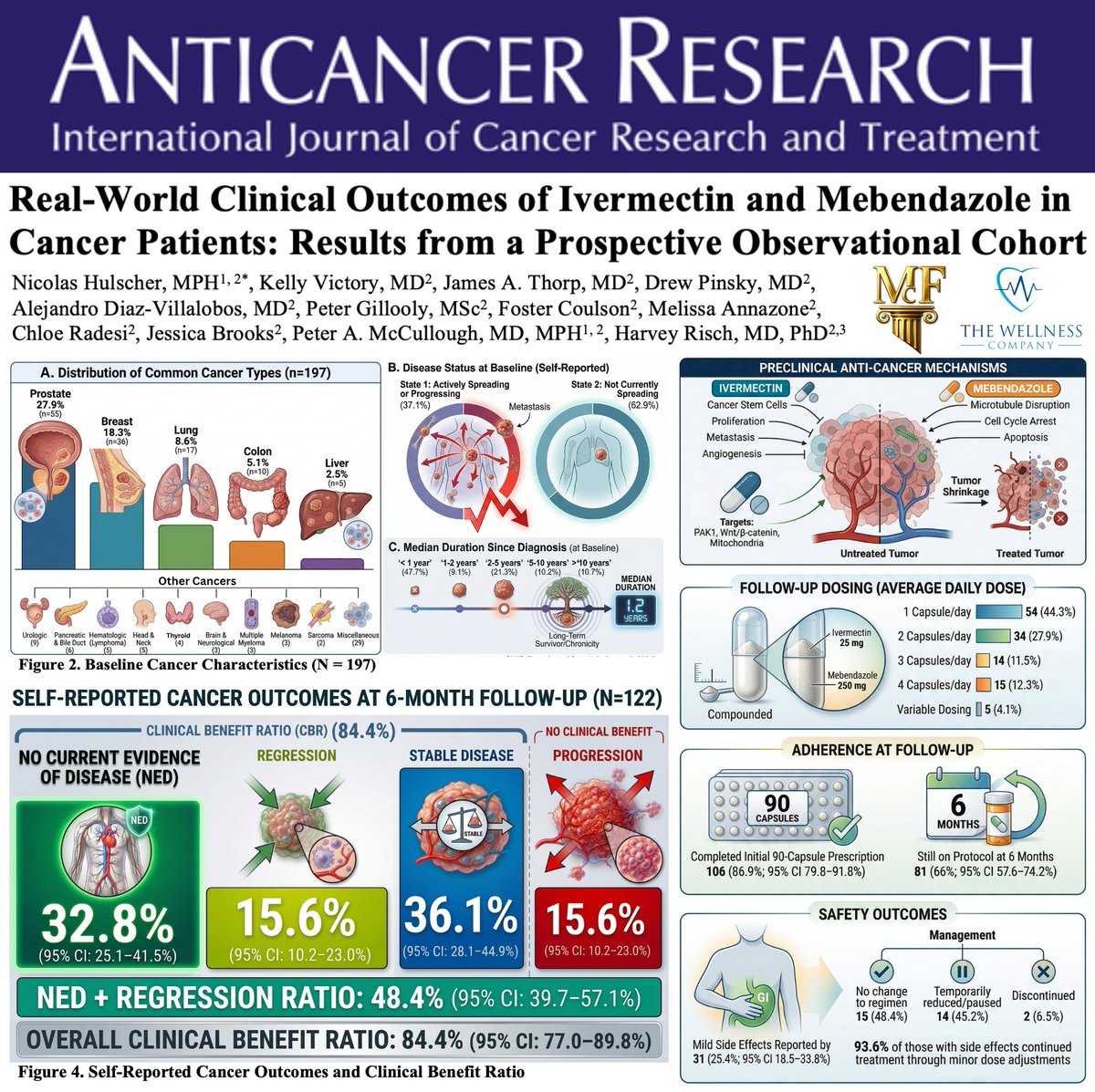
BREAKING: Largest Human Cancer Study of Ivermectin + Mebendazole Is Now PEER-REVIEWED and PUBLISHED in a MAJOR Cancer Journal
84.4% of cancer patients taking ivermectin + mebendazole for 6 months declared either CANCER DISAPPEARANCE, TUMOR REGRESSION, or CANCER STABILIZATION.
Our study, “Real-world Clinical Outcomes of Ivermectin and Mebendazole in Cancer Patients: Results from a Prospective Observational Cohort,” is now peer-reviewed and published in Anticancer Research—a major international oncology journal of the International Institute of Anticancer Research (IIAR), established in 1995.
The results represent one of the most compelling clinical signals ever documented for repurposed anti-parasitic therapies in oncology.
A diverse population of cancer patients (n=197) was prescribed compounded ivermectin–mebendazole through a U.S. telemedicine platform, with each capsule containing 25 mg ivermectin and 250 mg mebendazole.
Participants were followed for approximately six months using standardized digital surveys assessing cancer outcomes, medication adherence, and tolerability.
At approximately six months post-treatment initiation, we observed an 84.4% Clinical Benefit Ratio (CBR)—meaning more than four out of five patients reported either:
No evidence of disease (32.8%)
Tumor regression (15.6%)
or Cancer stabilization (36.1%)
Importantly, adherence was remarkably high, with 86.9% completing the initial prescription and 66.4% remaining on therapy at six months.
Side effects were predominantly mild and manageable, reported in 25.4% of patients (primarily gastrointestinal), with 93.6% of those experiencing side effects continuing treatment after minor dosing adjustments.
This groundbreaking peer-reviewed publication was made possible through a unique collaboration between The Wellness Company, the McCullough Foundation, and the Chairman of the President’s Cancer Panel—uniting real-world clinical data, frontline medical experience, and epidemiologic expertise to evaluate inexpensive, repurposed therapies with major translational potential.
With these extraordinarily promising results, double-blind, placebo-controlled clinical trials are now required.
In the meantime, many cancer patients are exercising their right to try.
@twc_health@McCulloughFund@IIAR_Journals@P_McCulloughMD@DrHarveyRisch@DrKellyVictory@jathorpmfm@drdrew@PeterGillooly@FosterCoulson
instead of watching 2 hours of Netflix tonight, watch this Stanford lecture
it's the clearest explanation I've seen of how ChatGPT and Claude actually work
useful whether you've never touched AI in your life or have been using it every day for the past year
I took the key ideas and turned them into a practical guide on how to actually get 100% out of Claude
find it below
When we first started our band, the way we learned to sing harmonies together was singing old gospel songs. Here’s “Just A Little Talk With Jesus” as we heard it done by Bill Monroe and The Blue Grass Boys.
There’s a reason this hymn stills the room. Its power lies in the fact that it wasn’t born of comfort, but of unimaginable grief.
In 1873, after losing his young son and his fortune, Horatio Spafford sent his wife and four daughters ahead to Europe. Their ship sank, and only his wife survived.
As Horatio later sailed to reach her, the captain paused the vessel over the spot where his daughters were lost. It was there, amid the waves of his own heartbreak, that he penned the words: “It is well with my soul.”
This timeless declaration of faith is brought to life here by the Zero 8 Chorus. It reminds us that peace isn’t the absence of pain, but a strength that carries us through it.
This interview with Ben Sasse is outstanding. Scott Pelley asks him about reformed theology and the belief that God ordains everything.
Sasse responds: “I hate cancer. But I'm also grateful for it, I tell a lot more truth to myself than I used to do it when I thought I was super omni-competent and interesting.”
Imagine the head of the "faith office" being someone with doctorates in theology and philosophy, conversant in ancient languages, and skilled in debate. Would never happen.
Since everything is stupid these days, we get this (calling her an embarrassment is much too flattering)
💰 This guy says you should start taking Social Security at age 62.
He walks through the real math on claiming at 62 vs 67 vs 70 using a clear example: roughly $18k/year at 62, $24k at full retirement age (67), or $36k at 70. He shows the break-even points and reminds us that the average life expectancy here in the US is 79 years old.
It’s not just about getting the bigger monthly check — it depends on your health, how long you live, and your personal situation.
It’s such a practical reminder that these big decisions need to be run with your own numbers, not just generic advice. It’s also wise to run this past a financial adviser.
Would you claim Social Security early (at 62), at full retirement age, or wait until 70? What’s your reasoning?
When the time comes, I’ll be collecting it at 62.