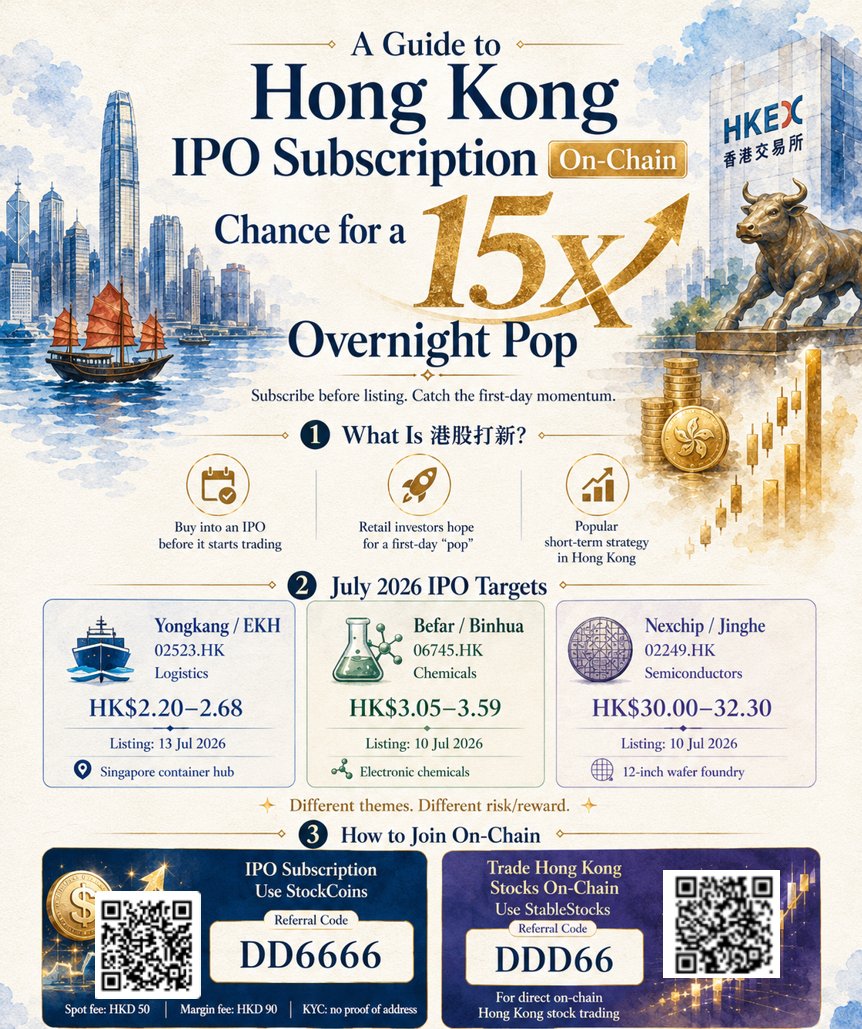
< A guide Hong Kong IPO Subscription (港股打新) On-Chain >
The way that you can get 15x overnight
1. What is Hong Kong IPO Subscription (港股打新)?
港股打新 (Hong Kong IPO Subscription) refers to the process where retail (individual) investors apply to buy shares of a private company right before it officially lists and begins trading on the Hong Kong Stock Exchange (HKEX). This event is called an Initial Public Offering (IPO).
It is a highly popular short-term trading strategy because investors hope the stock price will experience a "pop" (a sudden surge in price) on its very first day of public trading due to hype and demand.
2. Current Hong Kong IPO Subscription Targets
As of early July 2026, several Hong Kong IPOs are open for subscription, but the three names worth focusing on here are EKH / Yongkang Holdings, Befar Group, and Nexchip Semiconductor. These three represent different themes: logistics, chemicals, and semiconductors.
EKH Limited / Yongkang Holdings — https://t.co/gyM429R6Zj
EKH, also known by its Chinese name Yongkang Holdings, is a Singapore-based container depot and logistics operator. Its business includes container storage, handling, repair and maintenance, inspection, transportation, warehousing, container freight station services, and freight forwarding.
The company positions itself as the largest container depot operator in Singapore and the second largest in Southeast Asia by 2025 container throughput. This gives it exposure to Singapore’s role as a global shipping and transshipment hub. Its IPO price range is HK$2.20 to HK$2.68 per share, with 2,000 shares per board lot. The Hong Kong public offering runs from 30 June to 8 July 2026, and listing is expected on 13 July 2026 under stock code 02523.
The investment logic is relatively defensive. Logistics and container depot services are less “hot” than AI or semiconductors, but they benefit from recurring demand from shipping lines and container leasing companies. The main risks are competition, shipping-cycle volatility, and limited post-listing liquidity due to its smaller scale.
Befar Group / Binhua Group — https://t.co/UnHW8RNYF9
Befar Group, also known as Binhua Group, is a Chinese integrated chemical company founded in 1968. Its core businesses include chlor-alkali chemicals, C3/C4 chemicals, and wet electronic chemicals. Key products include sodium hydroxide, propylene oxide, MTBE, electronic-grade hydrofluoric acid, trichloroethylene, perchloroethylene, and allyl chloride.
According to available IPO information, the company is China’s largest producer of trichloroethylene, perchloroethylene, and allyl chloride by 2025 revenue, and one of the leading producers of propylene oxide and MTBE. This makes it a traditional chemical company with some exposure to higher-value electronic chemicals used in semiconductor and microelectronics manufacturing.
Its IPO price range is HK$3.05 to HK$3.59 per share, with 1,000 shares per board lot. The minimum entry amount is around HK$3,626.21. The subscription period runs from 30 June to 7 July 2026, and listing is expected on 10 July 2026 under stock code 06745. The company plans to offer about 352 million H shares, with around 10% allocated to the Hong Kong public offering and 90% to the international offering.
The investment logic is based on established market position, vertical integration, and exposure to electronic chemicals. The main risks are chemical-cycle volatility, environmental regulation, raw material and energy cost fluctuations, and the fact that this is a secondary listing of an existing A-share company.
Nexchip Semiconductor / Jinghe Integrated Circuit — https://t.co/aiIVBEnyxN
Nexchip Semiconductor, also known as Jinghe Integrated Circuit, is a leading Chinese 12-inch wafer foundry. It provides contract manufacturing services across mature and mid-range process nodes, including technologies from 150nm down to 40nm, and has also developed a 28nm logic platform.
The company benefits from China’s semiconductor localization trend, especially in mature-node chips used in display drivers, power management, automotive electronics, consumer electronics, AI-related hardware, IoT, and industrial control. It is already listed on the Shanghai STAR Market, so the Hong Kong IPO is an H-share secondary listing.
Nexchip is offering around 216.2 million shares, with the maximum offer price at HK$32.30 per share. Trading of its H shares is expected to begin on 10 July 2026. Reuters reported that the company aims to raise up to about HK$6.98 billion, and around 53.6% of the proceeds are expected to be used for R&D and optimization of its 22nm technology platform.
The investment thesis is stronger in terms of market theme because semiconductors remain one of the hottest sectors in Hong Kong IPOs. However, the risks are also higher. Nexchip faces competition from SMIC, Hua Hong, and global foundries, while semiconductor companies usually require heavy capital expenditure. Geopolitical restrictions and industry cyclicality are also important risks to consider.
3. How Can I Join Hong Kong IPOs or Trade Hong Kong Stocks On-Chain?
If you want to participate in Hong Kong pre-IPO or IPO subscriptions, you can use @stockcoinai
Register through this link:
https://t.co/ZIBqTOL8BH
Or enter the referral code manually:
DD6666
Current fee structure:
Spot subscription fee: HKD 50
Margin financing fee: HKD 90
KYC is simple and does not require proof of address.
If you want to trade Hong Kong stocks on-chain, you can use @StableStock .
Register through this link:
https://t.co/HTCzFnoMGv
Or enter the referral code manually:
DDD66
StockCoins is more suitable for users who want to participate in Hong Kong IPO subscriptions, while StableStocks is more suitable for users who want to trade Hong Kong stocks directly on-chain.
True T+0 settlement stock market WITHOUT KYC and conversion taxes
The traditional stock market is fundamentally broken when it comes to speed.
We live in an era of instant global communication, yet when you buy a stock through a standard broker, you are forced into a multi-day waiting game.
US markets run on a T+1 settlement cycle
Hong Kong operates on T+2.
You are essentially waiting for legacy clearinghouses like the DTCC or CCASS to manually reconcile ledgers. If you want to move capital across borders to catch a market trend in Japan or Korea, you are penalized with heavy foreign exchange spreads, wire fees, and days of locked capital. The friction is exhausting, which is why I completely stopped using traditional brokers and moved my equity trading on-chain with StableStock.
The experience is a massive paradigm shift. Instead of dealing with fiat deposits and bank delays, I simply fund my account using stablecoins like USDT, USDC, or even World Liberty’s $USD1 .
With one unified currency,
I can instantly allocate capital across global equities without worrying about currency conversion taxes
StableStock uses smart contracts to enable atomic settlement, meaning the moment my order executes, my stablecoins are deducted and the tokenized stock arrives in my wallet instantly.
true T+0 settlement WITHOUT KYC
true T+0 settlement
true T+0 settlement
There is no waiting for a clearinghouse to catch up; the trade and the settlement are the exact same event.
What makes this system work is that it remains backed by physical reality. Through their licensed broker partners, every tokenized share you buy corresponds to a real equity asset held in custody. You are just trading a highly efficient, blockchain-based representation of that asset. The platform charges a transparent settlement fee that simply mirrors the actual underlying costs, stripping away the hidden markups traditional platforms use to pad their margins.
Because these assets live on-chain, the utility expands far beyond a regular brokerage account. Certain tokenized assets allow for 24/7 trading, completely ignoring traditional market hours.
Kimi K3 launched just as U.S. chip stocks started selling off, so a lot of people immediately thought: here we go again. Is this another Chinese AI model shaking Wall Street?
Honestly, that was my first reaction too.
The timing looked especially strange because TSMC had just reported a record quarter. Its profit jumped 77% year over year, yet its U.S.-listed shares still fell 2.3%. Other chip and storage stocks dropped even harder.
Good earnings, falling stock prices. That tells me the problem is bigger than Kimi.
Kimi may have been the trigger, but AI expectations were already extremely high. Over the past two years, the market kept pricing in more GPUs, more data centers and more AI spending.
Now, strong growth is no longer enough.
Investors want to know when all that spending will turn into real revenue and cash flow. If AI models keep getting better and cheaper, can demand for expensive computing power continue growing this fast?
I do not think Nvidia GPUs suddenly became useless because Kimi launched. AI training, inference and cloud services still need huge amounts of chips.
But the market is clearly becoming less patient.
So I would not say the AI bubble has already burst. This looks more like investors finally questioning whether chip stocks ran too far ahead of the actual profits.
Besides U.S. stocks, I have also been checking Binance Wallet to follow on-chain AI projects and market sentiment:
https://t.co/xOPJQspSWD
AI is no longer just a Nasdaq story. Stocks are trading chips and data centers, while crypto is trading AI agents, data and computing projects.
Looking at both sides makes it easier to tell whether the market believes in the technology or is simply chasing the AI label.
A wallet is only a tool, though. Always check the project, token utility and risks before getting involved.
For personal research and market commentary only. Not financial advice.
DYOR.
20 ~ 6 hours (0718X03) 🧭🧱🌅✨
R | F :
https://t.co/iNIcT6aQvW
https://t.co/Dt1KjcNtGj
- - - - -
“The choices you make today are the blueprint for the life you’ll live tomorrow.”
100 ~ 72 hours (0716X03) 🚶♂️🌅🏆✨
R | F :
https://t.co/SUfRaUlwtG
https://t.co/qegOLJZzAD
https://t.co/cmYXB6e3pH
https://t.co/wQzucFRLAq
- - - - -
“Keep choosing the path that your future self will be proud of.”