The new Baran Lab website is live — same goal as the chemistry: Simplifying Organic Synthesis.
Every paper with its graphical abstract, a Seminar Atlas of 23 years of group meetings, interactive research themes and deep dives, Heterocycles class, and a globe of our alumni.
https://t.co/WA7FNEvzC7
When ACS shut down its mobile app, a lot of us lost the easiest way to keep up with some of the literature. Generic RSS readers are flaky, strip out images, and force you to bounce between publishers — while new chemistry papers are coming out at a firehose pace.
All most of us want is to open one app, scroll the latest ASAPs, and actually see the graphical abstracts first — because chemists read in structures, not walls of text.
So we built ChemASAP 🧪⚡
Open one app and see the newest ASAP and early-view papers (publisher agnostic), with their graphical abstracts front and center.
• Pulls crisp TOC / graphical abstracts automatically – even when a publisher's RSS feed breaks or leaves them out
• Works across publishers in one clean feed (ACS, Nature, Wiley, RSC, Cell Press/Chem, Science, and more — not locked to one house)
• Treats @ChemRxiv as a first-class journal right alongside peer-reviewed ASAPs
• Toggle only the journals you care about, tap straight to full text, or share a paper in one tap
• No account, no sign-up
100% Free for everyone.
So far, its been our go-to app for keeping track of the literature in real-time.
📱 iPhone/iPad: https://t.co/tYKpjAuKJn
💻 Web: https://t.co/dtIpSyVm43
Reply here with ideas for how to make it better!
Shout out to @knight_chem for sponsorship and @bot for development.
Please mark it on your calendar and come to join us at NOS2027 to celebrate Prof. Scott Denmark's Roger Adams Award! One evening program at the Symposium will be dedicated to the award introduction, presentation followed by Prof. Denmark's award lecture! Cheers! #NOS2027
Stop sampling accessible isomers. Start building the target matrix.
Saturated heterocycles bearing covalent reactive groups already appear in more than a dozen FDA-approved medicines, including ritlecitinib and ibrutinib, making systematic exploration of this space directly relevant to medicine. When covalently reactive molecules are screened by proteomics to discover new protein engagements, the relevant unit of design is no longer a single compound—it is the complete set of regio- and stereoisomers of a privileged scaffold. Incomplete libraries, constrained by synthetic bias, systematically miss the very interactions they set out to find.
Radical cross-coupling removes that constraint. By pairing stereorandomizing and stereopreserving manifolds from simple commercial precursors, we constructed exhaustive piperidine (40) and pyrrolidine (24) matrices and expanded the collection to 108 covalent stereoprobes. Proteome-wide ABPP revealed highly differentiated, stereoselective engagements that further diversified with the choice of covalent reactive group. Selected hits were characterized by X-ray, and protein-directed ABPP expanded the observable ligandability landscape still further.
A collaboration with @VividionRx and the Cravatt lab, appearing today in @ChemRxiv: https://t.co/HE5mPxD4U7
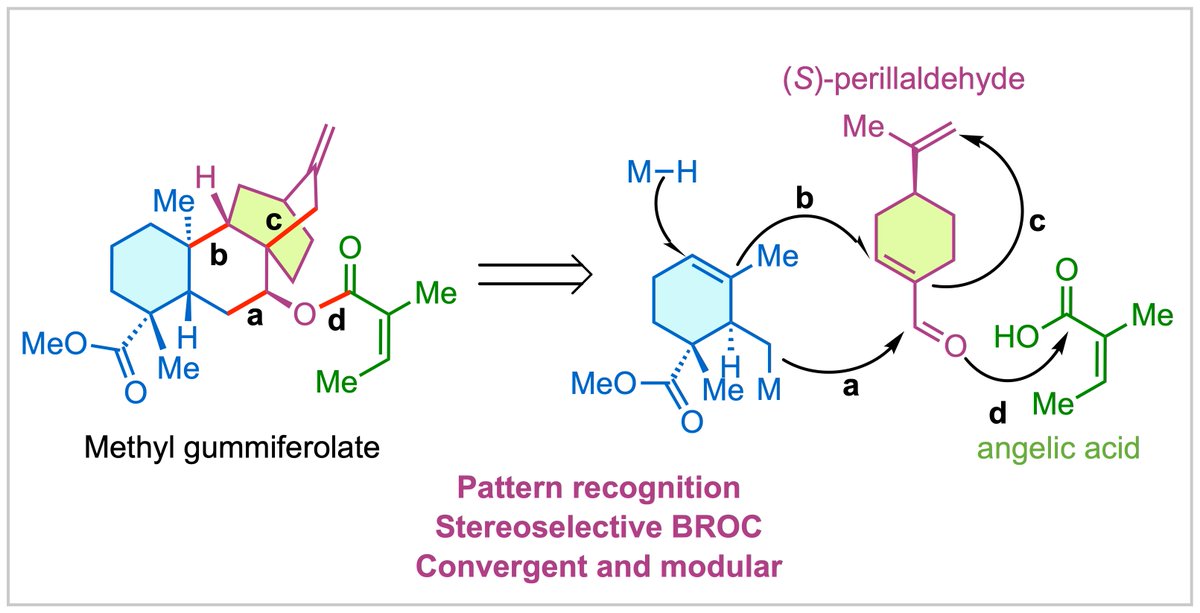
Happy to share our Total Synthesis
of (−)-Methyl Gummiferolate @J_A_C_S. Pattern recognition identified key starting materials and again the BROC chemistry @BaranLabReads formed key C-C bond and stereocenters. Congratulations to Weizhao and Jingsong!
https://t.co/UXj14SuwlD
Radical cross-coupling, simplified. No specialized equipment. No exogenous redox. No stoichiometric organometallics. The best part is no part.
A perspective on the field, appearing today in @ChemRxiv : https://t.co/g65WPyAVSx
RCC to the RESCUE: A rapid, convergent synthesis of roussoellatide enabled by redox-neutral radical cross-coupling, completed by @Nima_Nasiri_. A case study in how RCC prevails when classical polar methods fail. Out now in @ChemRxiv : https://t.co/gDlDQHQ4AU
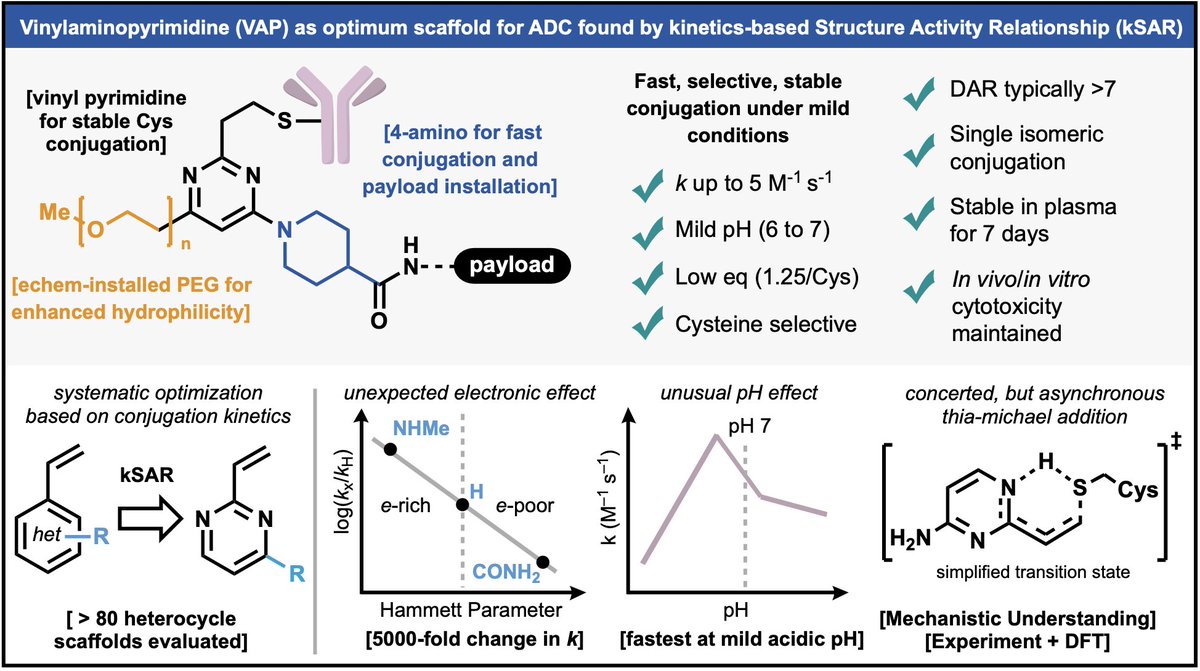
Textbook tells you that Cys-conjugation is driven by thiolate. The logic was simple: e-poor acceptor, high pH, more S-, and fast reaction.
But our (@BaranLabReads ) reagent reacts fastest under mild acidic pH and was boosted by EDG—the exact opposite!!!
Check this out!! 👇
A Kinetics-first Approach Reveals Optimum Vinylaminopyrimidines for Cysteine-Based Antibody Conjugation – an exciting collaboration with @scrippsresearch colleagues @Dawson_Group and the Blackmond group along with BMS – appearing now in @ChemRxiv : https://t.co/4f4UdZSkZ0
Hey @Support@Safety@X,
Our lab account @BaranLabReads was suddenly suspended, but we have exciting science to share! Appeal was submitted can you please help?
Calling on our science collaborators & friends to please RT for visibility. @ScrippsResearch