Stop sampling accessible isomers. Start building the target matrix.
Saturated heterocycles bearing covalent reactive groups already appear in more than a dozen FDA-approved medicines, including ritlecitinib and ibrutinib, making systematic exploration of this space directly relevant to medicine. When covalently reactive molecules are screened by proteomics to discover new protein engagements, the relevant unit of design is no longer a single compound—it is the complete set of regio- and stereoisomers of a privileged scaffold. Incomplete libraries, constrained by synthetic bias, systematically miss the very interactions they set out to find.
Radical cross-coupling removes that constraint. By pairing stereorandomizing and stereopreserving manifolds from simple commercial precursors, we constructed exhaustive piperidine (40) and pyrrolidine (24) matrices and expanded the collection to 108 covalent stereoprobes. Proteome-wide ABPP revealed highly differentiated, stereoselective engagements that further diversified with the choice of covalent reactive group. Selected hits were characterized by X-ray, and protein-directed ABPP expanded the observable ligandability landscape still further.
A collaboration with @VividionRx and the Cravatt lab, appearing today in @ChemRxiv: https://t.co/HE5mPxD4U7
Here comes a short review on the current state of electrochemical hydrogenation of arenes and heteroarenes, with a particular focus on how electrochemistry can precisely control partial vs. full reduction of the targeted aromatic rings.
Open access link: https://t.co/sCeMKRGzEH
Radical cross-coupling, simplified. No specialized equipment. No exogenous redox. No stoichiometric organometallics. The best part is no part.
A perspective on the field, appearing today in @ChemRxiv : https://t.co/g65WPyAVSx
Really excited to see this Perspective out today! 🚀
Radical cross-coupling carried a hidden tax: redox. Sulfonyl hydrazides changed that paradigm by bringing their own electrons 🎉
Two years later: what comes next and can radical cross-coupling become as intuitive as a Suzuki?
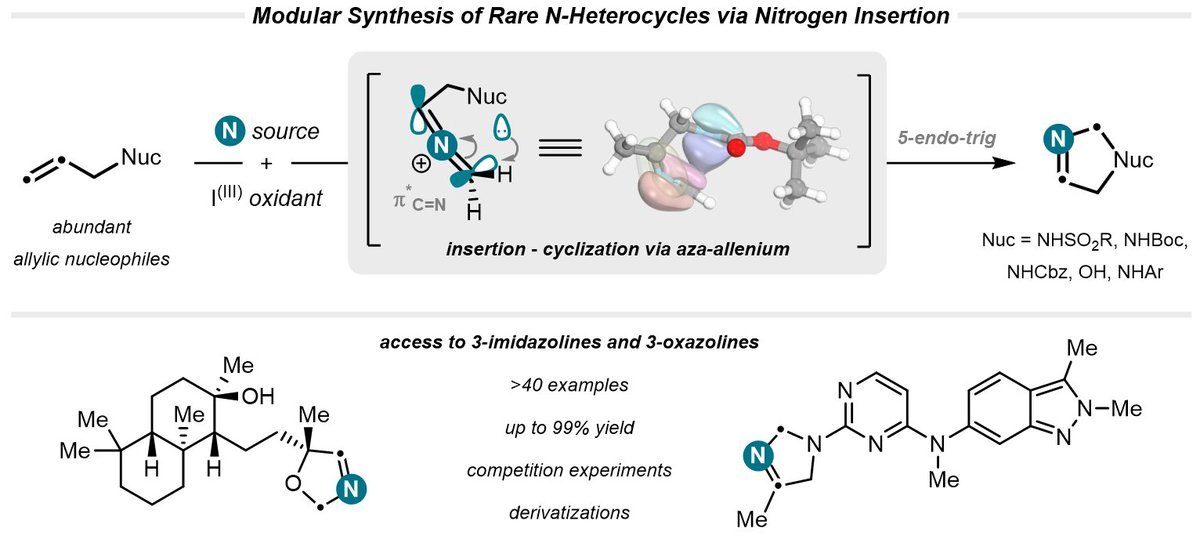
Check out the next chapter on nitrogen atom insertion into unactivated alkenes! Here, we present a method that furnishes aza-allenium salts from allylic nucleophiles furnishing N-heterocycles (3-imidazolines & 3-oxazolines) which were previously not generally accessible.
(1)
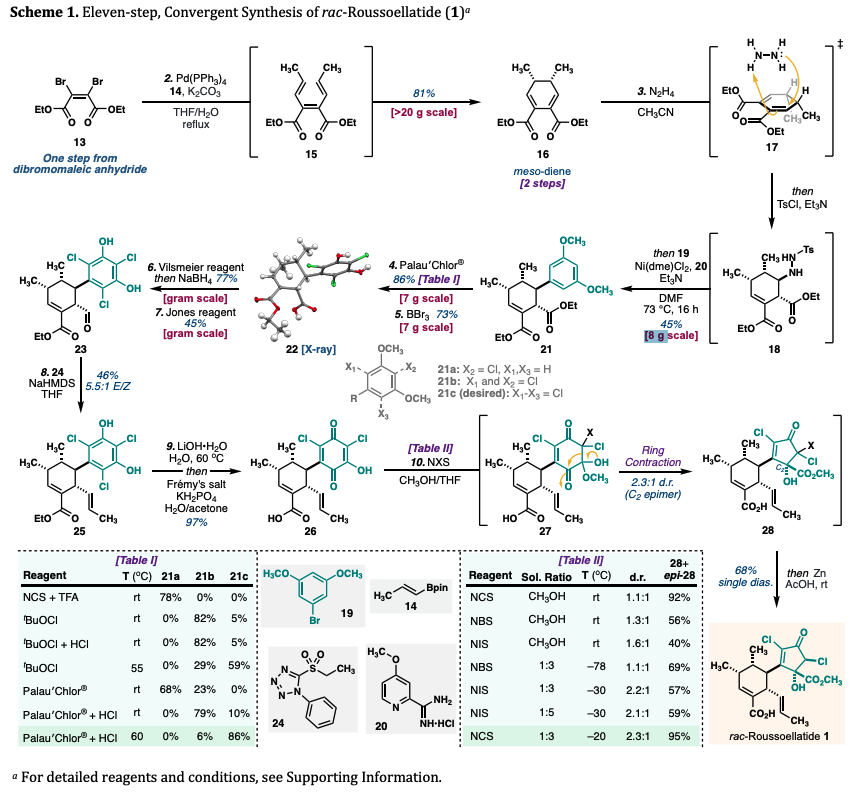
One C–C bond became our Battle of Thermopylae. Pass closed.
6 mo in, @BaranLabReads hydrazide RCC arrived.
Right reaction, right lab, very right timing. 😅
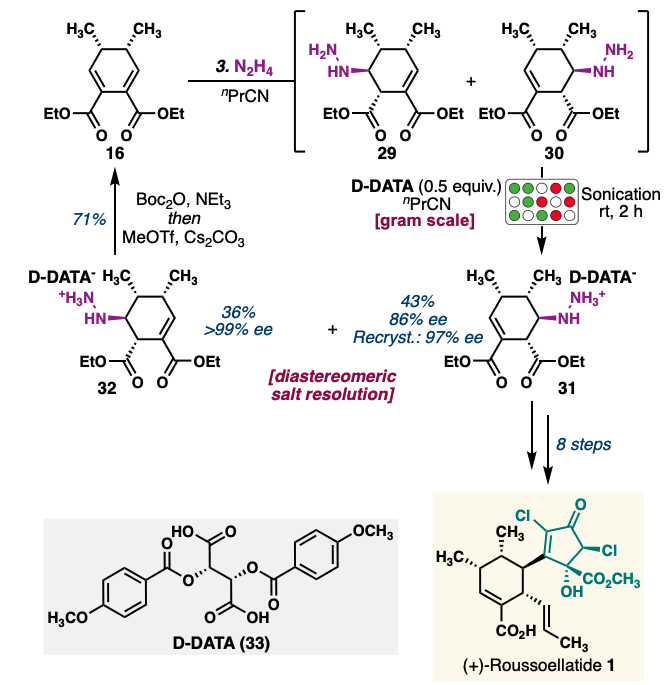
Desymmetrization + ring contraction → (+)-roussoellatide, 11 steps.
SI = casualty report 👀
🔗 https://t.co/h6ytXeCxB2
RCC to the RESCUE: A rapid, convergent synthesis of roussoellatide enabled by redox-neutral radical cross-coupling, completed by @Nima_Nasiri_. A case study in how RCC prevails when classical polar methods fail. Out now in @ChemRxiv : https://t.co/gDlDQHQ4AU
@nettik_etuc@46xyt مادرید بیلو خرید چون به نظرشون وینگر چپ تیم به اندازه کافی خوب نبود (دیماریا). سالیم که بیل اومد، زمانایی که رونالدو و بیل آماده بودن، دیماریا اصلا بهش بازی نمیرسید و رو نیمکت بود. ولی از خوش شانسیش، اون سال رونالدو و بیل نوبتی مصدوم میشدن.