Here comes a short review on the current state of electrochemical hydrogenation of arenes and heteroarenes, with a particular focus on how electrochemistry can precisely control partial vs. full reduction of the targeted aromatic rings.
Open access link: https://t.co/sCeMKRGzEH
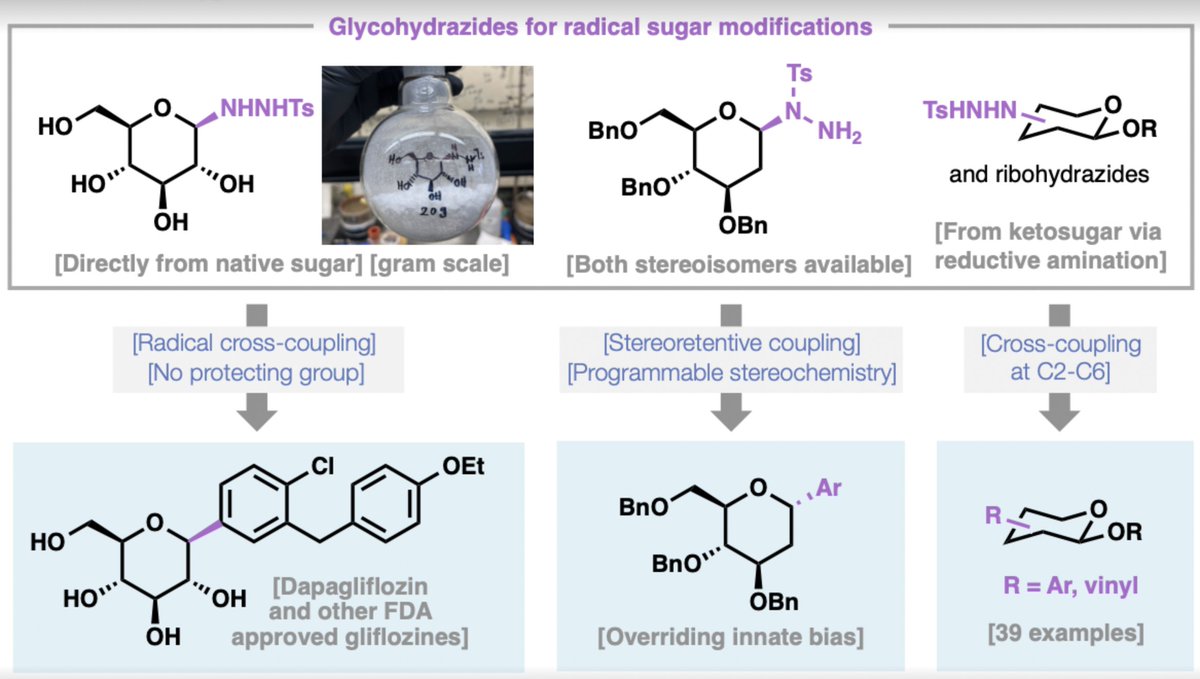
Making C-glycosides SWEET and simple! Today in @ChemRxiv we disclose (https://t.co/VDfit7itxh), in collaboration with @GroupAggarwal, an incredibly easy way to achieve radical functionalization of sugars. In this video (https://t.co/GRf6w9ZA7z), a two-step synthesis of the billion dollar drug Dapagliflozin is achieved using household vinegar and dextrose powder from the local supplement store.
High Level Summary:
The work addresses a longstanding challenge in carbohydrate chemistry: the efficient, scalable, and stereocontrolled synthesis of C-aryl glycosides directly from unprotected native sugars. C-Aryl glycosides form the core pharmacophore of the SGLT2 inhibitors (dapagliflozin, canagliflozin, empagliflozin, and related agents), which are frontline therapies for type 2 diabetes and represent one of the highest-grossing classes of small-molecule drugs.
Conventional synthetic routes to these molecules generally require extensive protecting-group manipulations, multi-step activation of glycosyl donors, or organometallic additions under demanding conditions. Recent advances in radical and transition-metal-catalyzed cross-couplings have improved access, yet most approaches still depend on protected precursors, specialized reagents, or protocols that are difficult to scale.
We report a practical alternative based on glycosyl sulfonyl hydrazides—stable, crystalline radical precursors that are prepared in a single step from unprotected sugars by treatment with tosylhydrazine in acetic acid, followed by simple crystallization. These hydrazides undergo redox-neutral nickel-catalyzed radical cross-coupling with aryl iodides or bromides under mild conditions (70 °C, DMSO, tetramethylguanidine as base). The reaction requires no external oxidant or reductant, no photocatalyst, and no organotin species. In glucose-derived systems the coupling typically delivers high β-selectivity (>19:1 in many cases), an outcome that appears to depend on hydrogen-bonding interactions between tetramethylguanidine and the free hydroxyl groups.
The main findings are as follows:
All five FDA-approved SGLT2 inhibitors, as well as several clinical candidates, can be prepared in a single coupling step from the corresponding glycohydrazide.
Decagram-scale synthesis of dapagliflozin was demonstrated starting from commercial dextrose; the product was isolated by aqueous workup and recrystallization (no column chromatography required at this scale).
Di- and trisaccharides (lactose, cellobiose, maltose, maltotriose) couple directly to give aryl-linked oligosaccharides.
Several natural products and medicinally relevant structures (salmochelin-SX, neopetrosin C, the tryptophan-mannose conjugate, and a ribose-derived IMPDH inhibitor) that previously required 9–20 steps or costly reagents are now accessible in 1–4 steps with good stereocontrol.
The platform extends to non-anomeric C–C bond formation at positions C2–C6 on glucose and ribose scaffolds, providing the first systematic exploration of radical diversification across these positions.
Stereoretentive radical cross-coupling, using configurationally pure hydrazides, enables programmable delivery of either α- or β-anomers, overriding inherent substrate biases and providing access to stereoisomers not previously obtainable by radical methods.
The chemistry builds on our earlier development of sulfonyl hydrazide-based redox-neutral cross-coupling and stereoretentive radical arylation, here adapted and optimized for carbohydrate substrates. The method is operationally straightforward, uses inexpensive reagents and starting materials, and eliminates protecting-group strategies.
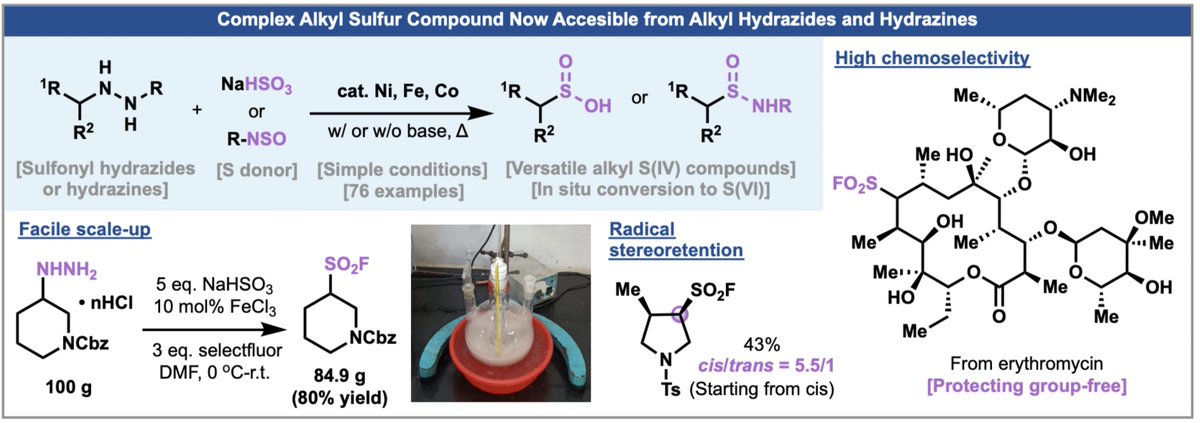
👋DRUG HUNTERS👋 N₂ extrusion from alkyl hydrazines delivers complex, medicinally relevant alkyl S(VI)-chemical space with exceptional chemoselectivity and operational simplicity.
Appearing today in @ChemRxiv: https://t.co/Y4JeCBWkGw
Alkyl hydrazines (or their sulfonyl derivatives) serve as practical radical precursors readily prepared from ketones, alcohols, amines, and complex molecules. Simple thermal activation triggers clean N₂ extrusion to generate alkyl radicals that are captured by inexpensive SO₂ sources, delivering versatile sulfinates convertible in situ to sulfonyl fluorides or sulfinamides.
70+ examples, protecting-group-free late-stage functionalization of natural products and drugs (ticagrelor, erythromycin, spiramycin), 100-g scale with trivial work-up, and stereoretentive variants round out a unified platform that directly addresses the growing need for complex alkyl S(VI) motifs in medicinal chemistry. Detailed mechanistic studies, including temperature scanning calorimetry, radical clocks, and DFT calculations help to demystify the process.
Tonight, we held our annual Paper of the Year meeting, during which we celebrated the great chemistry published in 2025. This year’s winner was the Stereoretentive Radical Cross-Coupling from @BaranLabReads https://t.co/oitdxeErgC
3D degraders, enabled by redox-neutral radical cross-coupling, appearing today in @ChemRxiv : https://t.co/f5rrV2VOmg. A fabulous collaboration with BMS and the Parker lab.
Great to have contributed to the early stages of this amazing project. The initial screening was promising, but pushing the chemistry this far is truly impressive, congrats to everyone involved!
Especially fascinating is how the mechanism diverges from polar–radical pathways!
We are hiring! Fully funded PhD position in Organic Chemistry: come join our team at @Stockholm_Uni and develop innovative methodologies!
Attach your CV and cover letter, deadline January 20th!
Link for application: https://t.co/6vaIvPEBAY
I have had a few people ask about this stereoretentive radical mechanism, and how we tested for one-electron (radical) and two-electron (organometallic/ionic) pathways. Here’s a thread🧵to help clear things up: (1/n)
Stereoretentive Radical Cross-Coupling — a pioneering achievement in the field! It's not every day that you get to work on a project that's the first of its kind. 🚀
🚨RADICAL RETHINK: STEREORETENTIVE CROSS COUPLING UNLOCKED🚨 Today in @ChemRxiv (https://t.co/zGZFCsK7aK) the first method for stereoretentive radical cross-coupling is disclosed. No fancy ligands or redox needed—just a Ni-diazene twist. 120 years after Gomberg, a new chapter begins.
Quick summary:
Since Gomberg discovered free radicals over 120 years ago and Kochi pioneered radical cross-coupling in the 1970s, this field has surged with interest for linking C(sp3) fragments. Unlike traditional polar methods (e.g., Suzuki), radical cross-coupling excels with saturated systems, offering mild conditions and chemoselectivity to build complex molecules from common fragments. Until now, enantiospecific radical cross-coupling was deemed impossible due to rapid racemization, but today that changes with readily available sulfonylhydrazides and a simple Ni-catalyst. This stereoretentive approach, enabled by a unique Ni-diazene transition state and driven by loss of N2, skips chiral ligands and redox steps, opening new possibilities for synthesis.
Finally, RADICAL CROSS COUPLING without the exogenous REDOX. We disclose in @ChemRxiv (https://t.co/FYy6i1J7p9) a broadly general platform for achieving transformations that normally required excess metallic or chemical reducing agents or photochemical setups (and their requisite catalysts) or potentiostats for electrochemistry. Now, such transformations can be accomplished with the same ease that one conducts a Suzuki coupling. You can scale up (its homogeneous) or scale down (use cheap parallel screening plates). Moisture is tolerated and base metal catalysis is used. As the best engineers like to say, "The best part is no part". Now, chemists have the option to remove the redox part from radical couplings.
Quick Summary: Sulfonyl hydrazides are disclosed as versatile radical precursors as exemplified with seven new C–C bond forming, redox-neutral cross-couplings with: (1) activated olefins, (2) alkyl halides, (3) redox active esters, (4) aryl halides, (5) alkenyl halides, (6) alkynyl halides, and (7) a trifluoromethylating reagent to forge C(sp3)-C(sp3), C(sp3)-C(sp2), and C(sp3)-C(sp) bonds. Sulfonyl hydrazides are stable and usually crystalline substances that can be accessed in a variety of ways including transiently from hydrazones to achieve a net reductive arylation of carbonyl compounds. Exogenous redox (chemical, photo/electrochemical) additives are not necessary as these functional groups serve the dual role of radical precursor and electron donor. The operational simplicity (homogeneous, water tolerant, dump-and-stir) and practicality of the method are demonstrated as well as applications to streamlining synthesis and mild late-stage functionalization.