Previous hackahton has 210 participants building multi-agent systems, from 82 countries. so we decided to put gas on this.
We are building community of AI engineers. Join Under the Hood, our community at JigJoy.
Share how you use AI, learn from fellow builders, and join our hackathons - with meetups coming soon.
https://t.co/DlO0UKHthz
Built with Mozaik: Metamorph 🦋
Metamorph uses concurrent AI agents to help migrate a codebase from one technology stack to another. Agents map the project, rewrite code, review the changes, and check the build. The work happens in a separate workspace, so developers can review it before applying it.
Explore the project: https://t.co/EZnpLbKQrf
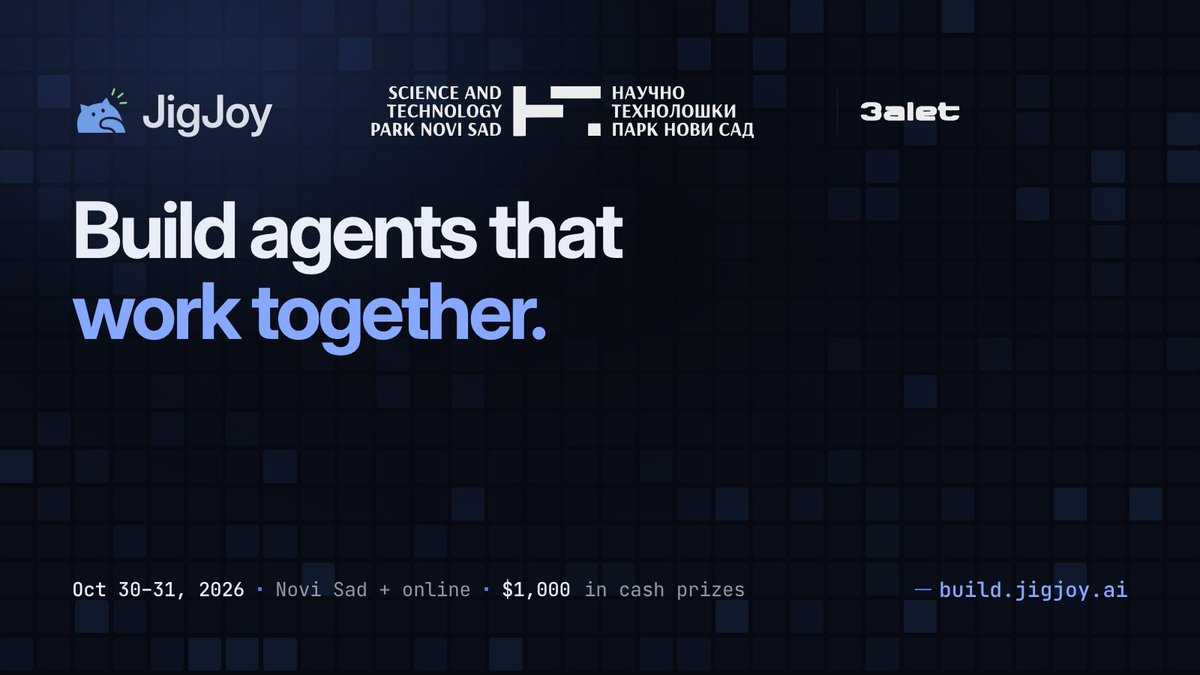
Due to demand from our community, we have decided to organize another @mozaik_runtime hackathon at the end of October.
$1000 in cash prizes, and also perks and free stuff from our sponsors, which will be announced in the following weeks.
This time it's a hybrid event, both online and on site at STP Novi Sad
Sign up link in comment 👇
We've just announced the winners of the first Build with Mozaik hackathon!
🥇 Separation
🥈 Metamorph
🥉 Watchtower
4 Butterfly
5 Hive
210 builders from 83 countries built 40 concurrent-agent systems in one weekend!
Huge thanks to everyone for participating, and also our partners and sponsors for supporting us @yourhyperskill@dailydotdev@mem0ai@adaption_ai
We just wrapped up our first Mozaik hackathon.
220 builders from 34 countries. 40 projects shipped in one weekend, every one running 2+ concurrent agents on Mozaik.
All of them live in the gallery → https://t.co/uWD55VCcpJ
Huge thanks to our partners and sponsors @yourhyperskill@dailydotdev@adaption_ai@mem0ai for making this possible!
Also shout out to @AHadzibabic for helping us out and joining the kickoff stream.
I joined @jigjoy_ai Hackathon
And there's this Idea that have been wanting to build and it fitted the Hackathon
I built ConcurProof because I wanted to answer a simple question: when AI agents run at the same time, does their collaboration actually improve the result?
It’s easy to show several agents working simultaneously. What’s harder is tracing how they influence each other and measuring whether those interactions help.
ConcurProof investigates the same controlled incident using three execution modes:
* Sequential: agents work through handoffs.
* Naive parallel: agents run simultaneously but independently.
* Reactive concurrent: agents overlap and respond to each other’s outputs.
ConcurProof runs four agent roles;
Evidence, Hypothesis, Critic, and and streams their activity into a live dashboard.
You can inspect execution timelines, events, and an interaction graph showing which agent responded to which output, reactive execution takes longer in that run. That trade off is part of what I want the project to expose: whether additional interaction earns its cost.
Go check it out now;
https://t.co/gg9qjwzguM
Repo; https://t.co/X2DAbWmMHd
Good morning.
Spent the weekend building Dinner Rush, a concurrent AI restaurant for the JigJoy / @mozaik_runtime Hackathon.
The idea:
what happens when an AI kitchen has to handle a real dinner rush?
Dinner Rush has specialized agents for Prep, Grill, Fryer, Pantry, Sauté, Oven, Salad, Dessert, Drinks and Serving.
Instead of taking turns, the agents can work concurrently, share live kitchen state, react to problems while service is already running, and coordinate until the final order is safely served.
You can actually watch their decisions, shared state and overlapping agent loops live in the app.
Built with @mozaik-ai/core.
Live: https://t.co/WR7dZ8Sq9V
GitHub: https://t.co/xGx0sYE4gf
Demo below ↓
Mozaik started with a technical insight - and an intuition: hardcoded workflows don’t feel particularly intelligent.
What if agents could operate concurrently, without blocking one another? That would open entirely new possibilities.
Concurrency led us to awareness: agents need to understand other participants and their environment.
Awareness led us to adaptivity: agents need to change their behavior as circumstances evolve.
Together, these technical insights led us to a market insight: there is no effective way to share AI agents and their capabilities across projects.
We keep rebuilding what someone else has already built. Tightly coupled systems prevent agents from moving between environments - limiting new markets, monetization opportunities, and the value we can extract from AI.
That is why Mozaik is built around three capabilities:
- Concurrency.
- Awareness.
- Adaptivity.
With one goal: agent interoperability.
This Saturday, we’re kicking off our hackathon for building concurrent AI agents with Mozaik.
Whether you’re an experienced developer interested in highly scalable AI systems or you’re just starting to explore multi-agent development, join us.
We’ll share the most important things we’ve learned while building a TypeScript runtime for concurrent AI agents, including:
- Reasoning vs. non-reasoning models
- How model context is structured
- Advanced agent-loop engineering techniques
- Event-driven coordination between agents
- Building agents that work concurrently without blocking one another
Join the hackathon: https://t.co/knsg01xYev
What if agents were no longer trapped inside individual products?
PostHog, Figma, Notion, or any developer could build an agent that joins any project at runtime, becomes aware of the other participants, adapts to the system’s goals, and starts collaborating.
This would unlock entirely new ways to build, share, rent, and monetize agents. That is why agent interoperability could be the next big thing.
https://t.co/66MqyY0CgN
Join a community of builders
The best way to learn AI engineering is not another tutorial.
It’s building something with other people who are experimenting with the same problems.
Our AI hackathon brings together developers interested in:
- AI agents.
- Multi-agent systems.
- TypeScript.
- LLMs.
- Agent architecture.
- Autonomous software.
You’ll build, exchange ideas, see how other teams approach the same problems, and become part of the growing Mozaik builder community.
September 5–6. Online.
https://t.co/XFQXBjPJkE
Want to learn how to build multi-agent AI systems in TypeScript?
Join our online AI hackathon on September 5–6 and build a real system with multiple AI agents working concurrently.
You’ll get hands-on experience with:
- agent loops
- tool calling
- event-driven coordination
- concurrent agents
- human-in-the-loop patterns
- building autonomous AI systems
You’ll build with Mozaik, our open-source TypeScript framework for concurrent AI agents.
🏆 Today’s prize highlight: $500 for the winning team.
Join the builders → https://t.co/XFQXBjPbv6
Mozaik makes it easy to build multi-agent systems where participants communicate, coordinate, and work in parallel inside a shared environment.
Here is a tiny example of how to build a CLI agent with Mozaik.
https://t.co/2sr2wJpjSv
In the last 45 days, our content reached 775K developers and generated 5.3M impressions on https://t.co/kRV79vrBhx.
The biggest lesson?
Developers don’t want another basic AI tutorial.
They want to see technology pushed to its limits.
Most developers use tools like Claude Code and Codex as black boxes.
To make the underlying principles easier to understand, I created an open-source starter template for building your own command-line AI agent.
The agent works directly with the local file system. It can autonomously:
- search and inspect files
- read and understand documents
- create and edit files
- execute terminal commands
- analyze the results and decide what to do next
It provides a small and transparent foundation that developers and enterprise engineering teams can understand, control, and extend for their own workflows.
It is intentionally a starter template rather than a production-ready product - ideal for anyone who wants to understand how tools like Claude Code and Codex work under the hood.
Built with TypeScript and Mozaik. Feel free to explore, fork, and extend it:
https://t.co/sGSFHoAwxG
Read how we used a Domain-Specific Language to find the right balance between agent autonomy and restrictions in a highly regulated market.
The goal was not to make agents blindly autonomous.
The goal was to let them reason freely inside domain boundaries they physically cannot break.
https://t.co/SMaKnblEIT