Professor & Director of Research (Psychology) @KeeleUniversity. University research integrity lead and @ukrepro institutional lead. Obsessed with #rstats
I've spent the past weeks publishing my flankr package on CRAN for R. Users who've only installed the first version will notice SIGNIFICANT improvements in model speed.
Plus, I made a hex sticker for it.
CRAN: https://t.co/6eHmvpm1u7
Github (dev): https://t.co/dO0E0EpfDN
$MSTR just broke above $105. Up 13% on the day.
Mark Palmer just put a $570 price target on Strategy by end of 2026.
His condition. Bitcoin reaches $95,000.
Bitcoin is currently at $71,000.
Same company. Same Bitcoin. Completely different trajectory from here.
$MSTR $BTC
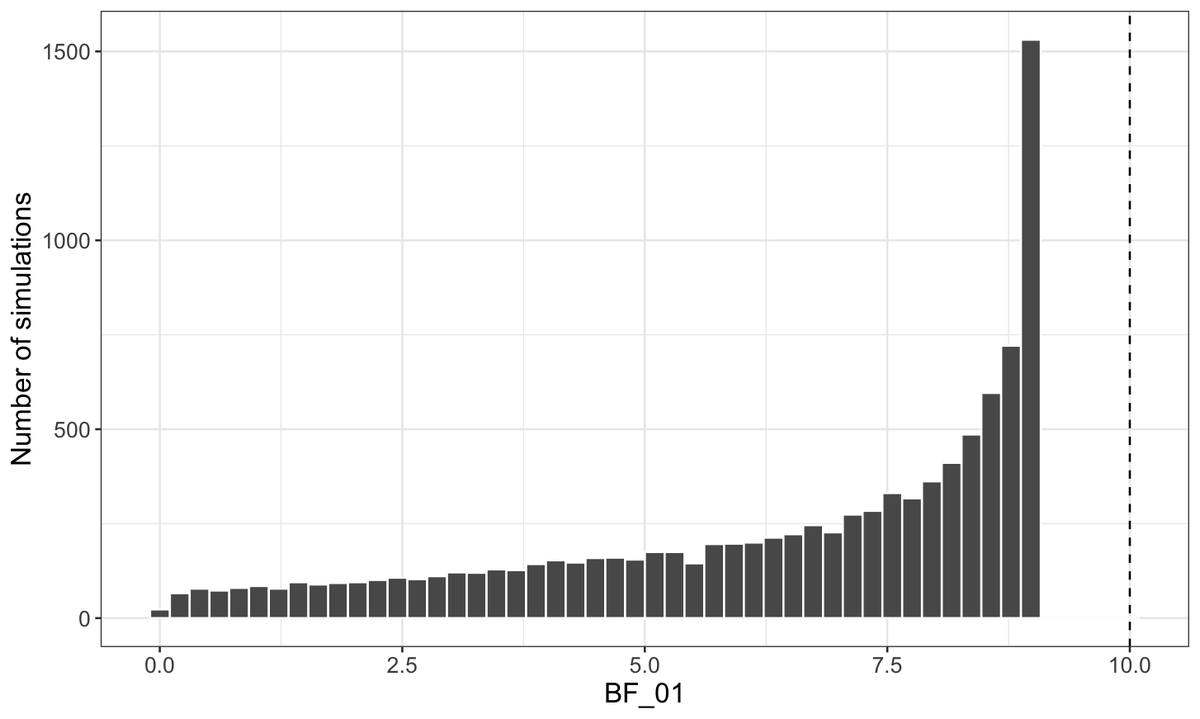
As the attached illustrates, even when both paired samples come from the same distribution, BF₀₁ doesn't reach 10 with N=100. Am I thinking about it incorrectly?
Can I ask possibly silly Bayesian design Q? If using a t-test Bayes factor as sequential stopping rule, is it defensible to use asymmetric thresholds (eg BF₁₀ > 10 but BF₀₁ > 5)? This would require strong evidence for a novel effect but moderate evidence to stop pursuing it.
@frankiekam@ReykjavikOpen Seeing how long you took over a particular move is very useful during post game analysis of your games. My coach is always asking things like "Why did you take so long over this move?", or "Why did you only spend 1 minute on this? It's a critical position."
Spent the morning writing a lecture on computational modelling of visual short-term memory, and I get to talk extensively about our paper in press at QJEP!
I love my admin roles, but nothing beats being in the classroom!
https://t.co/K89UiWIRXn
Woo! Paper just accepted reporting 7 experiments from my PhD student's work (the great Stuart Moore). Will appear in the Quarterly Journal of Experimental Psychology (@SageQJEP).
Early version here: https://t.co/K89UiWIRXn
New pre-print with colleagues from @KeeleUniversity and Midlands Partnership University NHS Foundation Trust(@mpftnhs) exploring research readiness in psychological services:
https://t.co/BBcoTj1EXB
Oxford’s new “Life & Mind” Building brings Biology and Experimental Psychology together, an example of how psychology thrives as an empirical, theory-driven, biological, and computational science. You can feel the intellectual energy there already!
https://t.co/tUaKT9mJYS
As someone who studies the visual system of the human brain, I'm loving this. This is powerful evidence that biological vision, unlike computer vision, is driven by movements in the visual field. 😍
If you want to solve vision, understanding this truth is essential.
Thanks for reposting this, @AlexanderNaume2. Great find.
No need for complex tools to prioritise credit to "first" and "last" authors (like this means the same thing across disciplines).
Just use the CRediT Contributor Role Taxonomy (https://t.co/r0oH3nucam)
New paper submitted over the weekend, where we examine age-related differences in inhibition in task switching using diffusion modelling.
https://t.co/3t7dyBGTq8
This could be done by (1) embedding open outputs in promotion criteria, valuing rigour & transparency over "high-impact" publications; (2) recognising data sets, pre-prints, and replication reports as valuable; (3) highlighting exemplars of researchers publishing negative results
"Research funders urged to drive culture shift on negative results". Interesting perspective at Research Professional. Of course, Registered Reports offer a valuable solution not mentioned here.
(https://t.co/EiSeHyE5oY)
It's also interesting the piece calls for "a couple of high-profile funders or institutions" to provide momentum for a tipping point in promoting the publishing of negative results. This seems something an agile University could look to implement to lead the way.
New paper, now out in Behavior Research Methods. "Multiverse simulation to explore the impact of analytical choices on type I and type II errors in a reaction time study"
https://t.co/bTAilsYGJX