Assistant prof at @UniUtrecht, trying to make science as reproducible as non-scientists think it is. Blogs at @the100ci. Now also on the app with nice weather.
New paper!
Got the best news on the weekend: "Why hypothesis testers should spend less time testing hypotheses", by @LeonidTiokhin, @peder_isager, @lakens, and myself, has been accepted at Perspectives on Psychological Science.
https://t.co/53Q4V60Fvw
There are still some spots open for PSYNETS 2026 (26–30 Jan) — a 5-day workshop on network psychometrics at the University of Amsterdam! 🇳🇱 📩Register here: https://t.co/mqXchzVfj4 Can’t join this time? Email [email protected] to stay in the loop for future editions!
@croissanthology Great stuff! I’d love to take a look at the data. Looks like the Google Drive isn’t open to the public? I’ve requested access but just flagging it here in case that wasn’t on purpose.
[1/3] Men's testosterone levels did not plummet over the past decade like many wellness podcasts would have you believe... we just switched the measurement assay from immunoassay to mass spectrometry
When we switched assays, we observed a ~100% increase in self-reported healthy men with low testosterone. The threshold needed to be updated when the assay changed.
Arun AS, Durant TJS, El-Khoury JM, Krumholz HM. Re-evaluating the threshold for low total testosterone. Clinical Chemistry 2025.
Most graphs of the fertility rate depict the 'period fertility rate', which is based on a single year's data and doesn't necessarily reflect how many children women actually have across their lifetimes.*
Instead, I've used data from the Human Fertility Database to make graphs with the cumulative number instead.
In the US, you can see that women born before 1979 have had >2 children per woman by the time they reached age 45.
Also, women born before 1984 have had >2 children per woman by the time they reached age 40.
You can also see the rates between 'by age 40' and 'by age 45' have widened slightly, as women increasingly have children at older ages.
You may also notice the line has been fairly stable since 1950 (that is, women born since 1950), and has actually risen among many of those cohorts.
I have written about this previously. As the baby boom was ending, births became more compressed into women's late twenties. Afterwards, it widened again (more early births and more later births) and the total number of births per woman rose slightly.
This may reflect the use of family planning and, probably to a slighter extent, advances in reproductive technologies, allowing more women to have children at all or have late births.
There's a slight downwards dip towards the end. The data comes with a delay - you wait until women reach a certain age to calculate how many children they have had by that age.
As women delay childbearing, it's unclear how precisely the lines will look like after this. It's likely that the gap between the lines will widen further.
The only way to know what the line will continue to look like is by making predictions about the future itself! Which is what the total fertility rate does, but with some questionable assumptions. You can of course also make some guesses about the range of scenarios based on other data.
Many factors could change what the line looks like in the future, including culture, reproductive technologies, family planning, policy, economic factors, and more.
---
My article on the baby boom: https://t.co/aBO0N5JXSZ
*I have previously written about why in this article: https://t.co/DDmzpnev4k
This data comes from the Human Fertility Database (https://t.co/kfRyVn7X5n), which is an amazing data source that has granular data that you can download and explore. We made lots of charts with this data on Our World in Data: https://t.co/ZFdRlyv6kj [scroll through]
Here is an interactive version of the chart below: https://t.co/8FL1tfvzcb
I made this graph with a simple R script this morning & I briefly explain where you can find the metrics if you want to recreate it for other countries with available data: https://t.co/CeMaFEUTYM
Thanks for reading!
Works in Progress is now available as a print magazine. I think it's the most beautiful and readable magazine I've ever seen.
Subscribe today for $100/£75 to receive six beautiful, 120-page issues a year.
https://t.co/sCOVnY1mf1
Time is running out to register for our pre-symposium workshop and Meta Research Symposium event at Paul Meehl Graduate School
Check the information and registration links below:
https://t.co/Po1lXGNn3T
The long term data on newborn hepatitis B vaccination shows it reduces the incidence of liver cancer by 84% and death from liver disease by 70%.
This comes from a large cluster RCT in which entire towns were randomly selected to give the hepatitis B vaccine to all newborns.
Only a few days remained to submit your abstracts for presentation at PMGS Meta-Research Symposium 2025. Make sure to submit them before the end of July by filling the following form:
https://t.co/b7zkhrNVQN
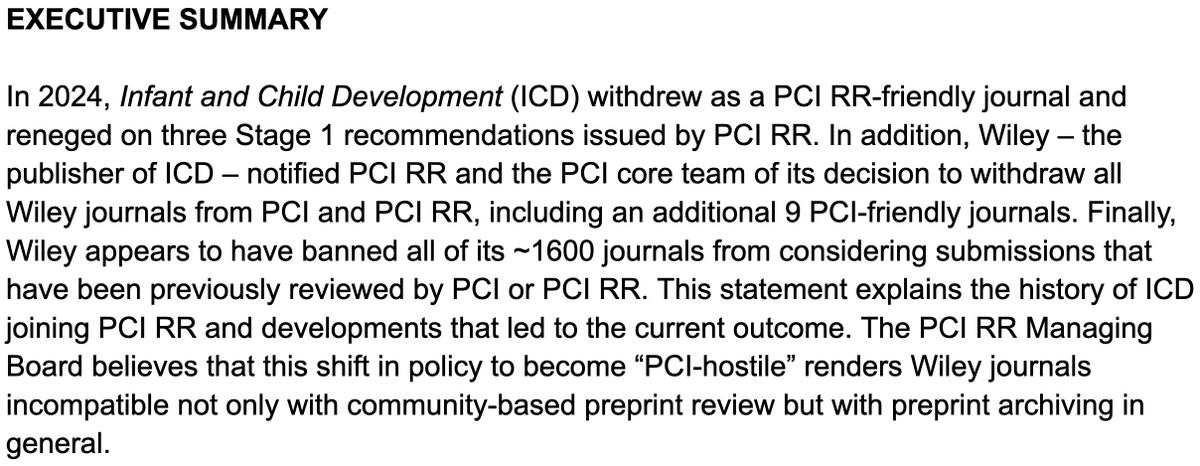
NEW: Statement from the PCI RR Managing Board on the withdrawal of Infant and Child Development as a PCI RR-friendly journal, and the decision by Wiley to refuse preprints that have been peer-reviewed by @PeerCommunityIn / @PCI_RegReports
Read here➡️https://t.co/NHhuNKdA0o
LAUNCH DAY 🚀 Today I’m launching a new podcast, Hard Drugs, with Jacob Trefethen (@JacobTref)
Our first episode is about lenacapavir — a new HIV drug that blocks infections with an efficacy rate of nearly 100%, and which could completely change the fight against HIV worldwide.
It’s also about the scientific journey leading up to this point, and how HIV was transformed from a lethal to a manageable condition.
3:52 How was HIV discovered? Where did it come from, and how does it attack the body and cause AIDS?
38:10 Antiretrovirals: How did scientists develop breakthrough HIV drugs — from azidothymidine to protease inhibitors to PrEP?
1:51:35 How does prevention and treatment work today?
2:19:03 HIV’s capsid and the breakthrough of lenacapavir, the first-approved HIV capsid inhibitor
2:50:36 How to develop long-lasting treatments
3:14:45 Lenacapavir’s near 100% efficacy in clinical trials
3:48:40 The impact of global programs against HIV, and can we now end HIV?
Our study "Does Scientific Productivity Increase the Publication of Positive Results?" is now published in Collabra: Psychology! Link: https://t.co/RMg427ttN6 (1/4)
Duygu and Mehmet are such sharp minds! They have convinced me that setting the alpha level to different thresholds for different studies is not a good thing beyond actual decision making, and that it is unwise to adopt context specific alpha levels for scientific claims.
Registration is open for our final workshop of the year: Scientific Criticism and Peer Review (June 6, Eindhoven). Led by René Bekkers, info: https://t.co/BZmA0Hl3mc
Great opportunity to attend both the workshop and PYMS symposium on June 5 in Tilburg: https://t.co/RD2Z4LHBt2
The Dutch rail service NS internally replicated all their A/B tests. 50% did not replicate. A familiar story for scientists, very intriguing to hear companies have the same problem in their own research. Food for thought! (Link in Dutch) https://t.co/cMqpzbCqPN
The regustration deadline for the Paul Meehl Graduate School's workshop about "Causal Inference and Variable Control" on May 9 is running out. Check the details of the workshop and registration form here:
https://t.co/N3v6tpJ1cW
I signed the 10% Giving Pledge this year, and this week, I decided to donate 19% of my annual income to global health charities.
It's not going to be anywhere near "enough", but I'm happy to do it —
https://t.co/Puoiv2H8qM
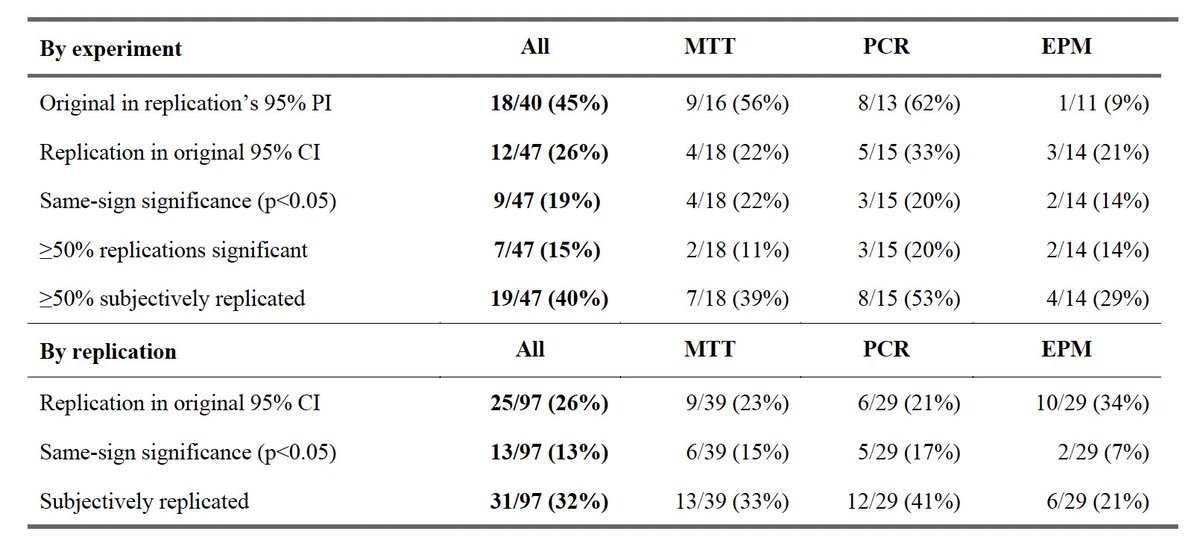
The long awaited results of the @BrRepNetwork are in! Their final sample consists of 97 replications of 47 studies. The only coherent measure of replication, p<.05, shows a replication rate of 19%. https://t.co/v8E3G7P3zq
and got its final shape with help from a brilliant team on the Cortex editorial board: Chris Allen, Magda Chechlacz, Marie Deserno, Marie Gillebert, Tom Hope, & Nick Holmes.
To end on a personal note, this my first proper gig as an editor and I couldn't be more excited! 9/9
Chuffed and excited to announce a new journal section in Cortex:
*Methods and Assumptions* is open for submissions starting today!
Read the opening editorial here (OA): https://t.co/9W7Ne7YUR3 1/
The idea for the section came out of a special issue I guest-edited together with @AnnaLSchubert, @Dan_Mirman, and @mcintord (https://t.co/cTCbEsABgk...) 8/







![aditharun_'s tweet photo. [1/3] Men's testosterone levels did not plummet over the past decade like many wellness podcasts would have you believe... we just switched the measurement assay from immunoassay to mass spectrometry
When we switched assays, we observed a ~100% increase in self-reported healthy men with low testosterone. The threshold needed to be updated when the assay changed.
Arun AS, Durant TJS, El-Khoury JM, Krumholz HM. Re-evaluating the threshold for low total testosterone. Clinical Chemistry 2025.](https://pbs.twimg.com/media/G3ui6SMXkAAQ0aw.png)




![salonium's tweet photo. Most graphs of the fertility rate depict the 'period fertility rate', which is based on a single year's data and doesn't necessarily reflect how many children women actually have across their lifetimes.*
Instead, I've used data from the Human Fertility Database to make graphs with the cumulative number instead.
In the US, you can see that women born before 1979 have had >2 children per woman by the time they reached age 45.
Also, women born before 1984 have had >2 children per woman by the time they reached age 40.
You can also see the rates between 'by age 40' and 'by age 45' have widened slightly, as women increasingly have children at older ages.
You may also notice the line has been fairly stable since 1950 (that is, women born since 1950), and has actually risen among many of those cohorts.
I have written about this previously. As the baby boom was ending, births became more compressed into women's late twenties. Afterwards, it widened again (more early births and more later births) and the total number of births per woman rose slightly.
This may reflect the use of family planning and, probably to a slighter extent, advances in reproductive technologies, allowing more women to have children at all or have late births.
There's a slight downwards dip towards the end. The data comes with a delay - you wait until women reach a certain age to calculate how many children they have had by that age.
As women delay childbearing, it's unclear how precisely the lines will look like after this. It's likely that the gap between the lines will widen further.
The only way to know what the line will continue to look like is by making predictions about the future itself! Which is what the total fertility rate does, but with some questionable assumptions. You can of course also make some guesses about the range of scenarios based on other data.
Many factors could change what the line looks like in the future, including culture, reproductive technologies, family planning, policy, economic factors, and more.
---
My article on the baby boom: https://t.co/aBO0N5JXSZ
*I have previously written about why in this article: https://t.co/DDmzpnev4k
This data comes from the Human Fertility Database (https://t.co/kfRyVn7X5n), which is an amazing data source that has granular data that you can download and explore. We made lots of charts with this data on Our World in Data: https://t.co/ZFdRlyv6kj [scroll through]
Here is an interactive version of the chart below: https://t.co/8FL1tfvzcb
I made this graph with a simple R script this morning & I briefly explain where you can find the metrics if you want to recreate it for other countries with available data: https://t.co/CeMaFEUTYM
Thanks for reading!](https://pbs.twimg.com/media/G2KpyPwWMAAC_ye.jpg)