In the last 2 years I (and our lovely collaborators) have been rather obsessively working on Metacheck - a tool to automatically check best practices in papers. In this RIOTS summerschool talk, I walk you through what the tool can do, and future plans https://t.co/ngNtNflRQh
@GregoryRHancock But draconian is not bad! You get valid claims, while gaining much more flexibility. I feel this is an exciting research area - when do we stick to 1 test at 5%, and when do we generate knowledge more efficiently by exploring with a lower alpha? We should do the second much more.
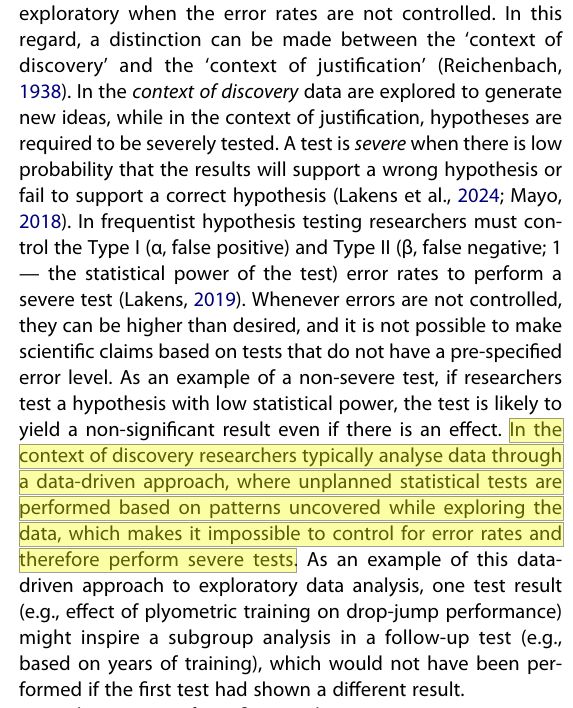
There is a lot of vagueness in the literature about when a test is exploratory, and when it is confirmatory. I really like our definition where a test is exploratory when you can't control the Type 1 error rate (even if you tried). See https://t.co/0A30Od190U
@GregoryRHancock There are some (indeed draconian) solutions to allow exploration at some reduction to alpha. Think of Safe Anytim-Valid Inference (very exciting stuff) or the sign-flip score test (see https://t.co/0vGRN3uUlc for an application to multiverse analysis).
Why are severe tests of claims so important in science? I believe that if we do not severely test claims, claims become less reliable, science will be wrong more often, science is less able to achieve it's potential for society, and trust in science is reduced.
@BrianCHolt@gtredoux That final to last sentence makes no sense. In the podcast we discuss selection of embryo's for down syndrome. Common in some countries. That is literally negative eugenics.
Getting ready to record a podcast on whether frequentist statistics is related to eugenics (in my view: not at all) and if Fisher is a terrible person (as far as I can tell, no, even though I thought so). The main lesson for me is: read history if you want an informed opinion.
Big news from the PsyArXiv team! They will be moving to a new host, KnowledgeFutures, which offers more room to develop existing functionalities: https://t.co/upPSM0PaNg
I beta tested the platform, and I think it an important step in making PsyArXiv more future-proof!
@BrianCHolt@gtredoux This might be worth listening too, if you really think they are not the same thing at all. I think they are largely the same thing for Fisher. You might think of eugenics and the nazis - that is not the same thing, but we are discussing Fisher https://t.co/TNFBCnxhQG
@BurmanPhD There is no conflict. He thought about the decline of societies, and the role genetic variation might play in it. Those ideas were not very interesting but a topic of debate in the time. His idea of scaling child benefits to income is pretty bland as eugenics goes.
@BurmanPhD This is closed access so I can't read it, but if the title says he was a racist than the author of this piece was not knowledable enough about Fisher to write about him. He was not a racist.
@nilslidhjortuio I watched this https://t.co/TNFBCnwK18 to prepare, so I think I will have gotten the highlights (but I still also ordered the book just now!)
@GGCanto Yes, very good summary (the dullness on politics is so noticeable and surprising!). But also the strictness of declarations (e.g., at UNESCO, disagreeing that all groups of people would be equal in ability).
New blog post, about a really cool new feature in Metacheck: Automatic computational reproducibility checks with Metacheck https://t.co/6H7260IidQ
This should be of interest to reviewers, data managers, and anyone sharing data and code. Run the checks on our SURF hosted server!
New blog post, about a really cool new feature in Metacheck: Automatic computational reproducibility checks with Metacheck https://t.co/6H7260IidQ
This should be of interest to reviewers, data managers, and anyone sharing data and code. Run the checks on our SURF hosted server!