The most bullish Bitcoin catalyst in the history of the asset could materialize by the end of the year.
Bitcoin is on the precipice of gaining access to the balance sheets of the global banking system.
Let's talk about the Basel banking standards.
Banks allocate capital. And they do this by optimizing their balance sheets for a return on regulatory capital. This means that for every asset a bank holds, it consumes a certain amount of capital based on its regulatory risk treatment.
Bitcoin has an extremely punitive capital requirement, so Bitcoin as an asset is, economically, very unattractive for banks to hold. Bitcoin exposures carry a staggering 1,250% risk weight.
What does that mean? Well, in practice, that means a bank seeking to hold $100 million of unhedged Bitcoin can face a minimum regulatory capital requirement of $100 million. There is an enormous structural disincentive for banks to participate in the ever-growing Bitcoin economy.
So what's the good news? On November 19th of last year, the Basel Committee agreed to expedite its review of crypto asset capital standards. In February of this year, they confirmed progress on the targeted review.
In March, the Group of Central Bank Governors and Heads of Supervision formally endorsed the ongoing review.
In May, the committee confirmed further progress.
On October 1st, the committee announced it expects to provide an update by year-end.
Six days ago on November 18th, the committee again confirmed the review remains active.
The key near-term catalyst is the December 2026 update, assuming the committee maintains its stated timetable.
But more importantly, after eight major Wall Street entities lobbied Basel last year to change the framework, and after the US and Canada opted to not conform to the crypto asset rules...
...just one month ago on October 23rd the OCC confirmed in the Federal Register that it plans a separate rulemaking project establishing a capital framework for digital assets.
We have he United States effectively advocating for international standards to adapt to its domestic digital asset policy, rather than simply importing Basel's existing restrictions.
American banks receiving more favorable capital treatment means that foreign banks face a competitive disadvantage, which just adds further pressure on Basel to modernize its archaic framework.
But these two major catalysts are converging on each other as we head into 2027. Even a marginal reallocation of the global banking system that controls well over $100 trillion of assets could have profound consequences.
The ETF era began with IBIT and we saw this open the balance sheets of the asset management industry, and clearly with corporate treasury adoption, this has blown open the public equity and credit markets.
One favorable recalibration of banking capital standards could begin opening the balance sheets of the global banking system.
The first 17 years of Bitcoin largely took place outside of this system.
Imagine the next 17 and what it will look like with the economic machinery of the system being built around it.
We are still so early.
Business 101. $MSTR Edition.
The paradox of a generational company is the following:
You don’t obsess over your shareholders.
You obsess over your CUSTOMERS.
And as a byproduct, your SHAREHOLDERS win.
Sam Walton understood this, which is why he built the world’s largest physical retailer with Walmart.
Jeff Bezos understood this, which is why he built the world’s largest digital retailer with Amazon.
Jim Sinegal understood this, which is why he built the world’s largest warehouse club retailer with Costco.
Michael Saylor understands this, which is why he’s going to build the world’s largest Digital Credit platform with Strategy.
So who are Strategy’s primary target customers when it comes to $STRC?
Institutions.
What do the institutions want?
They want high yield, minimum volatility and maximum liquidity.
We know directly from management that the institutions are happy with 12% yield.
So what’s left?
Minimise volatility. Maximise liquidity.
How does strategy achieve that?
By repurchasing $STRC shares when trading below par.
That builds TRUST.
Trust builds CONFIDENCE.
And confidence builds DEMAND.
And that is ultimately what will enable $STRC to scale.
In short, the more successfully Strategy serves its customers, the greater its capacity to scale the business and the more successfully it will serve its shareholders.
What’s good for customers is ultimately good for shareholders.
LATEST: 💰 Michael Saylor says Strategy plans to buy “trillions of dollars of Bitcoin” and send the price of Bitcoin “to the moon.”
“I intend to buy all the Bitcoin and drive the price of the Bitcoin to $10 million a coin.”
I’m positioned for a bull market
I genuinely believe we are in a bull market
Let the bears miss out the bottom again
Read yesterdays special report, understand
Strategy has acquired 457 $BTC and repurchased $212M of $STRC. We increased our Digital Credit Securities Repurchase Program by $1B and reallocated $1B from our USD Reserve to USD Cash. As of 11/22/26, we hold 851,305 BTC and $4.8B of USD Assets. $MSTR https://t.co/jqhYrehyTl
Strategy has acquired 457 $BTC and repurchased $212M of $STRC. We increased our Digital Credit Securities Repurchase Program by $1B and reallocated $1B from our USD Reserve to USD Cash. As of 11/22/26, we hold 851,305 BTC and $4.8B of USD Assets. $MSTR https://t.co/Wklom6dzrm
If markets tank tomorrow and Bitcoin tanks as well in sympathy, I'm buying Bitcoin.
If everybody suddenly realizes the only option left for the government to do, and the Fed and all the central banks, is to print like crazy, I'm buying Bitcoin.
Essentially, I'm buying Bitcoin.
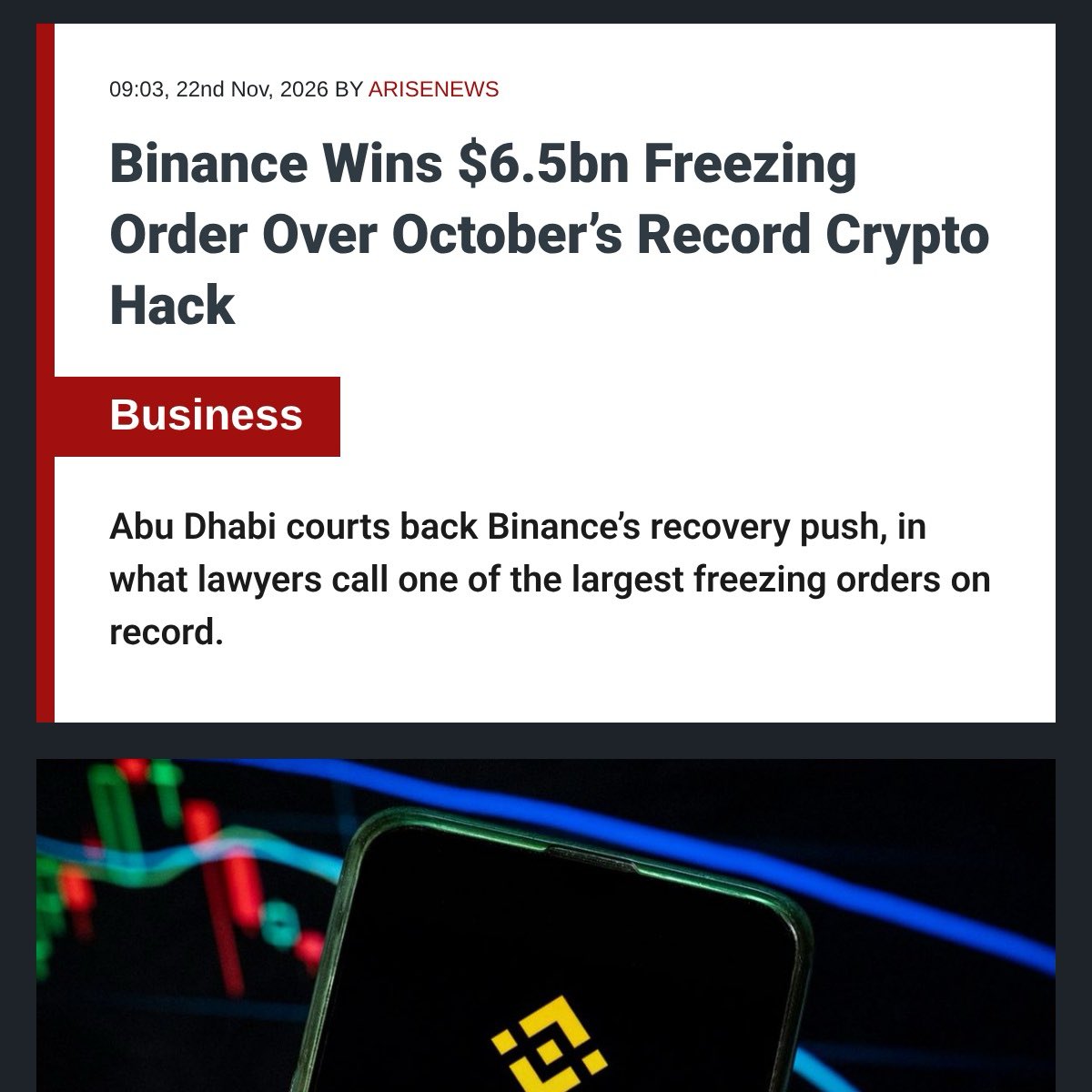
🚨 BREAKING: #BINANCE JUST WON A $6.5 BILLION WORLDWIDE FREEZING ORDER OVER THE BIGGEST HACK IN ITS HISTORY.
BUT ONLY $32 MILLION HAS REPORTEDLY BEEN RECOVERED. AND THE HACKERS ARE STILL MOVING THE MONEY.
→ 29 October: about $6.3 BILLION drained from Binance's hot wallets
→ The FBI blames North Korea. Pyongyang denies it
→ A court in Abu Dhabi has now granted a $6.5 billion worldwide freezing order
→ Frozen or intercepted so far, per Binance: about $2.85 billion
→ Reported recovered: $32 million
→ Elliptic: 2,310 BTC ($149 million) has already gone through mixers
→ Another 488,000 ETH ($860 million) has moved out of five wallets
Binance: "Users are protected, and Binance has absorbed the financial impact."
A court order can freeze an exchange account.
It cannot freeze a wallet in North Korea.
Will Binance ever see that money again… or is $3.5 BILLION already gone for good? 👀
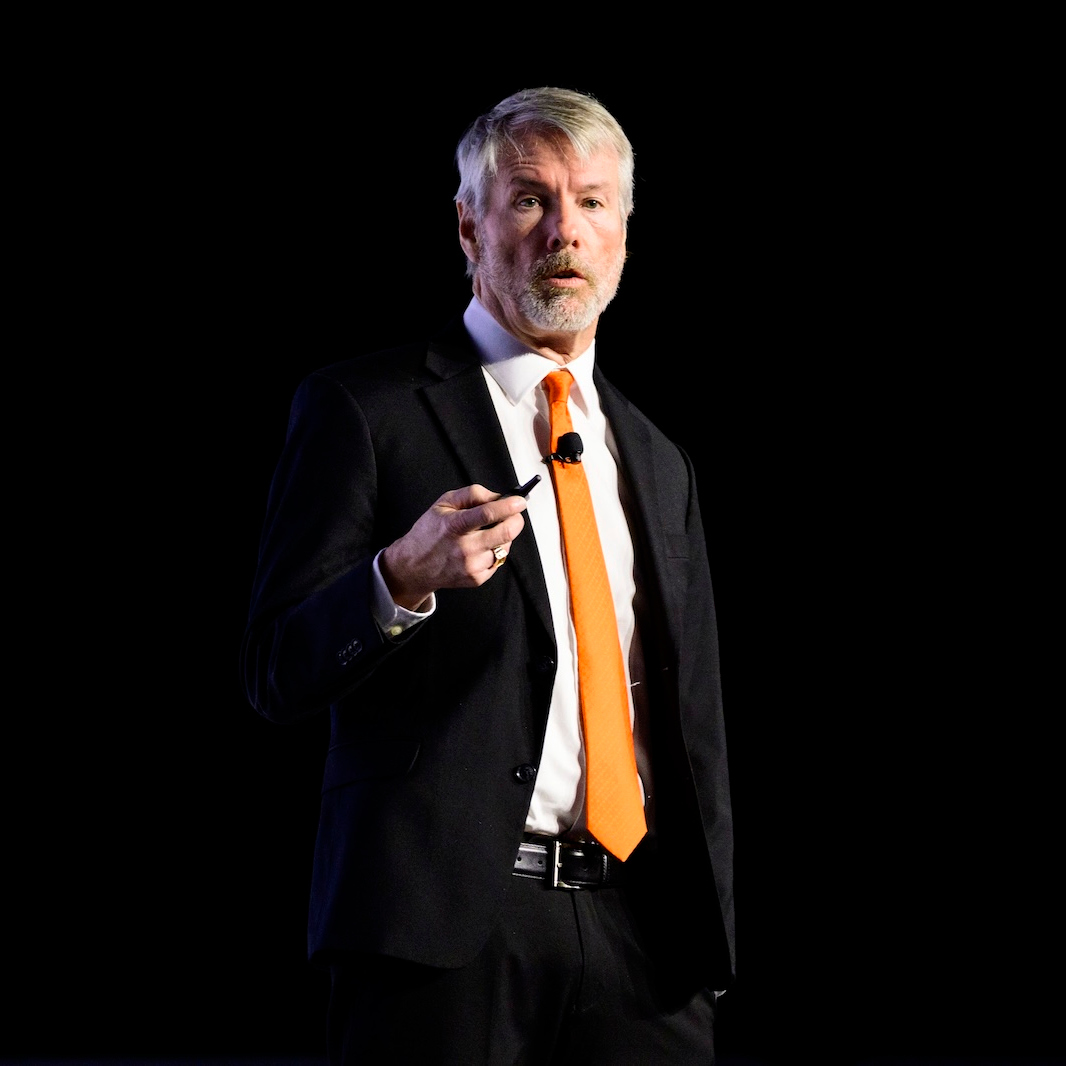
.@saylor’s presentation just now 👇
“If Bitcoin goes up 2.4% a year for the next century, we can pay all the yield and be just fine. If Bitcoin goes up by 10% a year we are doing phenomenal”
You don’t understand what’s coming…
Going into this weekend my mood wasn’t particularly the best, seeing your portfolio (which for me is 90% Bitcoin) being down 25% nominally is hard to cope with.
@saylor’s talk today at the @ITCConf refreshed me on exactly why I have those Bitcoin to start with, which you can forget when you’re caught in the short-term too often.
Heroically, Saylor said: “I’ll be buying $200 million a week to keep you afloat”.
If you are currently questioning your belief in BTC, I strongly recommend listening to 2-3 hours of Saylor’s speeches, you’ll be fine after.