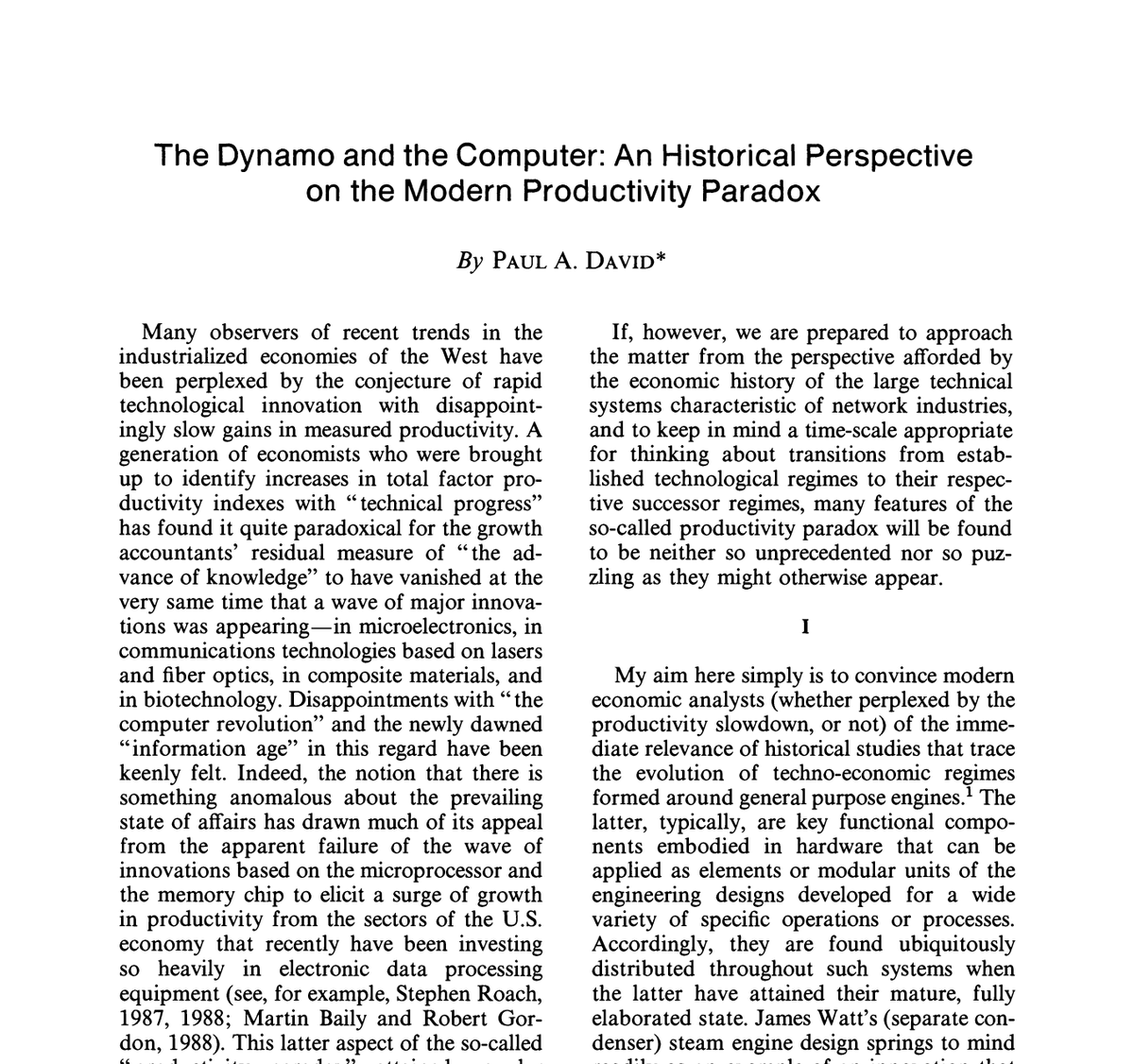
If you've adopted AI at your company but haven't seen any tangible results, read this 1990 article: "The Dynamo and the Computer" by Paul David.
When electricity first arrived, factories that "adopted" it barely got faster. They just swapped the steam engine for an electric one and ran everything else exactly as before: same machine layout, same workflow, same management. Electricity in, no real gains out.
The most common mistake with any new technology is to drop it into the old organization and then declare the transformation done.
The real leap came decades later, when each machine got its own small motor. Suddenly machines no longer had to be lined up around one central drive shaft. They could be rearranged around the actual flow of work.
The productivity gains didn't come from electricity. They came from REDESIGNING THE ENTIRE FACTORY around it.
AI is the same. Bolting it onto your existing process gets you a faster steam engine. The payoff comes when you redesign the work itself.
(link to paper in comments)
Andrej Karpathy's advice for beginners getting into AI:
"Put in 10,000 hours of work."
He's right.
But most builders waste the first 1,000 hours on the wrong things.
They write code before understanding context windows.
They build agents before understanding token limits.
They ship products before understanding what models can't do.
The builders who compound fastest aren't the ones who code the most.
They're the ones who understood the fundamentals before touching a single line.
These are the 10 concepts that make the first 1,000 hours count ↓
Bookmark this before you start.
Most healthcare reps are working from static lists in dynamic markets.
We just published new evidence showing why that fails:
Between Sept 2025 and March 2026, the top 10 fall prevention SNFs turned over completely. Not one facility from the earlier top 10 remained in the new one.
That is why account ranking beats spreadsheets.
Why Your SNF Target List Changes Every Month:
https://t.co/NSZkYjnv4Q
Elon Musk just put an expiration date on the medical profession.
And he gave it three years.
The interviewer asked when Optimus would be a better surgeon than the best surgeons on Earth.
Musk didn’t hesitate.
Musk: “Three years. I’d say three years at scale.”
Not a prototype. Not a lab experiment. At scale.
To understand why that timeline is plausible, you have to understand the fundamental problem with human medicine.
Musk: “Takes a super long time to learn to be a good doctor. And even then, the knowledge is constantly evolving. It’s hard to keep up with everything.”
Musk: “Doctors have limited time. They make mistakes. How many great surgeons are there? Not that many.”
That is the brutal reality of the greatest healthcare system humanity has ever built.
It runs on exhausted humans with biological limits, trained over decades, who can only operate on one patient at a time.
Optimus has none of those constraints.
It doesn’t get tired.
It doesn’t forget a study published last week.
It doesn’t have an off day. It doesn’t have a caseload limit.
And once you train one, you can manufacture ten thousand more with identical precision.
Musk: “At that point, there will probably be more Optimus robots that are great surgeons than there are on Earth.”
Think about what that actually means.
The scarcity of elite surgical skill has been one of the defining limits of human healthcare since the beginning of medicine.
Geography determined your odds of survival.
Zip code determined your access to expertise.
That bottleneck disappears overnight.
Because you can’t train human surgeons fast enough to meet global demand.
But you can manufacture infinite robots running identical perfect code.
The most valuable skill in the world is about to become software.
Infinitely replicable. Infinitely scalable. Available to every human being on Earth regardless of where they were born.
Medical scarcity doesn’t fade gradually under that reality.
It ends.
And whoever controls that code controls healthcare access for billions.
For all of human history, the leading cause of preventable death wasn’t disease.
It was the shortage of great people to fight it.
That problem has a solution now.
And it ships in three years.