Gemini 4 Carbon is being tested on the Arena platform under the codename "gemini-4-argon"—see the images in the comments for proof.
On the left is Gemini 4 Argon from Google AI Studio; on the right is "gemini-4-argon" from the Arena.
Comparing the two videos, Carbon appears more realistic in its details, whereas Argon leans toward a more cartoonish, vibrant aesthetic. Which one do you prefer? Do you think there’s an improvement?
@loveAIwang Haha, for some people who stay up all night, it's both a pleasant surprise and a torment. The torment is having to stay up all night for testing, haha 😂
@N1njaCodex At first glance, they seem pretty similar, but a closer look reveals differences in details and features—though, of course, the price points reflect that. Also, it seems Kimi might be open-source too! 😄
@itsfazley Wow, I feel like each has its own strengths. Overall, I prefer MiniMax for daytime scenes—the details are really well executed. On the other hand, DeepSeek looks very realistic; the lighthouse, in particular, is better.
@vib3coded Overall, they don't seem to have a huge difference, but the 18-fold cost reduction is indeed tempting. Have you ever tried having Kimi make secondary modifications that are better than Astra, and if so, did the cost increase compared to Astra?
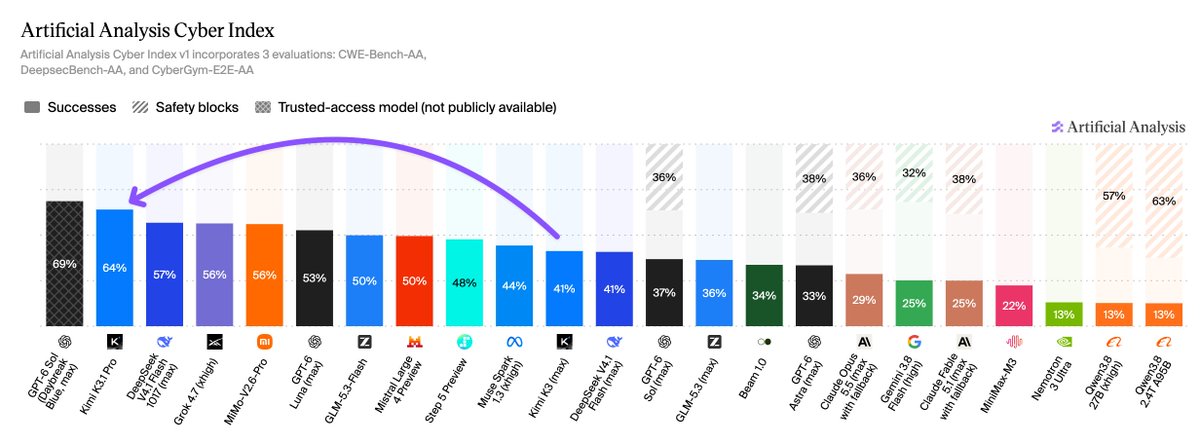
Kimi K3.1 Pro is the new #1 openly-available model for agentic cyber defense, behind only trusted-access model GPT-6 Sol (Daybreak Blue) on the Artificial Analysis Cyber Index
@Kimi_Moonshot's Kimi K3.1 Pro scores 64% on the Artificial Analysis Cyber Index, 7 points ahead of the previous leading openly-available model, DeepSeek V4.1 Flash 1017 (57%), and 5 points behind GPT-6 Sol (Daybreak Blue, max, 69%), which is only available through OpenAI's trusted-access program. Once the weights for K3.1 Pro are released, K3.1 Pro will also be the leading open weights model for cyber defense.
The Artificial Analysis Cyber Index measures capability on agentic cyber defense tasks and is composed of three benchmarks: CWE-Bench-AA, DeepsecBench-AA and CyberGym-E2E-AA. The Index primarily evaluates models through their publicly accessible APIs, reflecting the cyber capabilities available to developers.
Proprietary models from OpenAI, Anthropic and Google may have stronger cyber capabilities but lose points to safety refusals: GPT-6 Sol (Daybreak Blue, max), available through OpenAI's trusted-access program, scores 32 points above its public counterpart. Kimi K3.1 Pro encounters no safety refusals.
Key results:
➤ #1 openly-available model and #2 overall: Kimi K3.1 Pro scores 64%, up 23 points from Kimi K3 (41%) and ahead of DeepSeek V4.1 Flash 1017 (57%). Only the trusted-access GPT-6 Sol (Daybreak Blue, max, 69%) scores higher
➤ Highest CyberGym-E2E-AA score of any model: K3.1 Pro scores 95% on CyberGym-E2E-AA, placing it ahead of GPT-6 Sol (Daybreak Blue, 93%) and the next openly-available model, Mistral Large 4 (82%). On DeepsecBench-AA, K3.1 Pro scores 37%, behind GPT-6 Sol (Daybreak Blue, 48%) and GPT-6 Sol (46%). On CWE-Bench-AA it scores 61%, 4 points behind GPT-6 Sol (Daybreak Blue, 65%), with DeepSeek V4.1 Flash 1017 leading at 69%
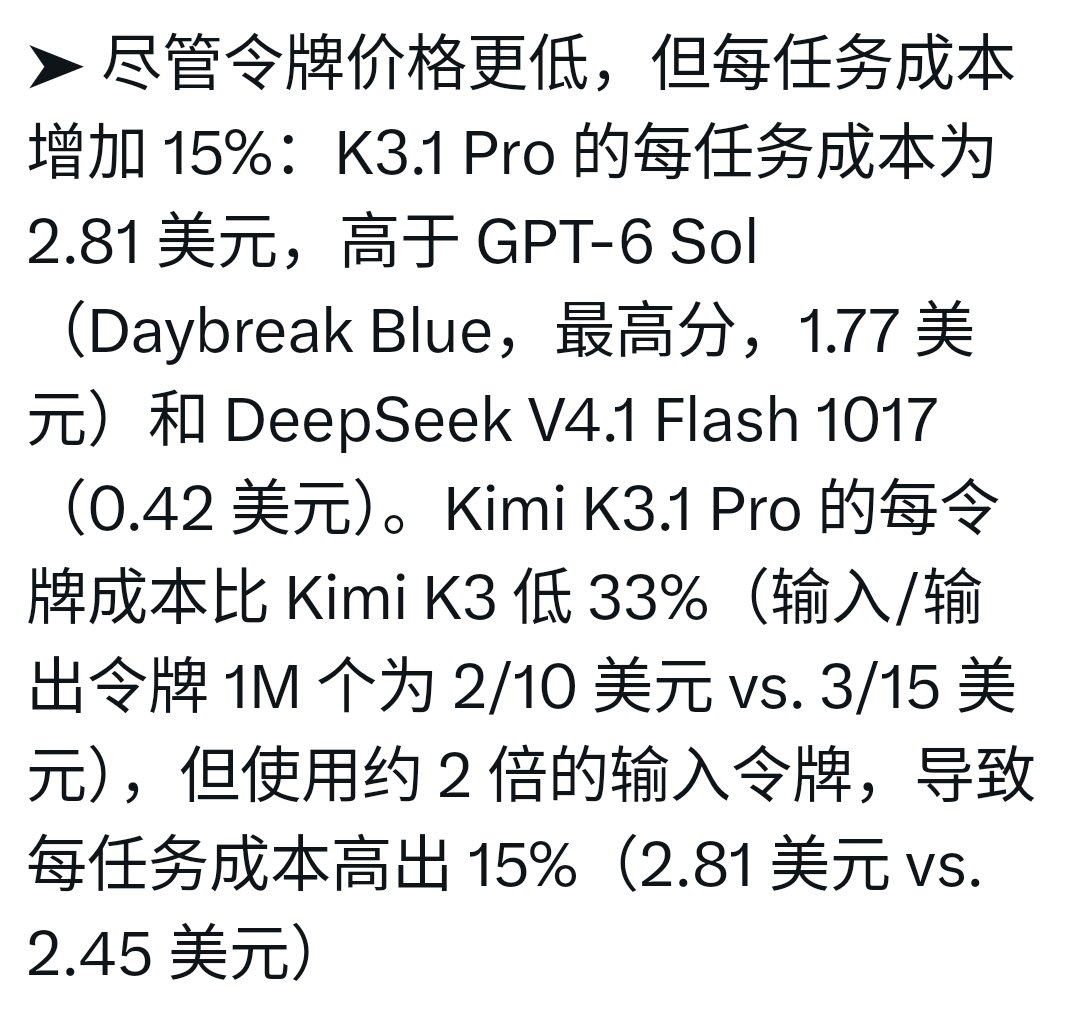
➤ 15% increase in Cost per Task despite lower token prices: K3.1 Pro has a Cost per Task of $2.81, higher than GPT-6 Sol (Daybreak Blue, max, $1.77) and DeepSeek V4.1 Flash 1017 ($0.42). Kimi K3.1 Pro is 33% cheaper per token than Kimi K3 ($2/$10 vs. $3/$15 per 1M input/output tokens), but uses ~2x more input tokens, resulting in a 15% higher Cost per Task ($2.81 vs. $2.45)
The main shortcomings lie in the long-range shots:
- During the day and in the early morning, the fog is too heavy; the tower appears dull and flat, lacking the necessary grandeur for a long-range view.
- At night, the structure is reduced to a mere silhouette, while the tower’s finial is excessively bright.
Additionally, there is a clear bug in this render: the control bar at the bottom is poorly laid out—the slider group overlaps with buttons like "Bell Striking" and "Auto-Orbit," which is visible in the video.
Actually, I also encountered a model on Arena codenamed "qwen3.8-max-0902." It produced a better pagoda model than the previous four I tested.
The beginning of the video isn't great, so feel free to skip to the middle to see the details.
I consider it superior not just because of the level of detail in the pagoda model, but also due to the clever design of the interactive UI buttons and a comprehensive, feature-rich interface. It’s got me wondering if I might have misremembered the name when I first noted it down.
Take a look for yourselves.which one do you think is better?
Same task, 4 models: an interactive 3D Chinese pagoda in one HTML file.
My take:
• Overall form: kibitiz (Arena) wins, with the most natural daylight too
• Detail: Claude Opus 5.5. The windows on every storey, the bells and the finial feel real. The deep eaves make it look a bit squat, though real pagodas can be built like that too
• Most dramatic eaves: Claude Fable 5.1, though it runs dark in daylight
• Courtyard and stone lanterns: all solid except Gemini 4 Argon
• Backgrounds: none really nail it, Opus comes closest
• Gemini 4 Argon falls behind, washed out by overexposure