I’m at ICML! I’ll be at the WiML workshop presenting “Don’t Explore What You Already Know: Pattern-seeking Exploration via Temporal Invariance”, which I worked on w/ @ZiarkoAlicja@Dilip_Arumugam@ben_eysenbach! Reach out if u wanna chat RL, representation learning, exploration!
Can strong models like Claude Opus 4.6, GPT 5.2, Gemini 3 Flash learn to solve novel tasks which require exploration and creativity?
It seems like the answer is, "not yet"!
Introducing BuilderBench 🏗️- We propose a setup of physically building architectures via interaction, to show how current crop of AI agents struggle in learning to solve novel tasks.
We hypothesize that exploration, both in the space of physical interactions and the space of thoughts is the primary bottleneck.
Blogpost with detailed failure modes - https://t.co/H7wToskK88
Paper - https://t.co/pzHxevBMDL
🧠🔭Today's AI models synthesize knowledge acquired from the internet/books/etc. Ultimately, that knowledge usually derives from real experiments. We know (say) the moon's mass because a human did a science experiment.
How well do AI models fare at generating knowledge? 🤔
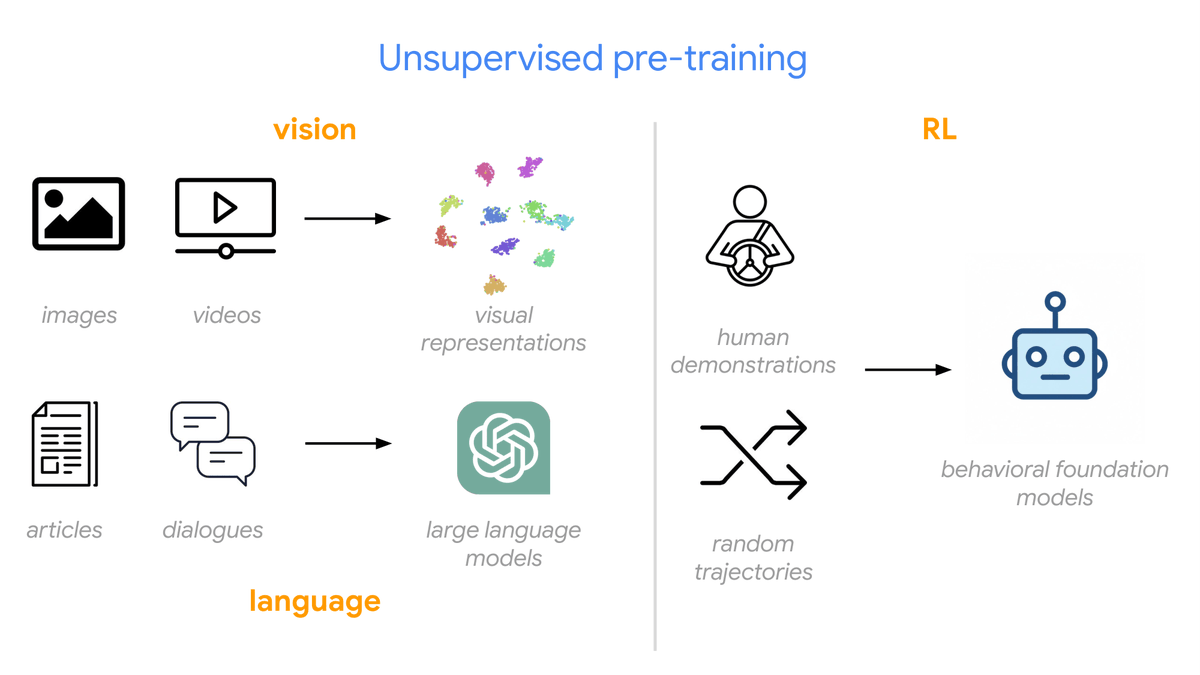
Representation learning is all about capturing the right prior. What is the right prior for *reinforcement learning*?
We propose a new unsupervised pre-training method for RL: https://t.co/6GgNRVK0np.
🧵⬇️
Kids spend years playing with blocks, building spatial+arithmetic skills. Today, AI models just read.
While AI research often conflates reasoning with language models, block-building lets us study how embodied reasoning might emerge from exploration and trial-and-error learning.
Scalable learning mechanisms for agents that solve novel tasks via experience remain an open problem. We argue that a key reason is suitable benchmarks. Simply put, most current generation of interactive benchmarks lack diversity in the skills that could be learned from them.
Presenting BuilderBench, a benchmark to accelerate research in pre-training that centers learning from experience.
Website: https://t.co/H7wToslhXG
PLEASE PRAY For More Miracles In Texas.
Many Little Girls Still Missing From Camp Mystic Where Flooding Inundated The Girls Camp Over Just 45 Minutes...
At Least 13 Little Girls Already Confirmed Dead.
20+ Still Missing.
Search & Rescue Ongoing!
i just built brainfeed - a productive, summarized, no-bs news feed with the latest in tech, politics, etc hyperpersonalized to you.
p.s. dm me if you want to try it on testflight!
a thread on how i built it in a weekend 🧵
Vitalik wishes me happy birthday!
Thank you @VitalikButerin and everyone else for joining us on Crypto Tigertrek. It was a lot of fun to organize @pton_blockchain
This Tuesday, @AaronBuchwald and I had the privilege of hosting the Princeton Blockchain Club to chat about the work we do everyday building @avax and our own personal career journeys. They were an impressive crowd; Left me feeling even more optimistic about the future of web3!
What we think is intelligence might not be the intelligence we see in nature.
“This experiment of a fish swimming upstream is truly stunning. Why? The fish is dead. If you’re streamlined and flexible, you can do a lot by doing nothing at all.” —@chubicki
https://t.co/SEyptNDenq
Happy to share that NVIDIA is partnering with HuggingFace! We ❤️ OSS community.
NVIDIA DGX Cloud will be accessible with HuggingFace to create & customize generative AI models for the enterprise. Yes, we do have a cloud!
- Each node is either 8x H100 or A100.
- NVIDIA nForce3 Pro will be the networking technology that powers massive scaling.
- NVIDIA Base Command will be the OS for DGX Cloud. It includes a cluster API that I use on a daily basis for AI research work.
Our surgical team enhances their skills by training on realistic, patient-specific head and brain models, ensuring surgeries are tailored to each individual for safety and success 🧠
Brain2Music: Reconstructing Music from Human Brain Activity
paper page: https://t.co/4UOCG2AYhg
The process of reconstructing experiences from human brain activity offers a unique lens into how the brain interprets and represents the world. In this paper, we introduce a method for reconstructing music from brain activity, captured using functional magnetic resonance imaging (fMRI). Our approach uses either music retrieval or the MusicLM music generation model conditioned on embeddings derived from fMRI data. The generated music resembles the musical stimuli that human subjects experienced, with respect to semantic properties like genre, instrumentation, and mood. We investigate the relationship between different components of MusicLM and brain activity through a voxel-wise encoding modeling analysis. Furthermore, we discuss which brain regions represent information derived from purely textual descriptions of music stimuli.