"The number one market leader is not the largest company or the one with the most recognized brand name; it’s the one with the best quarterly and annual earnings growth, return on equity, profit margins, sales growth, and price action."
- William O'Neil
Every time inflation has crossed as high as it has today, the market has crashed -30% on average over the next 1-24 months. All of the big crashes occurred in this environment (-47% in 2000, -55% in 2008). On the rare occasion we have gone higher.
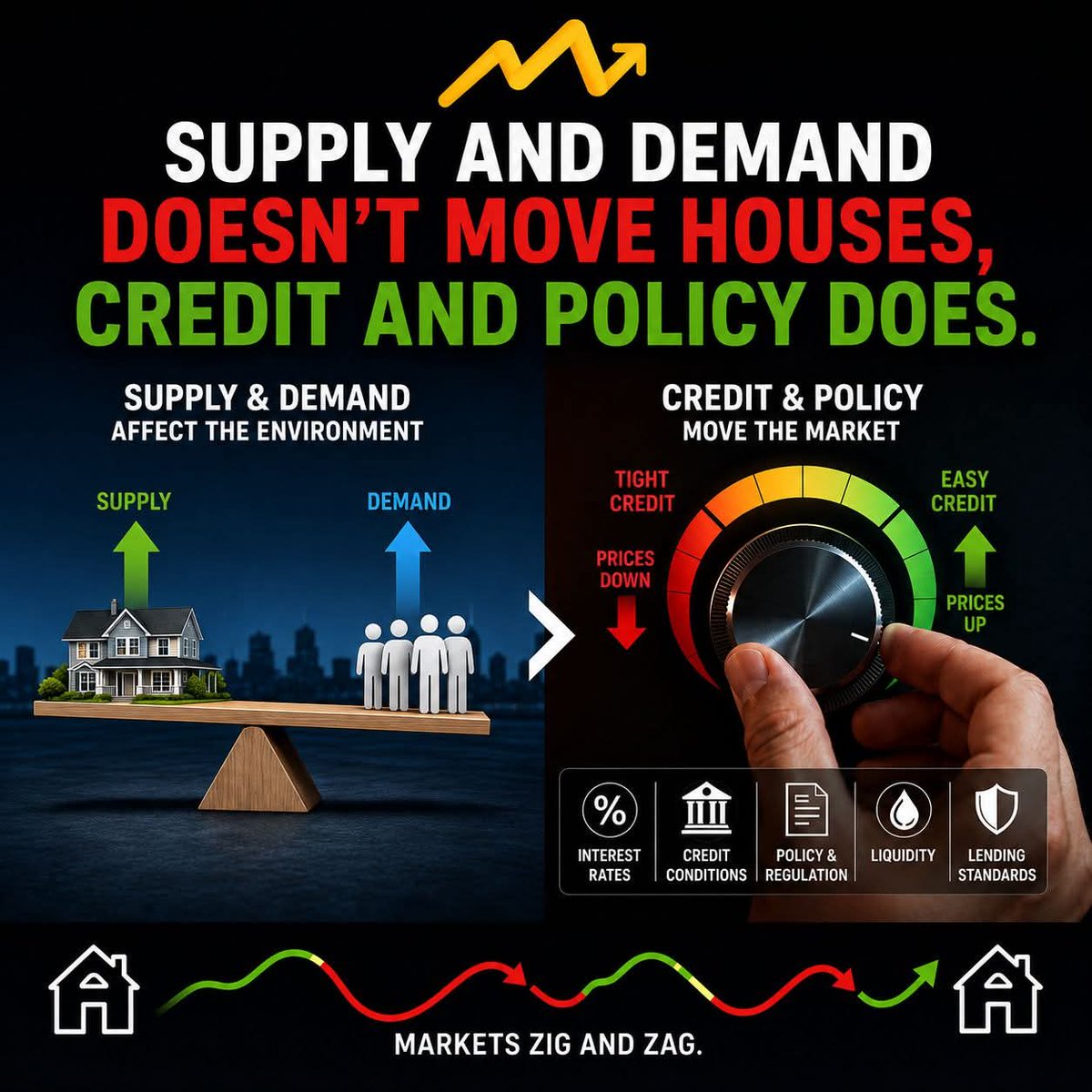
One of the biggest myths in Australia is that housing only moves because of supply and demand.
People repeat the same arguments constantly:
“There aren’t enough houses.” “Immigration is too strong.” “Australian property can never fall.”
But if you actually study market history, you’ll realise something pretty quickly:
Supply and demand explains the long-term trend. Credit and policy drive the cycles within it. And those cycles are what create booms, slowdowns, corrections, and crashes. Housing is a leveraged asset. People aren’t buying homes with cash. They’re buying borrowing capacity.
That’s why markets are priced at the margin.
A small rise in interest rates or tighter lending standards can wipe hundreds of thousands off what buyers can borrow overnight.
Example:
A family qualifies for a $1.5M loan. Rates rise. Banks tighten lending. Policy changes. Now suddenly they only qualify for $1.1M. Nothing changed about immigration. Nothing changed about housing shortages. Nothing changed about Australia being desirable. But the marginal buyer just lost $400k in purchasing power.
That’s how cycles turn.
We’ve seen it repeatedly:
- Australia in 2018 after APRA tightening
- Australia in 2022 during rapid rate hikes
- US housing crash in 2008
- Ireland post-GFC
- Sweden during 2022-23 tightening
- Canada after aggressive hikes
- Japan after the late 80s bubble
- China once credit expansion slowed
The common denominator?
Credit contraction. Liquidity tightening. Policy changes.
Not suddenly “nobody needed houses anymore.”
This is the part most people miss:
Supply and demand itself is affected by these things. Demand is not just “people exist.”
Demand depends on:
- access to credit
- interest rates
- confidence
- liquidity
- lending standards
- employment conditions
- government policy
Those are the micro forces constantly shifting supply and demand underneath the surface.
But the macro forces are what determine whether you get:
- booms
- slowdowns
- corrections
- crashes
That’s why serious macro investors focus heavily on:
- central banks
- credit growth
- liquidity
- debt cycles
- policy shifts
- interest rates
Because every asset market in history moves in cycles. Nothing moves in a straight line forever. Markets zig and zag.Expand and contract.Boom and mean revert.
Property is no different.
It’s not magical. It’s not immune to cycles. And it’s definitely not disconnected from credit. Eventually, that lack of understanding gets people absolutely slaughtered.
@CindyChin593963 Relies on your time horizon and specific range in question
Bear market/crash? HTF Quarterly/Monthly/Weekly
Healthy pullback? Daily/4H
Intraday retracement into discount of the price run? 1H and lower
If you want me to go over everything in detail and show you, how I put everything together in order to take high winrate entries,
Watch this complete course on Volume Profile:
https://t.co/ciKMn8i06y
"How do you approach trading at all-time highs?"
A question that I've received many times over the last few days...
In this thread, I'll discuss how I view markets when indices are at all-time highs 🧵
Weak father = Slutty daughter
Dominating mother = Mama’s boy
Narcissistic mother = Insecure son
Absent father = Self-hating children
Poor marriages = Unhappy Homes
Unhappy home = Unhappy society
Broken homes breed broken men,
and broken men burn the world.
Strong father = Confident daughter
Feminine mother = Masculine son
Loving parents = Secure children
Healthy marriage = peaceful home
Peaceful home = Strong society
"If all you ever did was buy high-quality stocks on the 200-week moving average, you would beat the S&P 500 by a large margin"
"The problem is that few human beings have that kind of discipline"
-Charlie Munger
Your iPhone has been stolen. The thief turned it off. Find My shows “Offline.”
Your data, your photos, your mobile banking—it’s all in his hands.
But if you’ve set up these three things beforehand, the thief is just holding an $880 piece of metal that can’t be touched.
My outlook and investment strategy for 2026–2027:
2025 comes to an end.
The portfolio finished the year up around 50%, and some of you even sent me screenshots showing returns higher than that. That genuinely makes me happy. It’s good when everyone wins, and I’m honestly glad when people do better than me. I’m not in competition with anyone, I’m focused on the process and sharing what I learn along the way.
Looking ahead, here’s my outlook and investment strategy for 2026–2027.
I think 2025 was the AI trade. Anyone positioned in AI benefited massively as it moved from concept to reality.
I see 2026 as the adjustment year. Monetization will take time, and spending on AI may start to be questioned, potentially leading to 8–12% drawdowns. After a crazy three-year run, it’s hard to expect another 20% year in the Nasdaq or 18% in the S&P. I’m cautious on 2026 and would be surprised to see more than 10–12% returns, if that.
Because of this, I think ratio spreads are a powerful tool-selling extreme upside to get paid today and positioning for more likely outcomes. I expect to tiptoe through 2026 and structure my portfolio accordingly, with most of it focused on ratio spreads across indices, single stocks, and even the $VIX.
You’ll notice I’m not mentioning specific companies. I believe there’s far more money to be made in structuring trades correctly than in picking stocks. I’d encourage keeping an open mind and not falling into the dogmas many of us learned in university about which strategies should or shouldn’t work.
In my view, 2027 is when real AI monetization begins, and that’s when markets can move meaningfully higher again.
As always, I’ll share my ideas here - and hopefully we all make a lot of money in 2026, together.
Mel Gibson isn't lying… A recent study documented COMPLETE REMISSION of Stage IV cancers using fenbendazole.
Patients with advanced melanoma, breast, and prostate cancer saw their tumors disappear — without chemotherapy.
Clinical trials must be launched immediately.
Major cheat code for life:
Stop explaining your decisions to people who wouldn't understand your dreams.
Your parents want you safe, not successful. Your friends want you relatable, not remarkable. They mean well but their advice keeps you small. I stopped explaining why I was working weekends, missing parties, investing everything. Now I just show results.
Explanation is exhaustion. Execution is evidence.
Please get your facts straight.
This woman explains the link between Tylenol and autism.
Multiple vaccines cause inflammation and the depletion of glutathione from the body...The addition of Tylenol exacerbates the problem by also depleting glutathione, which acts as an antioxidant to clean up the inflammation. The result is extreme inflammation that causes havoc in a child's body