@prithvi525@PanditRamJoshi I'm happy to look at the evidence and correct my understanding where needed.
No hidden motives here, just trying to get the history right
Gautama Buddha in 'S' tier for philosophical depth?
Let’s look at the facts.
When asked foundational philosophical questions about the existence of God or the nature of the Soul (Atman), Buddha famously remained silent or gave evasive answers (the Avyakata).
Furthermore, a philosophy that prioritizes universal asceticism (Sanyasa) as the ultimate goal is inherently unsustainable. If fully followed, it completely collapses the social, familial, and economic structures required to sustain human civilization.
As a Hindu Dalit, when I exercised my fundamental rights to write a book, false cases were filed against me, and I was jailed for a month.
My sincere gratitude to @HinduLegalFund elders for stepping forward and supporting my bail despite being strangers to me.
Fair point that Bhadrabahu may not have been the very first Jain here.
But ‘Karnataka was already a center of Jainism’ needs evidence. What inscription, monument or text shows Jainism in Karnataka before Bhadrabahu?
The earliest Shravanabelagola inscriptions about the migration are from around 600 CE.
Even the traditional story says the sangha came south because of a famine in Magadha, not because Karnataka was already Jain.
Jainism clearly grew big here later under the Gangas and Rashtrakutas, but saying ‘everyone here was Jain’ is as much an overstatement as my ‘zero.’
@naadu_nudi language politics is as Right Wing/Hindutva thing?
dude do you have any ideas as to what Dr Ambedkar said about those who object to Hindi as the only official language of all states and central govt?
looks like Arun doesnt know anything about Instrument of Accession and Privy Purses, but Ranganna has answered rightly in another video and has spoken about Instrument of Accession
The Mysore Maharaja was entitled to the full ownership, use and enjoyment of all private properties (as distinct from State properties) belonging to him on the date of this agreement
The Maharaja and the members of his family shall be entitled to all the personal privileges, dignities and titles enjoyed by them whether within or outside the territories of the State immediately before the fifteenth day of August 1947
The Government of India guarantees the succession according to law and custom to the gaddi of the State and to the personal rights, privileges, dignities and titles of the Maharaja
source - https://t.co/XX61AzSnz1
nope this is not the right answer
reincarnation doesn't mean the soul gets a human body again, depending on their present activities it can be born as an animal, plant etc
In Vedic theology, the human body is viewed not as a permanent destination, but as a rare junction point (bhoga-tatsa-sadhana)—a unique vehicle equipped with viveka (intellect and discrimination) to achieve spiritual liberation (moksha). If a conscious agent misuses this intellect to act purely on primal instincts (eating, sleeping, mating, and fearing), the metaphysical architecture of samsara dynamically accommodates those desires by providing an animal or plant body better suited to express that unrefined consciousness.
Chandogya Upanishad (5.10.7)
"Those whose conduct here has been good will quickly attain a good birth... But those whose conduct here has been evil will quickly attain an evil birth—the birth of a dog, the birth of a pig"
Katha Upanishad (2.2.7)
"Some souls enter the womb to have a body as organic beings, while others go into stationary things (plants, trees, or minerals) according to their deeds and according to their thoughts."
Bhagavad Gita (14.15)
“Dying in Raja-guna (passion), one is born among those attached to work; dying in Tama-guna (ignorance/darkness), one is reborn in the wombs of the unintelligent [animal kingdoms].”
Oh, Friedrich… Was hast du bloß gemacht?
A Rogue disciple of the German Idealists, hurling the ultimate taunt at the founding fathers of Indian Idealism… Hmmm.
How strange that Indian Idealists have never critiqued this new school of thought called Existentialism—even though it was a group of Cittamātravadins, led by Bodhidharma, who undertook the first radical deconstruction of 'religious-morality' in the history of philosophy. And many of the conclusions of that grand experiment seem to reappear in Nietzsche. 'Kill the Buddha!'
But for today, we shall judge a book by its cover. No more, no less. 'Thus Spake Zarathustra'
For a magnum opus that asks its readers to transcend good and evil, this is the ONE title that should never have been used. And Atharvan Zarathustra—the one man who should never have been elevated to the high honor of being mascot for such an ambitious philosophical project.
The fire priest who divided the whole universe into good and evil.
But who was he, really, this Zarathustra?
We must travel back in time, four thousand years, to the age of the Sapta-Sindhu Civilization. Because the events imagined in Nietzsche’s book actually transpired in ancient India, in the territory remembered as Gandhāra, on the banks of the Rasa river.
There dwelt the Atharvans, the infamous clan of fire priests. And among them, one Atharvan of the Spitama family rose to absolute power: the Dakhyuma of Rangha, the priest-king of the Dasyus and the Dāsas, with all temporal and spiritual authority concentrated in a single man. How dangerous! Kshatra and Brahma should always be separated...
He turned the old Indo-European religion upside down. He divided everything into good and evil. Even the animal kingdom was not spared. There were animals belonging to the Asura and animals belonging to Angra. Even the gods were torn apart into Devas and Asuras. He even laid down the foundations of monotheism. His changes triggered internecine war between brothers, permanent schism between Indo-Iranians, the Paurava and the Anava, and brought the joint civilization continuum to an end.
And so I ask you, Friedrich: you who boldly proclaimed 'the transvaluation of all values is begun'; you who commanded the Germanic mind to transcend good and evil—did you know what you were doing when you chose the Atharvan as your alter-ego?
Sag mir, Friedrich....
@RohitMishra2024@Swamy39 Well these un verifible claims do not hold any weight
this मैं नहीं बताऊंगा means I am lying
I can also say Swamy was caught in a financial fraud hence Modi kept him away
The Jain tradition says Rishabhadev introduced the foundational arts of civilization.
He taught the science of numbers to his daughter Sundari, and the art of writing (Lipi) to his other daughter, Brahmi.
Because he first taught this script to his daughter Brahmi so she could master writing, the script became known within Jain tradition as Brahmi Lipi
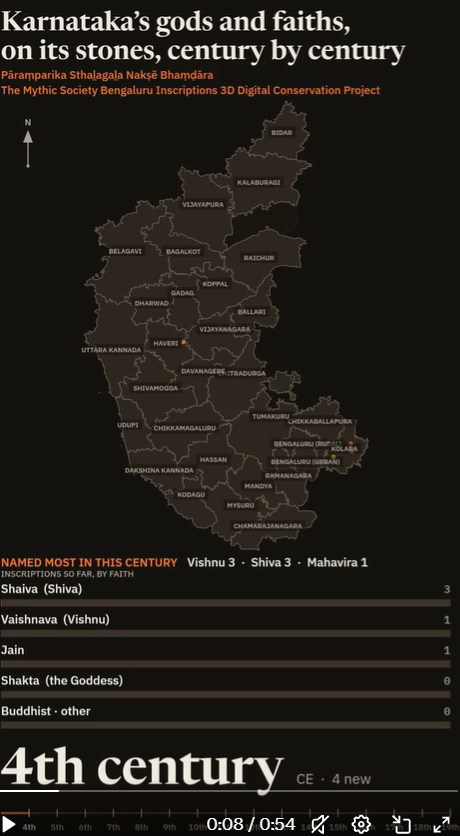
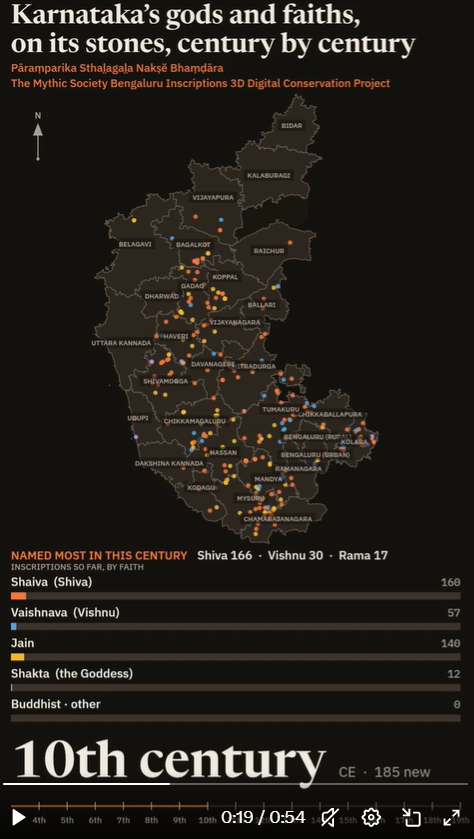
This data from Mythic Society is a great tool to combat the nonsense that is often posted on X, saying Karnataka was all "Jaina faith" and other faiths usurped it due to some "conspiracy".
Since I can post only 4 images in one post, let's look at the data in the 4 images - corresponding to 4th, 6th, 8th & 10th centuries - Pre-Hoysala times.
Here are the cumulative numbers, by what is indicated in the invocatory verses:
4th C - > 3 Shaiva, 1 Vaishnava, 1 Jaina
6th C -> 8 Shaiva , 7 Vaishnava, 2 Jaina
8th C -> 38 Shaiva, 24 Vaishnava, 39 Jaina
10th C -> 160 Shaiva, 57 Vaishnava, 140 Jaina
So where is the "all Jaina" period in the history of Karnataka? Don't get me wrong. Jainas were part of the Karnataka population for a long time, but the area was NEVER EXCLUSIVELY Jaina, as it is made out to be by some handles here.
How does it follow in later centuries? See the reply.