Even if dead and diseased children do not move you, USAID is a direct investment in America's prosperity, security, and global power.
We create new markets and trading partners by helping nations transition from crisis-mode aid recipients to stable, thriving economies. This goes double for nations that did have stable infrastructure, but are weathering civil war or natural disasters. The support also keeps people from becoming economic migrants to Europe or the US.
The wealthier these developing nations become, the more that they can cultivate markets to buy American exports of luxury goods and services. We also have a large agricultural sector that can and should sell to other countries rather than being subsidized by tax payers not to grow more food that Americans do not need.
When America invests in government stability abroad, especially in transportation infrastructure and education, it reduces extremism, civil wars, and the need for expensive military interventions. This saves American lives and, once more, decreases the level of migration that can destabilize surrounding destination countries that are close to the brink themselves. Refugee camps are net-recipients of aid, and often full of people that cannot work. Reducing refugee camps is a net good.
Also, USAID was the most powerful tool of soft power America had outside of its cultural output. We get access to alliances, overseas operational bases, and ways to counter the influence of China, Iran, or Russia that we otherwise would not have access to, for pennies on the dollar. Further, we do it in a nice aid package that you can sell to the peaceniks with the picture of starving children, rather than being honest that we're seeking Forward Operating Site/Bases.
Even outside of purely military security, USAID keeps us save by giving advance warning of pandemics and outbreaks at their source before they start arriving at JFK. We can keep an eye on how dangerous strains of zoonotic diseases are mutating and where hotspots are, so we can respond quickly and shut down borders or restrict migration before we get to pandemic levels of spread. This also lets us keep an eye on diseases like TB, which America doesn't much worry about anymore, but could become antibiotic resistant and quickly overwhelm us once more if we do contribute to curbing overseas spread.
On further security grounds, allowing USAID to hand out assistance to those only that do not participate in illicit networks keeps people out of the international drug and weapons trade. Those drugs wind up in our country, and those weapons cause civil wars that create migrants that want to come to America. Reducing the desperation that drives illegal migration worldwide is positive.
All told, USAID was our global insurance policy. For a fraction of the total federal budget, we stabilized volatile regions, combatted transnational threats, and built partners we rely upon for future growth and safety.
But we threw it away because uneducated vice-signaling dorks thought being mean to other people on purpose to piss off the libs is way more important than America's best interests.
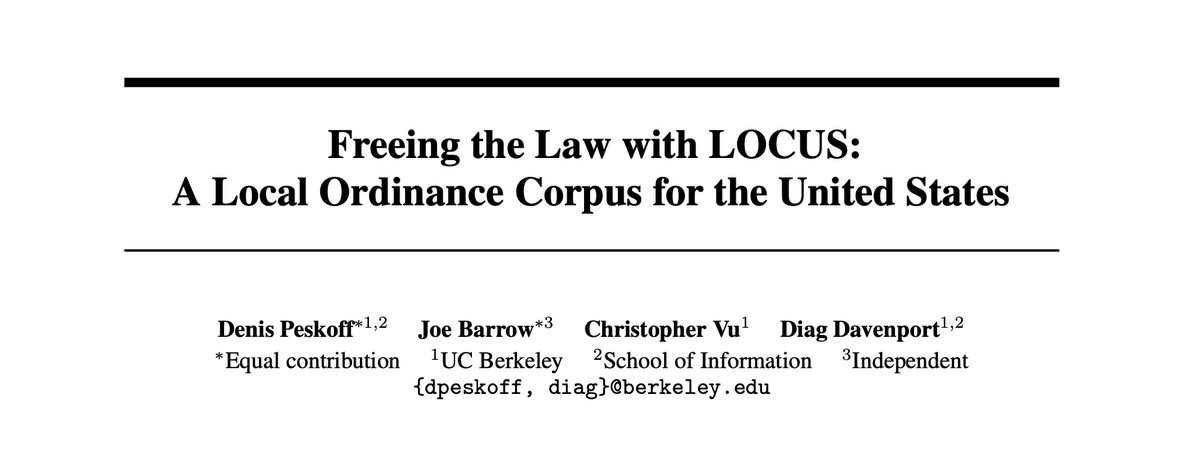
New paper: every law in America is technically public. But not really, until now!
With @DenisPeskoff at UC Berkeley, we built a corpus of ~every publicly accessibly city and county law, and released a huge chunk of it!
2.2 million laws, you're (probably) covered in it!
🧵
@Noirchick1 I remember being surprised when I watched Hoopla because I didn't expect her voice to be anywhere near that deep and husky, but she's so wonderful it really doesn't take long to get used to it.
For the first time yesterday, I experienced the new @alamodrafthouse QR code ordering system and I can tell you it’s truly awful. Rather than making ordering food and drink more efficient, it actually adds steps to the process AND if you want to order additional items during the film you HAVE to open your phone. No, your cute reference to that irony in your How To Alamo video doesn’t negate how ridiculous this is. Please don’t cut corners with your staff and revert back to physical menus and order cards.
Toru Miyazaki gave 11 cats with advanced kidney disease an experimental injection. 15 others didn’t get it. A year later, 9 of the 11 treated cats were alive. Only 3 of the 15 untreated cats survived. He just filed for approval, and the drug fixes a defect only cats have.
Most cats die from one thing: their kidneys fail. By age 10, 4 in 10 cats already have chronic kidney disease, and by age 15, the rate doubles to 8 in 10. Once diagnosed, a cat has about 2 years left.
The reason kidney disease hits cats so hard is a broken protein in their blood. All mammals carry a protein that helps the kidneys clean out waste. In humans and dogs, the protein floats freely and goes to work when the kidneys are in trouble. In cats, it stays stuck to another protein and can’t get loose. So the waste piles up, and the kidneys eventually give out.
Miyazaki originally found the protein in 1999, back when he was at the University of Tokyo. He figured out the cat-specific glitch in 2015. The paper he published in the Veterinary Journal in February laid out the trial. The injection is a working version of the missing protein. His company, the Institute for AIM Medicine, filed the approval paperwork with Japan’s Ministry of Agriculture on April 24, 2026. If the review clears, the drug goes on sale in spring 2027.
The 30-year lifespan figure in the tweet is Miyazaki’s own projection of what cats could reach without kidney disease. The trial only ran a year, and the average cat today lives 15. Most die from the same disease this injection treats.
The research almost died in 2020. After running out of funding during COVID, Miyazaki went public. Cat owners across Japan responded by sending in 300 million yen, around 2 million dollars total. He resigned from the University of Tokyo and worked on the drug full time. The treatment in front of regulators today exists because cat lovers refused to let the research die.
Aziz Ansari just appeared as Kash Patel on SNL, and they went innnnn on him
"I'm a trailblazer. I'm the first Indian person to suck at their job. Everyone says Indian people are smart, hardworking, incredibly intelligent. I prove without a shadow of a doubt that we can be just as incapable and incompetent as the whites."
The National Park Service ran on a $3 billion budget and generated $56 billion in economic output in 2024. That’s over $17 back for every $1 invested.
With a record of 332 million visitors last year, Americans clearly care about their parks and expect them to be funded.
Some good news: Since 2024, over 700 independent bookshops have opened. Print book sales have risen in each of the last two years. Denmark and Norway are spending millions to get screens out of schools and bring books back. *This* is what real progress looks like.
To say nothing of far more robotic exploration. We wouldn't still only have a single probe to Uranus and Neptune that never got followed up. Hell, we could at least be talking about a nuclear pulse propulsion interstellar probe.
But nope, we're just getting back to 1968 again.
One always has to wonder how far we actually would have been by now if Congress had continued to fund NASA at Apollo levels (~2-4.5% of the federal budget) instead of gutting it (~0.5% of the fed budget pre-DOGE cuts) as a reward for *landing on the damn moon*.
"Deep corners of the universe" is a stretch, but permanent moon and Mars bases, semi-affordable commercial flights to the former, manned missions to the outer planets either ongoing or at least on the books? Yup.
we live on a planet where trees warn each other of danger through underground networks. where octopuses dream. where elephants return to the bones of their dead and stand over them in silence. where bees communicate through dance, showing each other where to fly. where flowers bloom...where crows remember human faces -especially those who were cruel to them - and pass that memory on to their young. where ants build entire cities. where cats purr at a frequency that can help heal bones. where forests, after fires, grow flowers first.
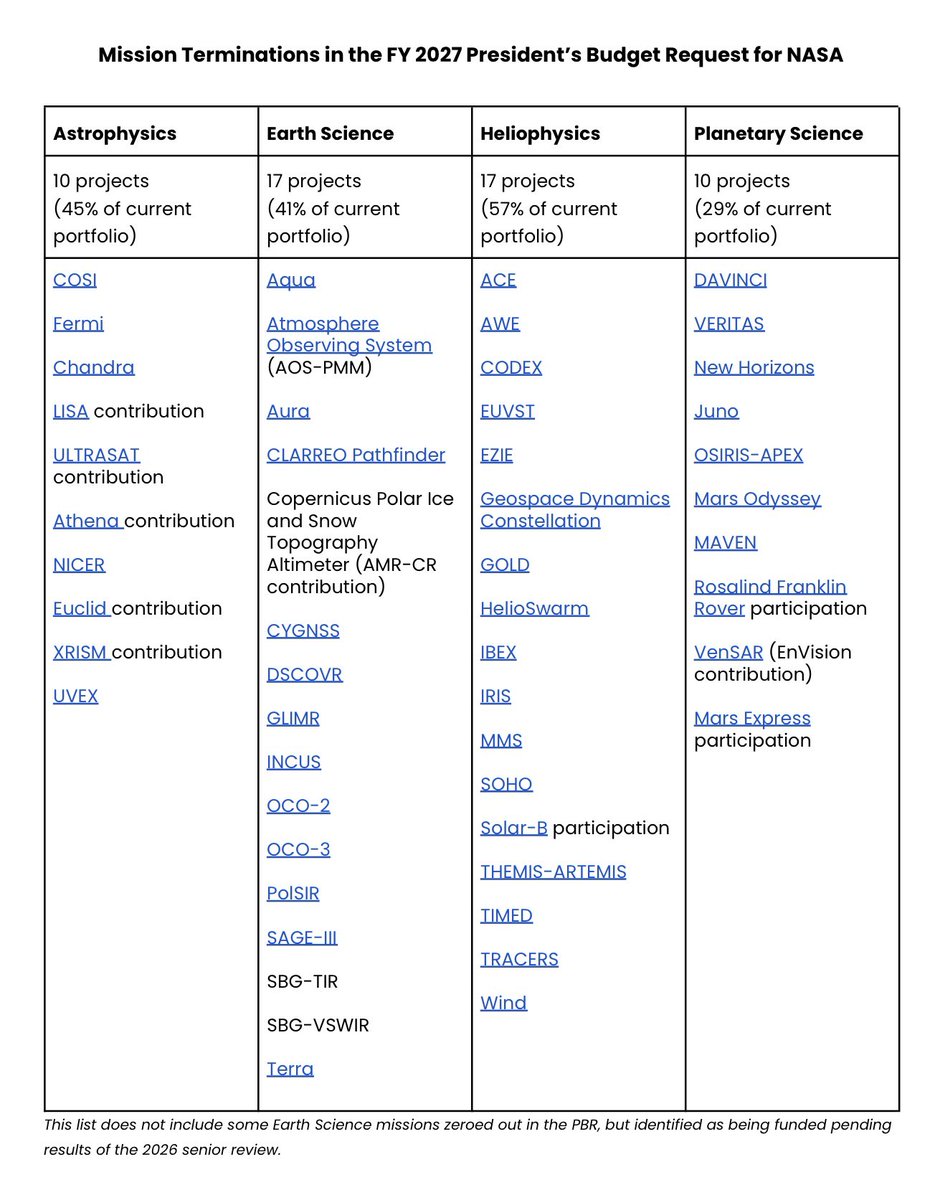
Here is the list of NASA science missions that the Trump administration proposes to terminate.
Note that it includes many missions that are already in space, fully operational.
This is a wrecking operation against America.
Ok, now that our astronauts are back safely after a generationally-inspiring mission, can we all agree to oppose Trump’s slashing of NASA science budget by 47% and the entire NASA budget by 23%?