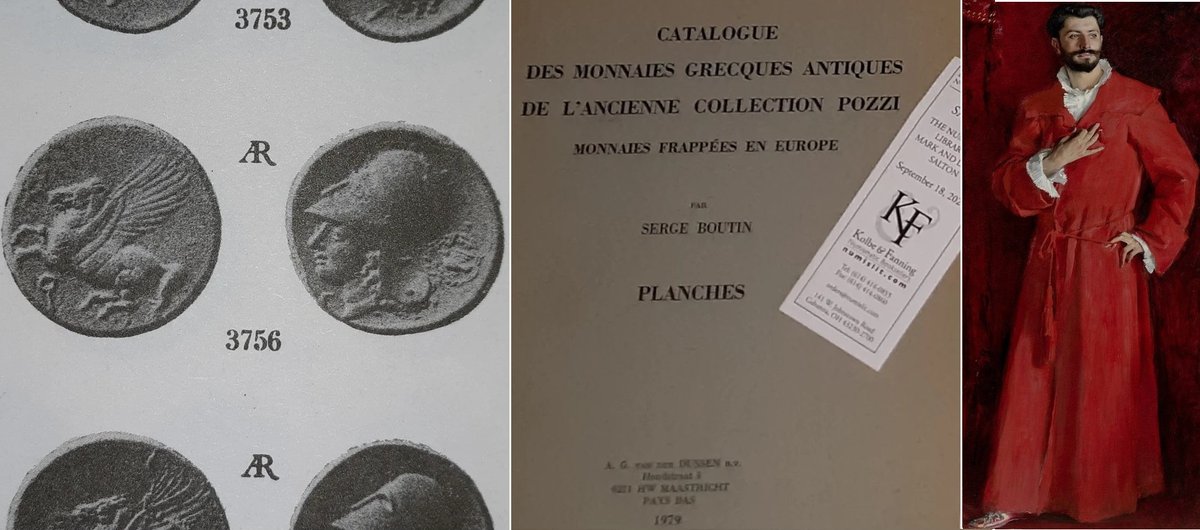
One of my first coins in 1991, Corinth Stater (4th BCE). After 30 years I learned it was once Dr. S. Pozzi’s (1846-1918; Ars Classica I). Just now I’ve found it was also in Valerio Traverso’s Collection (Baranowsky 1931). A few more decades & I'll know where it resided 1931-1991!
@1ALbryan Thanks! Just paging through every plate of ancient coins I can find, one catalog at a time. Some collections I look at often (e.g., Pozzi, Weber, Lockett) but this was my first time going through all the old Baranowsky sales on BnF-Gallica (via rNumis) https://t.co/rcNtcmADOE
Any ideas what this is? Trajan RY 12 (108/9), Alexandria. Not the usual arcade-style Triumphal Arch (same statues), mystery legend ΒΑΛAΝΗΟΥ (odd genitive)? Maybe related to Trajan’s “Nymphaeum” Drachm? Propylaeum of Thermae Traiani or Alexandrian baths? https://t.co/1LBcT9lxef
@histories_arch Interesting: Very similar to the Dacian gold coins of Lysimachos & "Koson" (w/ NO monogram) types, about 85٪ gold or so & 10-15% silver. (The monogram-Koson gold were much higher Av, presumably from a non-Dacian source.)
As reported in Vilcu et al 2010 https://t.co/yQSl3m2jif
(5 of 5) As was often the case, Bruce McNall’s EID MAR Aureus was unknown prior to his NFA XXV (1990) sale. It appeared again in Sotheby’s 1993 Athena Fund liquidation sales. Last I heard, it had been displayed at Deutsche Bank Money Museum & loaned to British Museum at one time.
(1/5) A few favorites of the Brutus EID MAR Denarius & Aureus from my private collection (of 20th century ancient coin auction catalogs).
Many have interesting backstories & repeatedly in my numismatic library over the generations.
Can you recognize the repeaters (2X2)?
(4 of 5) How things changed: In 1930, it was a big deal that Jacob Hirsch illustrated & gave weights & diameters for every Naville-Ars Classica coin. In 1990, the Sotheby’s Hunt Coll. sale dedicated 3 pages to that one coin!
(Yesterday I posted my Elis AE from Ars Classica XV.)
@RobertJ09323900@Karl_Lucid@archeohistories TREXEDIPNOC (Trechedipnos): Run to dinner.
I guess the sun-dial is saying he is late, he better hurry if he doesn't want to go hungry
@JulienOlivier45@laBnF Étrangement, le Peltast de Pelinna a aussi souvent une autre lance (ou deux autres!) dans sa main du bouclier. Même chose pour les petites (Obol, 0.82g / 13mm, Coll. S. Pozzi 1236, et al.):
Nicomedia was among the cities that worshipped Antinous after his death in the Nile in Egypt. There are coins confirming that the young Bithynian was heroised, as he is shown on coins with the legends ‘ΗΡΩϹ ΑΝΤΙΝΟΟϹ’ (hero Antinous) on the obverse and ‘Η ΜΗΤΡΟΠΟΛΙϹ ΝΙΚΟΜΗΔΕΙΑ’ (Nicomedia the Metropolis) on the reverse. Bithynia saw the importance of Antinous in linking the birthplace with the empire and wanted to commemorate him as a divine local hero as well.
History of controversial dating:
Franke (1984, before he got this one) argued 4th-3rd BCE.
Others: 3rd or 2nd (Wroth, Wojan, Moustaka).
Nicolet (1998) & Warren (1999, JA not EP!): c. 30s, Antony & Cleopatra.
Making the thunderbolt Ptolemaic.
AE Diassarion or Dupondius-equivalent
Lost & Found Collection History:
Olympia, Elis. 30s BCE. Hera & Eagle. Ex P.R. Franke (1926-2018) Collection, sold w/ no further provenance. But I recognized it:
Ex Christopher Morcom, Col RK Morcom (1877-1961), E.P. Warren (1860-1928) [Ars Classica XV], G. Philipsen (1853-1925)
And surely ex hoard IGCH 216 (Wroth, NC 1905: 334f., c. 1887-94), a nearly complete chain-of-custody for >100 years (or 2,000, depending).
See: https://t.co/SJeeV7xlhQ
Wroth: https://t.co/KtruS5cMlN
Earle-Fox 1898: https://t.co/VOusoOqbE4
BCD Olympia 307: https://t.co/6OMbCCDEfv
@KoinonJournal Bizarre! Acheloos may have had his revenge. The coin must've crossed any number of rivers in transit, all opportunities to summon a spirit from his network. But when a coin is lost, I remember the saga of the Peyrefitte-BCD Antinoos (there's always hope!) https://t.co/XTIhS2B4hg