A super long overdue (3+ years?) post on scaling laws.
Compute is expensive. Scaling laws are a way to help us reason about the optimal compute allocation between data and model size before committing to a large run.
The post covers what scaling laws predict, how compute-optimal allocation works, why Kaplan et al. and Chinchilla disagree, and how data limits + fitting details make extrapolation tricky.
https://t.co/HP26eJvjHB
Feynman: "We know a lot more than we can prove" 🤔
Deng: "For me personally, an important reason is that I don't particularly like pure theory. I feel that in this world, the truths that can be rigorously proven are actually very limited, but the truths you can feel are very numerous. Many principles are more like a feeling or an energy, and it's hard to express them completely in mathematical form. But in mathematics and theoretical computer science, your conclusion must be rigorously provable, written on paper, before people will accept it. In AI, as long as you observe certain phenomena through experiments and intuitively feel they are correct, even if you can't fully convince everyone, you can gradually build your own system of understanding. This approach to understanding the world through intuition and experimentation appeals to me greatly. And this approach lets you discover patterns much faster than disciplines that rely on rigorous proofs."
My 6yo cousin's lemonade stand was doing $2/day, so we pivoted to GPU rentals.
Nvidia acquired him for $1.8 billion.
He's currently learning how to spell Jensen.
Craziest part is we all knew each other already in high school! Along with @randomjohnnyh (Perplexity cofounder), @demi_guo_ (Pika CEO), @stevenkplus1 and Andrew (Cognition), and many others. We all grew up in different states but met thru the olympiad scene.
Vividly remember this line from @alexandr_wang when we were around 19: "I hear people saying they want to find the next Paypal mafia. Why shouldn't it just be us?"
Glad to see @chameleon_jeff get the recognition he deserves :)
When you ask ChatGPT a question, the time before the first word appears is called time-to-first-token (TTFT). It is the LLM equivalent of page load time and one of the biggest factors in whether an interaction feels responsive or sluggish. Who wants that? Not me, and hopefully not you either, because there is a better fix.
TTFT matters a lot. Users start abandoning interactions after a few seconds of staring at a blank screen, regardless of how good the eventual answer is. Who cares? Industries that monetize attention do.
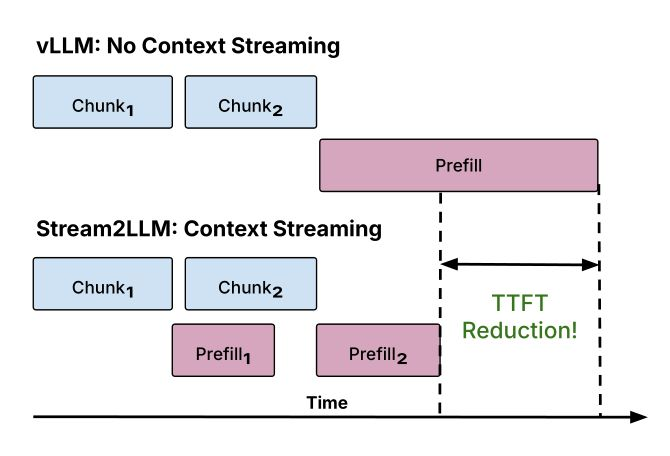
Here is the problem: modern LLM applications increasingly rely on external context, such as web search, vector databases, and document retrieval, to provide accurate, up-to-date answers. This retrieval can take from hundreds of milliseconds to several seconds. Traditionally, the model waits for all of that context to arrive before it starts processing. In other words, TTFT = retrieval time + prefill time, and retrieval usually dominates.
The fix seems obvious: stream context to the model as it arrives, overlapping retrieval with prefill. For a single request, this works well. But production systems serve many requests concurrently, and this is where things get ugly. Concurrent streaming requests compete for GPU compute (scheduling slots), and GPU memory (KV cache residency). Without the right scheduling policies, TTFT latency can become 5x worse than with no streaming at all.
We built Stream2LLM to solve this. The gains come from better scheduling and more efficient GPU memory management. The details are in the paper.
On real-world web crawling and vector search (ANNS) traces, Stream2LLM achieves up to 11x faster TTFT with negligible throughput loss. That means you can significantly reduce TTFT without paying a meaningful throughput penalty.
Paper (MLSys 2026): https://t.co/nz8JwPWu8L
Code: https://t.co/cYJC9caK5u
Project members: Rajveer Bachkaniwala (me), Chengqi Luo, Richard So, Divya Mahajan, and Kexin Rong at Georgia Tech.
We are disappointed to see that the TurboQuant team has not directly responded to our concerns majorly on Openreview. Their reply even suggests that we had not raised these technical points to them through academic channels over the past year, which is factually incorrect.
We have submitted our email records with the TurboQuant team to ICLR Chairs. According to ICLR Code of Ethics “Researchers must not deliberately make false or misleading claims, fabricate or falsify data, or misrepresent results. Methods and results should be presented in a way that is transparent and reproducible. ”, we respectfully request that ICLR initiates a formal research-integrity review of this paper.
Excited to announce our latest (submitted to) SIGBOVIK 2026 @sigbovik paper: "SchmidhubAI: Accurate Historical Paper Attribution". We built an AI system that, given any modern AI paper, automatically determines which of its ideas were already published by Jürgen Schmidhuber.
@NeurIPSConf This statement reads like an author rebuttal after getting 1/1/1 scores: We thank the reviewers for their valuable feedback. The concerns raised were due to a miscommunication and have been addressed in the revised version.
The TurboQuant paper (ICLR 2026) contains serious issues in how it describes RaBitQ, including incorrect technical claims and misleading theory/experiment comparisons.
We flagged these issues to the authors before submission. They acknowledged them, but chose not to fix them. The paper was later accepted and widely promoted by Google, reaching tens of millions of views.
We’re speaking up now because once a misleading narrative spreads, it becomes much harder to correct. We’ve written a public comment on openreview (https://t.co/nDVjmNhATM).
We would greatly appreciate your attention and help in sharing it.
A great video by @jbhuang0604 about DeepSeek's Manifold Hyper-Connections paper!
walks through the equations step-by-step
honestly super impressive this well-done video is out so soon after the paper was released.