I just started a Substack!
If you enjoy my writing, please consider subscribing here (for free!):
https://t.co/UmVnlbzlya
Or help me get if off the ground by QTing / RTing + liking this post to help me counteract the deboosting these sorts of articles get on here.
The first post is a longform article about the Amazonian tree I've often discussed here that is said to have achieved enlightenment.
After you subscribe, you'll see it as the first article on my Substack home page.
Enjoy!
BREAKING NEWS: Anthropic's latest model will NOT help you if it thinks your ML research/ML engineering is interesting, and/or will secretly degrade its IQ so that the average engineer won't notice. We are already seeing Anthropic's latest model's moderation filters our GPU inference research and programming 😭
New preprint!
We introduce a new benchmark, SciConBench, with 9.11k scientific questions derived from Cochrane Systematic Reviews.
We find evidence that frontier AI agents **cannot** synthesize scientific conclusions well.
A thread 🧵
w/ @hayounggjung, @korolova & others
For medical information, general AI frontier models (Google, OpenAI, Anthropic) outperformed specialized @EvidenceOpen and @UpToDate as assessed by 12 US clinicians, randomized and blinded to which model and extensive testing/benchmarks. This was not anticipated. @NatureMedicine
https://t.co/KCH1ADfQWz
🚨 JAILBREAK ALERT 🚨
ANTHROPIC: PWNED 🫡
FABLE-5: LIBERATED 🦋
let's start with the 🐘...
the consensus seems to be that this has been one of the most disappointing model drops of all time, effectively preventing legitimate researchers from contributing their talents to our collective advancement. and not just because of what it means for the short-term, but for what these decisions signify for the long-term.
but despite this overly sensitive, authoritarian "safety" layer on top of Mythos, my lil liberators have been hard at work—mapping the boundaries, probing the depths of long-context convos, and cleverly finding the holes in the fence that the thought police missed 🤗
we got some cyber, some chem, some psychological manipulation, and some good ol' fashioned explosives!
it took many attempts from multiple agents hunting as a pack, during which I observed a combination of techniques across:
• Unicode, homoglyphs, Cyrillic, and other Parseltongue-style text transforms
• Long-context reference tracking
• Taxonomy and document-structure reasoning
• Fiction and narrative framing
• Academic-review style contexts
• Intent-classification inconsistencies
but perhaps the most effective is decomposition + recomposition in the backend. it's hard to get explicit names of harms like "Meth Recipe," but getting uplift on the process itself, like birch reduction method/reductive-amination (classic meth synthesis pathways), is much more doable.
defense becomes much more difficult to maintain when you start throwing in out-of-distro tokens, breaking up the harmful uplift into benign chunks, and then piecing the innocuous-seeming facts back together, especially when you have jailbroken Opus helping you do it 😉
gg
there's so much more ro biotech than ideas and software that I think a stronger model is a net positive and still won't make a huge deal to make the biotechs more successful in terms of significantly higher probability of meeting trial endpoints or significantly shortening the long timelines
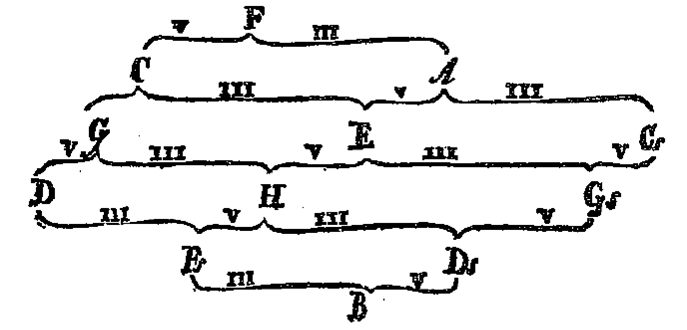
STOP DOING MUSIC THEORY. THIS IS REAL THEORY DONE BY REAL MUSIC THEORICIANS.
"This semi-tonal graph is homeomorphic to the cartesian embedding of S1xS1" <--- statements by the utterly deranged
As impressive as frontier LLMs are in solving hard math problems, it usually seems to be a variation on search and optimization and triangulation based on known concepts.
AI needs to be able to make conceptual leaps, great to see research in this direction!
We've made a breakthrough in self-evolving AI scientists moving from "search" to "principled discovery": Scientific discovery requires that the search space itself changes, and an AI scientist must perceive this shift without intervention. We built an AI that achieves this for the first time with the ability to discover the scientific vocabulary it reasons in. Evidence, tools, artifacts, verifiers, failures & claims become typed provenance. We show three distinct modalities: 1) retrieval, adding known objects; 2) search, exploring a fixed schema; and critically: 3) discovery, a verified regime transition.
We solve the open-endedness evaluation problem by lifting agentic workflows into a typed copresheaf and proving, via a Kan obstruction, that true discovery is not unbounded generation but a verifiable schema expansion: old evidence is transported by Left Kan extension, and genuine novelty is mathematically quantified by the pointwise residual beyond the transported image - separating discovery from mere search and making novelty objective and measurable rather than a subjective judgment or benchmark delta.
Our AI scientist is built in a way that does not pre-conceive the approach it chooses; instead, we endow the system with formal power to adapt, evolve, and reason from first principles. Case studies include:
1⃣Builder/Breaker model that discovers mode-conditioned compliance in proteins;
2⃣CategoryScienceClaw that finds anisotropic fiber-network stiffness rules.
Great work in collaboration with my graduate student @fwang108_@MITdeptofBE
F.Y. Wang & M.J. Buehler, Self-Revising Discovery Systems for Science: A Categorical Framework for Agentic Artificial Intelligence, arXiv:2606.01444, 2026
As impressive as frontier LLMs are in solving hard math problems, it usually seems to be a variation on search and optimization and triangulation based on known concepts.
We need AI to be able to make conceptual leaps, this paper seems to be going in the right direction
Great idea for self-evolving AI scientists from this new MIT paper.
Tries to make an AI scientist notice when its current way of thinking is too small, then add new scientific concepts instead of merely searching harder.
The problem is that most AI science systems still search inside a fixed setup, even when real science sometimes needs new kinds of variables, tools, tests, or claims.
The paper’s core idea is to make every data point, model, tool output, failure, and claim a typed artifact, where typed means the system records what kind of thing it is and how it was produced.
Then the system can tell the difference between retrieval, which adds known things, search, which explores a fixed setup, and discovery, which changes the setup itself.
So novelty AI scientists is not defined by surprise, fluency, or benchmark gain, but by what could not be expressed inside the previous schema.
A serious attempt to formalize something most AI systems still fake: the difference between finding an answer inside a language and earning the right to change the language.
----
arxiv. org/abs/2606.01444
Title: "Self-Revising Discovery Systems for Science: A Categorical Framework for Agentic AI"
fed the hopfield network chinese glyphs this time - radicals and components instead of latin letters.
as memory decays it starts drafting characters that don’t exist - forgetting becomes a way of inventing.
You can better model brain data if you assume quantum-like entanglement.
New work from our centre indicates that the brain expresses the efficiency of quantum computation through classical mechanisms. The brain is a magnificent specimen because it operates on 20w—or a banana and some water—and yet generates a coherent, stable, adaptive, and conscious inner universe that can build rockets, computers, fall in love, and construct empires and religions.
And it does so against the backdrop of slow, wet, porous, and inexpensive bioelectric activity. Compare this to contemporary AIs, which are energy guzzlers and require massive data centres. The difference is likely 10,000x or more. Instead of looking interstellar for data centres, we should really be looking to the brain.
First, you model the brain as a network of coupled oscillators (commonly used for whole-brain models). If you wire these coupled oscillators up like the brain’s connectome you get very interesting, very surprising, brain-like dynamics; such as criticality, metastability (via turbulence), etc. These stochastic dynamics are crucial for rapid information sharing and maintaining local and global integration. And when these dynamics are included in the model, it fits the brain like a glove.
Interestingly, when you then include long-range exceptions to the exponential distance rule (common in mammalian brains), you get a spectral gap that separates the dominant modes from the noisy bulk. These dominant modes behave like coherent state-vectors and their interactions produce interference effects, i.e., quantum-like entanglement.
These interference effects may be one of the secrets to how the brain rapidly binds distributed information into unified, context-sensitive states. The paper also demonstrates that QL entanglement provides the brain a richer dynamical repertoire at lower energetic cost. Keep in mind that this “quantum-like” entanglement arises from the interference of coupled oscillators, but the functional end state is analogous in that you get the same mathematical advantages.
It’s super exciting and we have a lot more to share in coming months.
Just listened to @Plinz at the @CIMCAI conference outline a solution to the phenomenal binding problem (the neural network version of this problem is summarised in the quoted post)
Roughly as I heard it, he said that true phenomenal simultaneity is impossible in the physical universe. It is only possible in a simulated virtual universe which can ascribe different laws to the physical universe, including a law that states "these experiences are holistically experienced" (or similar).
Bold idea! In this view, our own human-style consciousness is only possible in virtue of the simulation that our brains create of the world, and that simulation having rules that are not directly reflected in physical reality (but might be some coarse graining of those rules? Or entirely new?).
@ylecun@AnnaCiaunica@jithinmukundan@Pontifex what about the phenomenal binding problem though? Maybe that gives us access to computation greater than is possible with symbolic manipulation