The International Day of Women in Statistics and Data Science (IDWSDS) is coming up! 📈📊
What better way to celebrate than by attending a ✨️FREE virtual conference✨️ hosted by @cwstat !
Details on the conference and the awesome keynote speakers 👇
https://t.co/bKWqfORTWp
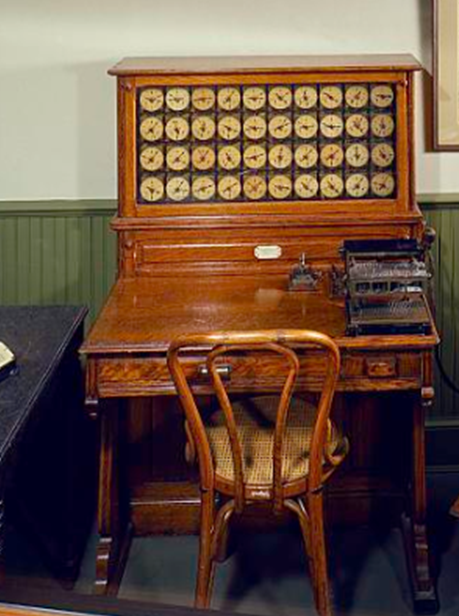
Happy 41st 🎂 to the Leap Day baby Herman Hollerith b 29 Feb 1860 (d 17 Nov 1929) 🇺🇸 Inventor of the punched card tabulating machine (1884) & pioneer of data processing automation & mechanized binary code. 1/2
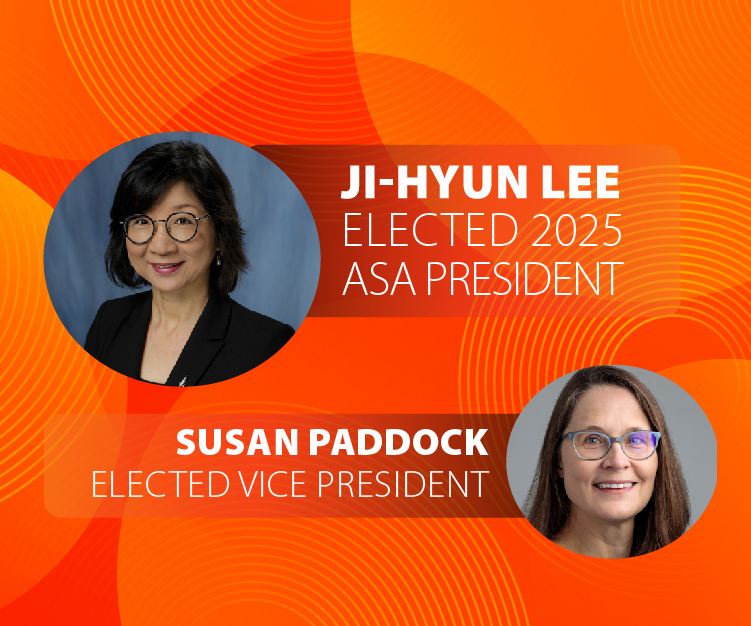
Congratulations to @JiHyunLEE_Stat, recently elected the 120th ASA president! Learn about her and view a list of the newly elected board members and section officers. https://t.co/nbPdVbLbCt
Deeply honored to be elected 120th President of the ASA. Together, let's strive to use rigorous statistics for good, making society better, more informed, & inclusive. Excited for the journey & grateful for your trust and support. #ASA#statistics#collaboration
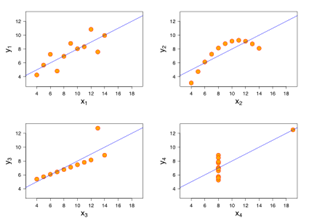
#OTD 1918 Frank Anscombe b (d 17 Oct 2001)🇬🇧 @Amstat Fellow 1956. Best known for the most compelling argument ever made why data should be plotted before analysis. Anscombe's quartet shows 4 data sets with * identical* summary statistics but very different distributions #dataviz
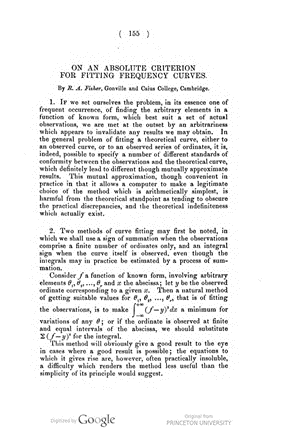
Derived from the theory of errors taught by his tutor the astronomer FJM Stratton, it features a critique of the method of moments favoured by Pearson. He finally settled on the name ‘‘maximum likelihood’’ in 1922 2/
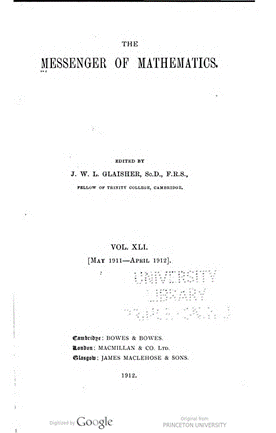
In April 1912, as a third year undergraduate student at Cambridge, RA Fisher published his first mathematical paper ‘On an Absolute Criterion for Fitting Frequency Curves’. This was the first iteration of what would later become the method of maximum likelihood 1/3
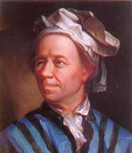
#OTD 1707 Leonhard Euler b (d 18 Sep 1783) Laplace called him the “Master of us all”. Immensely prolific (>850 publications, plus 13 children), Ahrens said he created the whole form of modern mathematical thinking by using (& inventing) consistent notation and terminology 1/4
Much of the ground-breaking joint work with Egon (1928-33) on hypothesis testing had been carried out by letter. He came back to London in 1934 after Karl retired ,and later went to Berkeley where he established a major statistical center 3/
With Egon Pearson developed the ‘hypothesis testing’ paradigm (Neyman–Pearson lemma 1933). In 1925 he joined Karl Pearson’s team on a fellowship but was disappointed to find it ‘old-fashioned ‘and Pearson ‘surprisingly ignorant of modern mathematics’ so he went to Paris. 2/
Fisher first welcomed Neyman as an ally in the effort “to free statistics from unwarranted Bayesian assumptions”. However relations deteriorated, to say the least. Fisher was outraged by the Neyman–Pearson hypothesis-testing approach, in contrast to his 'significance’ testing 4/
#OTD 1894 Jerzy Neyman b (d 5 Aug 1981) 🇵🇱🇷🇺 🇺🇸@AmStat Fellow 1942; FRS, #Guy Gold Medal 1966; ASA Wilks Award 1968; US Natl Medal of Science 1969. Best known for developing modern concepts of statistical hypothesis testing - introduced the confidence interval in 1937. 1/4
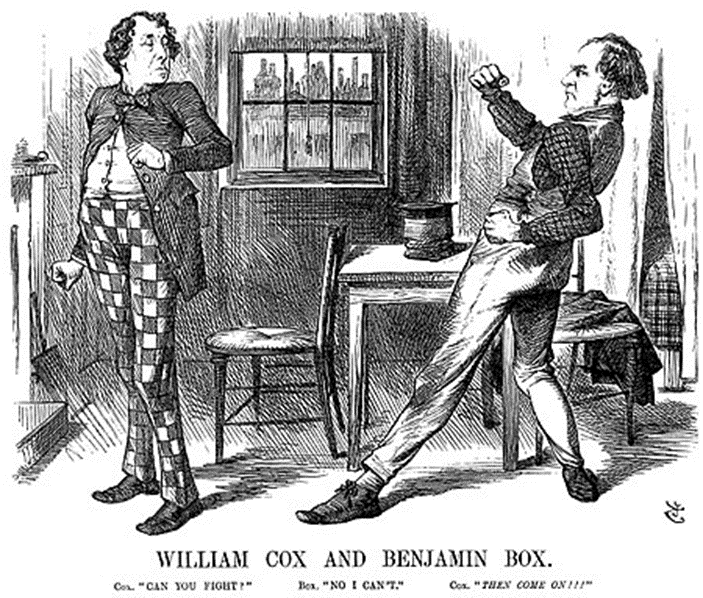
In the UK the phrase 'Box & Cox' refers to “people who always miss each other & thus are never together”. Everyone thought how funny it would be for Box & Cox to write a paper together. Box said it was obvious it had to be on transformations. So a citation classic was born 2/