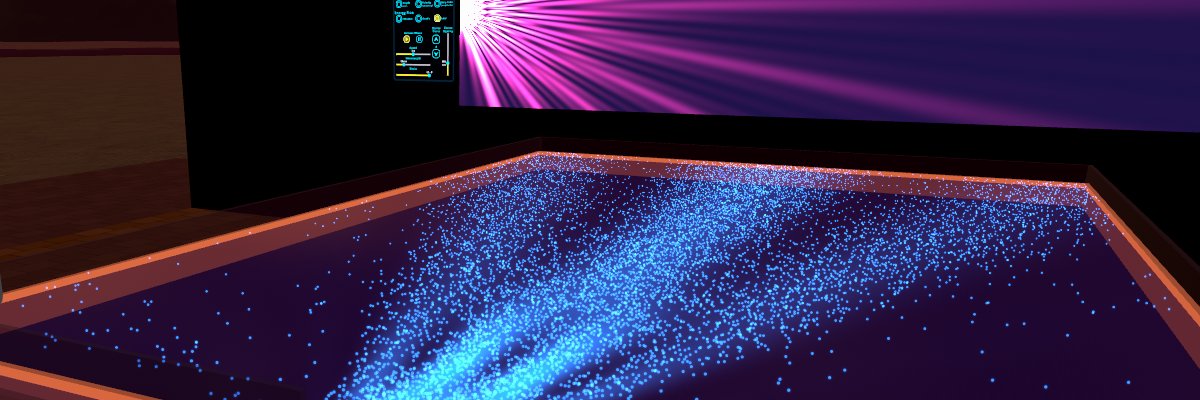
Carolyne Van Vliet's scientific work enables direct simulation of quantum scattering through the double slit. This simulation of the 1995 "Ghost" imaging experiment by Strekalov et al. runs 60,000 pairs of entangled particles in VRChat - Quest-compatible!
https://t.co/ALvWgPSf6T
@Samuel_Gregson@Hassaan_PHY If you quantize the set of plane-waves that form the superposition of classical plane wave-fronts at the aperture then you have the probability of momentum distribution in the final photon pattern.
@Samuel_Gregson@Hassaan_PHY As you move away from the from the slits the overall pattern transitions from the aperture pattern to the momentum distribution within the set of plane-waves making up the wave-front at the aperture. Part-way the pattern's a convolution the momentum distribution and the apertures
@Samuel_Gregson@Hassaan_PHY Sabine got off to a good start point out the fallacy, then trips and falls by pivoting to Superdeterminism, rather than staying with the core science.
@Samuel_Gregson@Hassaan_PHY The excerpt's from "What the Bleep?" where Wolf, "AKA Dr Quantum" perpetuates egregious misconceptions about both diffraction and scattering that cross into pseudoscience around the effect of observers. IMO lack of critical pushack from physicists opens the door to "The Secret".
@martinmbauer The fine-tuning may be an artifact of the structure of the models we use. Like arguing that the solar system would look different if you chose different epicycles.
@demystifysci@DanielleFong Whether initially bound or free, the equations of conservation of momentum and energy in classical physics predict the relative changes in momentum and kinetic energy when photons collide with free charged particles. How do you get these relationships in your model?
@demystifysci@DanielleFong Compton scattering describes the inelastic collision of a photon with a free electron; the bound versions are approximations.
The best free-electron versions are with electron beams:
https://t.co/zyl4BOS2S8
@demystifysci@DanielleFong It works for borh loosely bound and free. The core equation predicts the momentum sharing between electrons and photons using basic conservation of momentum/energy. How do you deliver that in your model?
@demystifysci@DanielleFong How does this atom transaction model explain the Compton effect, which describes momentum exchange interactions between free electrons and free photons?
@mathandcobb It's a useful rule that allows us to construct clean analytic representations of the effects of a single phase variable in physical systems where energy is conserved and oscillates between two forms (e.g. potential and kinetic).
@hankgreen@elonmusk It is still indeterminate because the reaction of the slit screen is a quantum event, and cannot be 'observed' without destroying the structure of the scattering.
It also allows us to calculate probability densities by adapting ray-tracing techniques.
@hankgreen@elonmusk There's a neglected fully quantum model scattering in the literature that lends itself to computer simulation. It treats the slits as a quantum system (not an averaged barrier) that interacts with the particle to supply the impulse that deflects particles.
@PeterMorganQF Not enough is made of the fact that the evolution of position probability in space (calculated from the SE) is mathematically equivalent to evolution of an ensemble of particles undergoing statistical ballistic diffusion.