Excellent new survey of agentic AI applications in finance from Irene Aldridge et al:
https://t.co/C6K0fk77Gq
Thanks for the recommendation Nathan Attrell and cc Matt Robinson this might be of interest.
Hope ya'll had a good Thanksgiving,
JR
@PTrubey Agree with this but would go further as Figure's in-house AI Helix is as impressive/differentiated as their hardware. Further robotics is one area that being first *does* matter, because of the feedback loop between deployed hardware and training data sent back to Helix.
This is some of the best research on language models I've seen, comparing ability to classify central bank communication. spoiler alert - good'ol roberta large dominates over llama 4, gpt 4, deep seek, gemini....
https://t.co/gHlM1Mgl60
The financial institutions best positioned for success in their use of AI (classical ML too) have focused on and will continue to focus on two things: data strategy and technical talent.
Yet you will see very few social media posts about these two topics...
Potentially unpopular op: the gulf between social media GenAI hype and enterprise GenAI implementation has never been wider.
In fact, the two have no relation at this point.
At enterprise level, I haven't heard anyone care about new model releases in more than 6 months.
@GestaltU I've seen great applications of LLMs in the realm of research and textual analytics - but guardrails are in place and the practitioners are skilled.
Linear regression (in use since the *19th century), logistic regression (in use since the 1950's) and XGBoost (in use for over a decade) are the most common models I see and use in the wild to solve real problems.
I wonder if the last 24 months have given people the wrong impression of data science and ML...
If GenAI is your entry point into this world, it might seem that we make progress by awaiting the arrival of a new model every 6 weeks. Nothing could be further from the truth.
cruise past 20 months and set a modern record. Recessions are bad, so that's a good thing but it can't last forever. I don't want to end on a sour note so finally here's a chart of the unemployment rate since 1980 to put things in perspective.
A rather interesting jobs report last week. I had to double check the first chart below.
Look closely and you'll see the top bar is 'education and health', next is 'government'. Usually the total payroll us up top because the total is the largest increase. Not so in October!
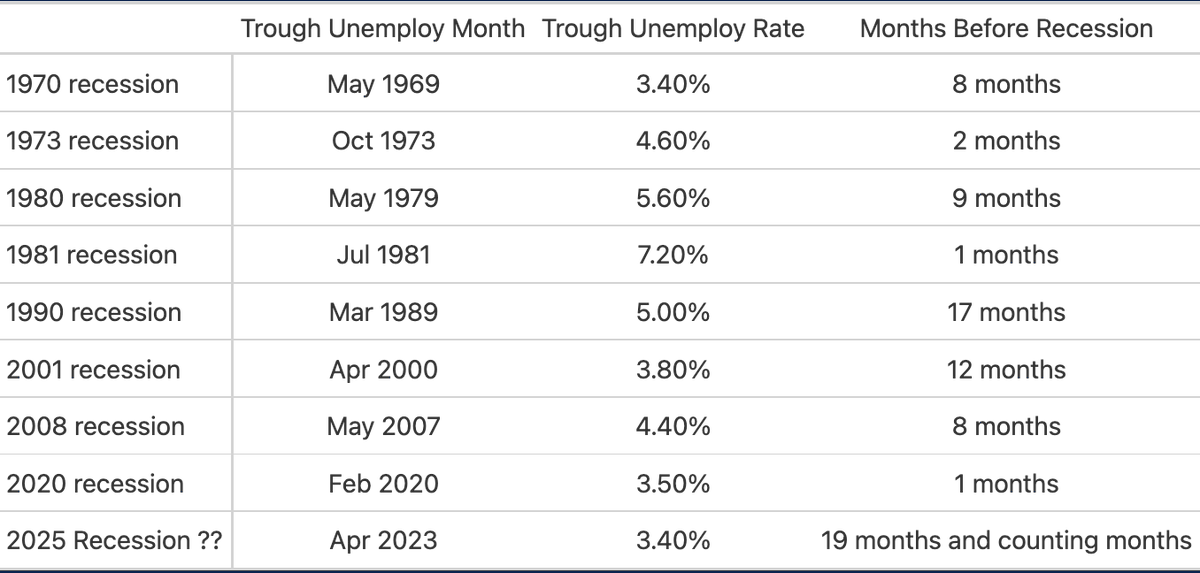
Second table below shows how long it typically takes for a recession to arrive after the trough or lowest unemployment. Unemployment hit 3.4% in April of 2023, we are already 19 months removed from that and nowhere near a recession. Barring a geopolitical/economic disaster we'll