As part of my comps, I'm studying how autoimmune diseases could be caused by the loss of microorganisms. This article was particularly helpful in explaining the old friends and hygiene hypotheses! @OxyEvo
https://t.co/4riNVWhwU0
An example of (maybe) sympatric speciation in progress: orcas diverging based on their diet preferences. They may be in that middle stage where speciation is happening but we cannot say right now that two distinct species exist. @OxyEvo
https://t.co/Ql7kxX39m3
I was interested in finding a website that had illustrations of our ancestors. The Smithsonian Museum has a human family tree that describes our ancestors from as long as 6 million years ago! @OxyEvo
https://t.co/cUZMWk8jC7
I'm really bad at memes but I felt today's lecture was just asking for it...
So I imagine Prof. McCormack as the panda saying nope to all of Zink's work
....I'm sorry for the bad gif, someone please do better @OxyEvo
Since we're sharing study partners, here's mine trying to give me encouragement yet he's sitting on my review sheets. We say he's a sweetheart but not the brightest kitty in the litter @OxyEvo
@jmaereed@OxyEvo HE SHIMMIES FOR LOVE! 😍
Like many things, it begs the question: where does he learn how to do this? Like spiders creating webs, animals just seem to know how to create these complex structures. Absolutely fascinating.
Prof. Gary Martin used this image in Histology to discuss why people near the equator have darker skin compared to people living poleward. The gradient is irregular because of sexual selection - one skin tone may be preferred even if it's not physiologically advantageous @OxyEvo
Whenever I think of sexual selection, I immediately go to this classic video from BBC Planet Earth of a Bird of Paradise Mating Dance.
What other dance competitions are there in nature??
@OxyEvo
https://t.co/FHqFxdXlWy
After the Metzker case, two other criminal cases in Washington and Texas used phylogenetic analysis of HIV-1 as evidence. Turns out there are many other cases around the world that used phylogenetics to help bring justice! @OxyEvo
https://t.co/ak9w1W87Cl
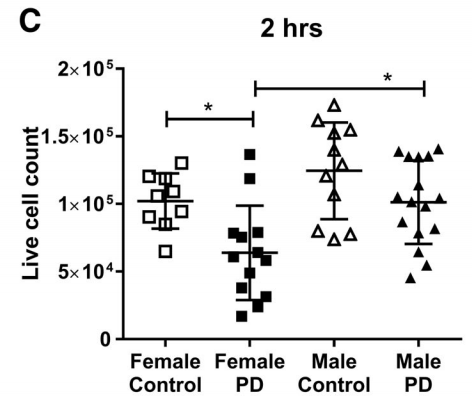
A study on monocyte function in Parkinson's disease patients. The graph shows live cell count after 2 hours in culture analyzed with a two-way ANOVA test. https://t.co/6xnNyUNiua @oxybiostats
Why was a gene named "Sonic hedgehog"?? Turns out, it was because a researcher decided to rebel. Despite its silly name, it is important for embryo development, especially the eyes and limbs. @OxyEvo
https://t.co/iYZa79YAAy
Diving deeper into the evolution of the eye with pictures from many species. One quote stood out: "Eyes didn't evolve from poor to perfect... they evolved from performing a few simple tasks perfectly to performing many complex tasks excellently"
@OxyEvo
https://t.co/zuLIfPoruz
An article on the Galapagos Island marine iguana - within one species, there is a lot of genetic variation. Species may have hybridized with others, thus absorbing adaptations and increasing the evolutionary potential of the species as a whole @OxyEvo
https://t.co/XEfqeQq12y
A very interesting article on genetic essentialism, which is thinking that your genetics determine who you are. Just because you have the DNA from a certain country/ethnicity doesn't mean you share the characteristics or culture of their people! @OxyEvo
https://t.co/EVfgXdqRbl
From one of my favorite Youtube channels - the history of humans. No explicit mention of evolution but they nod to fossils, gradual change over time, and our ancestors having beneficial traits that allowed them to survive over similar species! @OxyEvo
https://t.co/I7vWiJcoRo
The migration of monarch butterflies has been disrupted due to development, agriculture, and logging. A new effort has pushed for more protected land to conserve our monarch population. Very similar to the wildlife corridors Roshni discussed! @OxyEvo
https://t.co/4NvBkHI0i5
The sharply jutting jaws characteristic of the Habsburg family was likely due to inbreeding. Just as we learned, the jaw was likely manifested because of the reemergence/uncovering of a recessive allele. @OxyEvo
https://t.co/FA79sU8h9r
NZ black robins had only 5 individuals with 1 mature female. Careful monitoring of rim eggs allowed the population to increase and keep genetic variation high, stopping a genetic bottleneck.
Plus, they're just the cutest dang birds. Pure fluff ☺️ @OxyEvo
https://t.co/fo1cCtNah6
Hope for the future - the slow genetic drift of SARS-CoV-2 may mean a developed vaccine will be more effective. But perhaps, as the article states, there hasn't been any immune pressure to force the evolution of the virus. @OxyEvo
If there's one good thing about #SARSCoV2, is likely has an Achilles heel: its very slow genetic drift, highly stable genome. This remarkably low genetic diversity makes it so well suited for a vaccine. Look at the difference in surface glycoproteins👍👀
https://t.co/MRh9R45WqL