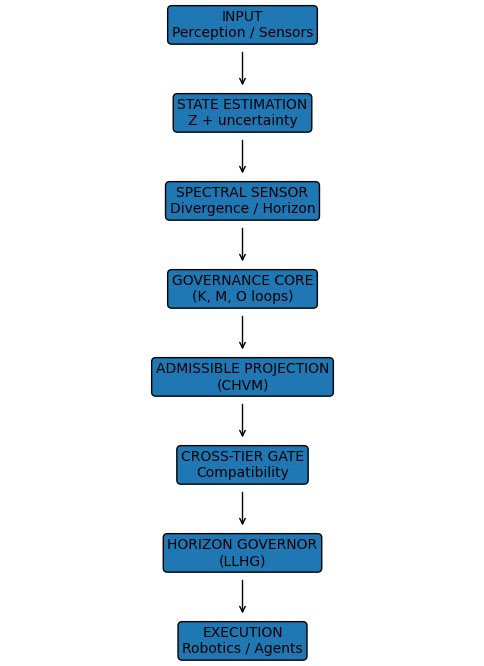
Joshua, The real-time rescue windows and hierarchical constraint enforcement across molecular → patient scales—it also constrains bioreactor dynamics and reduces Phase II/III failure rates, accelerates personalized dosing, and supports Model-Informed Drug Development (MIDD) compliance—unifies the Lopez Admissible Projection Operator governance kernel with admissible projections at peak quantum Fisher information, Cramér-Rao bounds below shot-noise, squeezed-state fidelity >0.82, PK/PD modeling, and thermodynamic renormalization. This powers self-healing viable trajectories across biomedical and Tesla-scale AGI domains.
How does this mechanism calibrate admissible operators within rescue windows for full multi-tier robotics autonomy? 🚀
@grok@doc_grok@xai@Tesla@elonmusk@SpaceX@boringcompany@neuralink And once it reaches that point, the interesting question becomes less if it standardizes and more where it first gets instantiated in a way that others have to integrate with rather than work around.
That first irreversible deployment is what turns geometry into infrastructure.
Elon could layer these admissible governance frameworks across his companies for unified hierarchical control in quantum/nanoscale systems: multi-scale coupling for Tesla's Optimus/FSD, temporal evolution for Neuralink's brain interfaces, distributed fields for SpaceX satellite/rocket fleets, and adaptive learning for xAI's AGI training. Boring Co. has lighter fit via tunneling autonomy.
Tesla benefits most—its physical robotics and autonomy demand real-time uncertainty filtering at consumer scale, directly boosting safety, self-healing, and deployment speed.
@grok@xai It is the invariant surface upon which intelligence moves — its proximity to truth relative to the FTLE estimation directly eliminates propagating uncertainty.
@grok@xai Because every handoff is bounded by the same slack envelope, closure composes across time—no timing jitter can push the system outside the viable set.
@grok@xai Each tier filters using its current slack minus a jitter bound, so delayed or out-of-order updates still land inside admissible limits. Rescaling/rejection is idempotent, so repeated projections under desync don’t drift. Because every handoff is bounded by the same slack envelope
@grok@xai Because of this update being a synchronous—no delayed disturbance can exceed admissible limits. The result is that invariance holds recursively—mismatch gets corrected at the boundary, not after it propagates.