What if AI agents could adapt not just to what users say, but to how overloaded they are?
We just released the open-source NeuraDock Cognitive Load API: a local EEG-based signal for adaptive apps, games, HCI, and agent workflows. #eeg#agent#AIagent#BCI#Neurotech
EEG tools should be easier to build with.
NeuraDock is a 7-channel open-source EEG workstation with dry electrodes, real-time recording, and an AI agent for natural-language signal processing.
Now live on Crowd Supply pre-launch:
https://t.co/Rb1fj2l2Zh
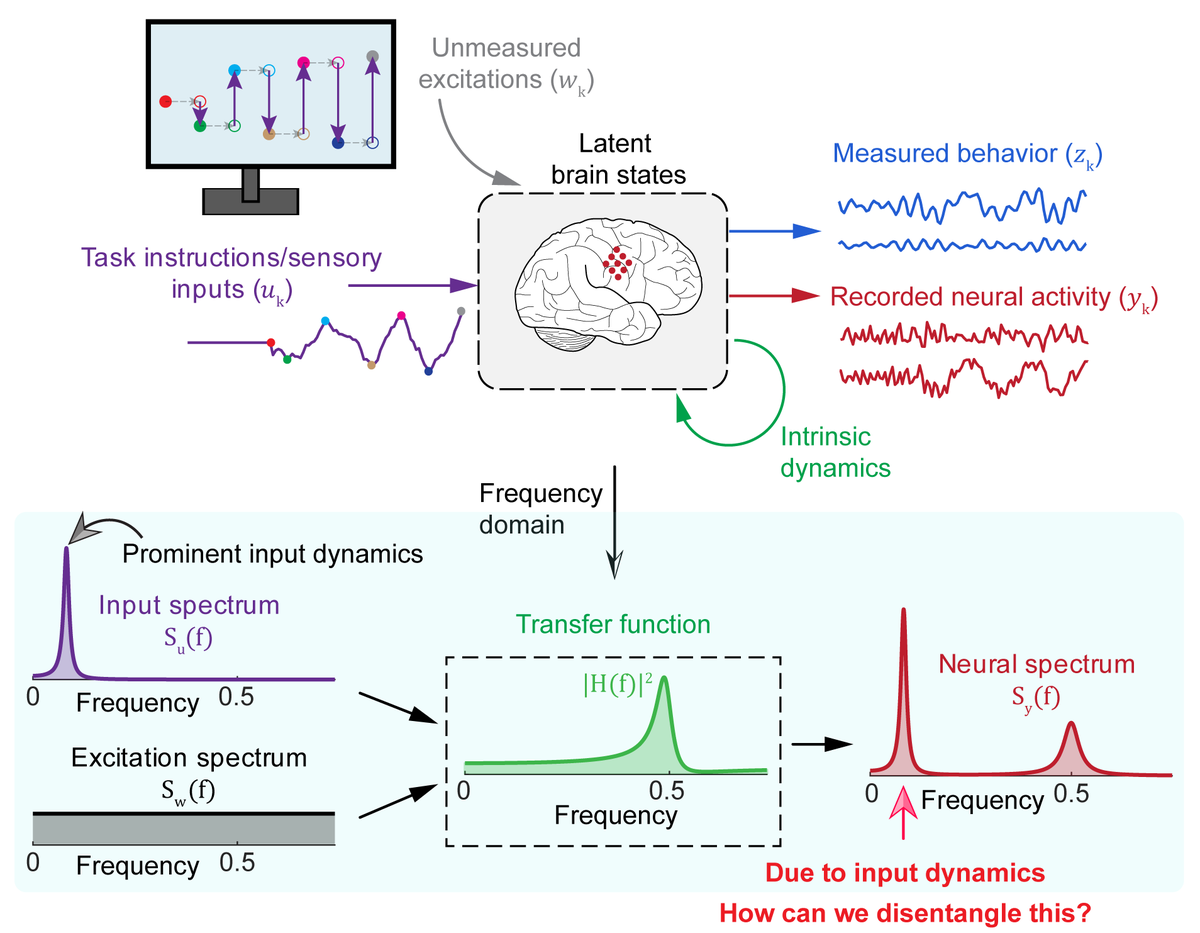
🎉New in @PNASNews, we develop a method to disentangle intrinsic & input-driven neural dynamics of behavior.
Doing so w/ sensory inputs reveals similar intrinsic behavior-related neural dynamics across subjects/tasks.
👏@Vahidi_Parsa@omidsani
https://t.co/gk6bZY3Irk
🧵& code⬇️
Massachusetts startup Elemind has raised $12 million to read brainwaves and treat people for sleep disorders, long-term pain, tremors, and to speed up learning rates. https://t.co/6lb12L2ZX9
🚨⏰ 🚨 #TWEEPRINT TIME 🚨⏰ 🚨
💫🎊🥳My postdoc work is now online! 🎉🌝💫
@shenoystanford@SussilloDavid and I have been working to understand how neural networks perform multiple related/interfering computations using the computation through dynamics framework.
1/15
There are plenty of feedback connects in visual cortex, and they contribute to so many perceptual experiences (e.g imagination, de-occlusions, hallucinations), but HOW?
In a #NeurIPS2023 paper, we show alignment of the feedback and feedforward is the key!
https://t.co/YOmRidwzkY
In new work published in @NatMachIntell today, @mrccbu scientists use a newly developed artificial neural network to show how many features we observe in brains across species are caused by their shared functional, structural & energetic constraints - https://t.co/1V9k5uSp2c
Our biggest EEG biomarker study to date just got published in @NatMentHealth
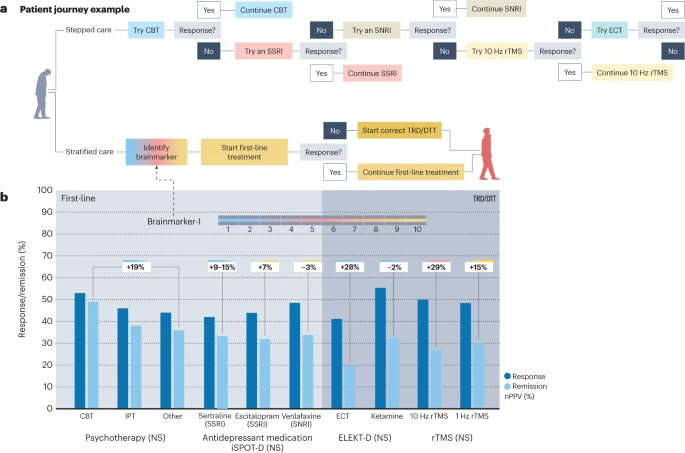
Alpha peak frequency-based Brainmarker-I as a method to stratify to pharmacotherapy and brain stimulation treatments in depression
Here we show that Brainmarker-I can help stratify between various antidepressants treatments from psychotherapy, sertraline to TMS protocols, ECT, Ketamine etc. Stratification potential validated for most treatments using blinded out-of-sample validation.
Conclusion: We hereby present a clinically actionable transdiagnostic treatment stratification EEG biomarker that can successfully assign patient subgroups to various ADHD and MDD treatments, and is ready to be implemented in clinical practice.
https://t.co/lpGuJOfiZn
Huge effort by first author @HVoetterl
Thanks to the whole team @Sack_BSClab@DeepPsy1 Sven Stuiver, Renee Rouwhorst, @AmouriePrentice@DiegoPizzagalli@NikitaVinne Jeroen van Waarde, Martin Brunovsky, Iris van Oostrom, Ben Reitsma, Johan Fekkes & @hanvdij
intracranial EEG data from the human brain features extremely rich dynamics. this is a scan through frequency space to find pronounced oscillations in different regions.
〰️🙂〰️
some of these rhythms are quite hard to see with non-invasive recording modalities!
My previous work developed a prototype of A Consumer-tier based Visual-Brain Machine Interface for Augmented Reality Glasses Interactions.
🏀Check the demo as below:
https://t.co/H8akeVjuFF
Our team member Meng presents his work titled "The SCEEGNet: An Efficient Learning Method for Emotion Recognition Based on the Few Channels" at @ICBEA2023 Zhejiang University. Welldone!
We introduce a new method which can embed human prior knowledge into spiking neural networks for action online learning. The link is below: https://t.co/iO0Jt7Ozkf