@davideoks You can't write an essay about China's ascendance without mentioning the country's large scale industrial espionage. Without Nortel, for instance, you likely wouldn't have Huawei. https://t.co/U6xmsywtLZ
An #Ottawa police officer who was found guilty for assault after stepping on a man’s neck and striking him with a baton made Ontario’s Sunshine List this past year despite being suspended with pay since 2023.
I dig into that a bit here ⬇️
@SMohyeddin@AlirezaNader Once had something go viral and eventually make national news. Multiple people posted the photo, including a news director in Toronto, as their own without attribution.
“What I keep encountering is a kind of anguished double consciousness: people who despise the ruling Establishment in Iran, who have lost family members to its prisons, who have spent decades dreaming of its end but who cannot bring themselves to celebrate the deaths of Iranian children.”
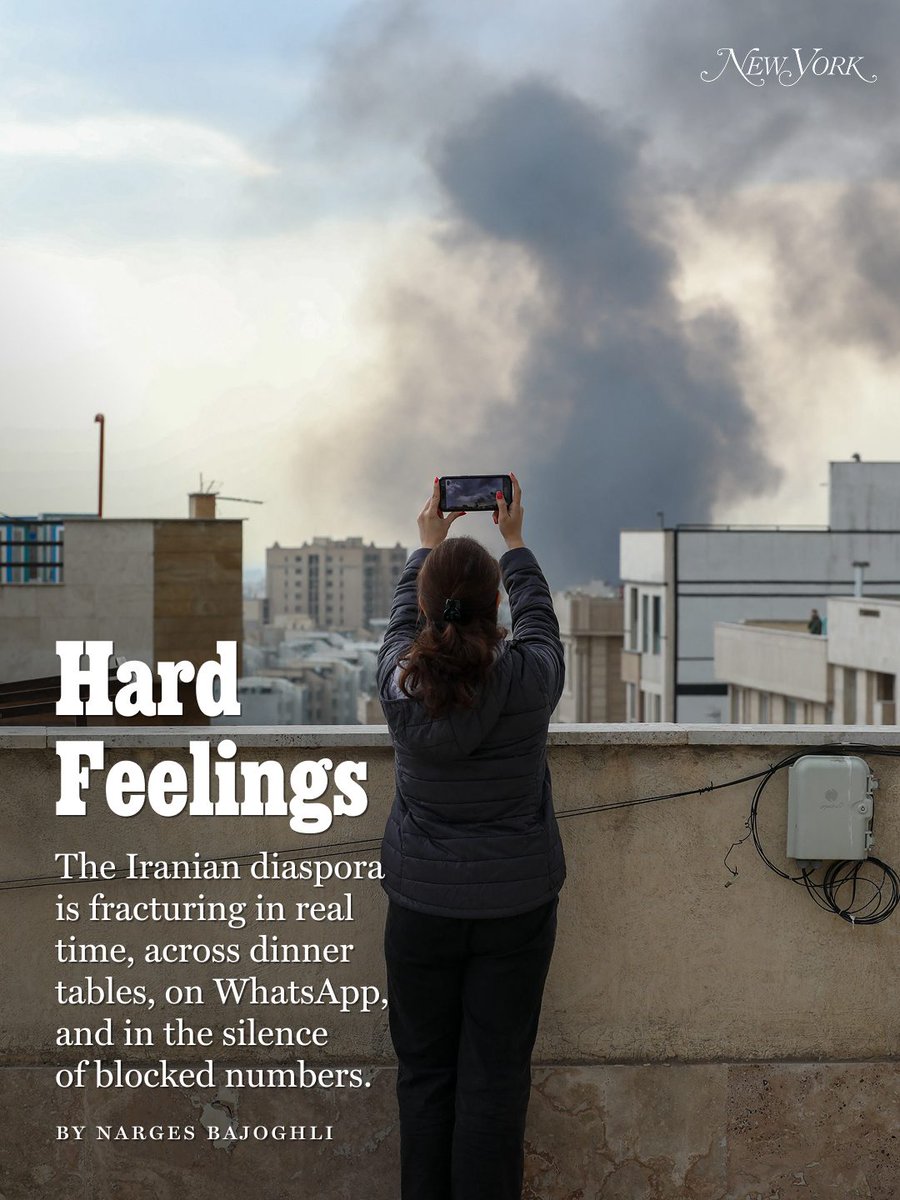
“Over the past week, the Iranian American community has been fracturing in real time across dinner tables, in group chats, in the silence of blocked numbers,” Narges Bajoghli writes.
There has always been infighting among Iranians in the diaspora. But today’s divisions do not fall neatly along the old political lines. What has changed is more atmospheric: the speed of polarization, the way people whose politics you thought you knew have arrived at positions you did not see coming.
“The fault line, crudely stated, runs between those who see this war as a long-overdue liberation — the regime finally falling, whatever the cost — and those who find something perverse, even obscene, in celebrating bombs falling on the country that made you,” Bajoghli writes. “But to state it so crudely is already to misrepresent it because almost no one I know sits at either pole completely.”
“What I keep encountering is a kind of anguished double consciousness: people who despise the ruling Establishment in Iran, who have lost family members to its prisons, who have spent decades dreaming of its end but who cannot bring themselves to celebrate the deaths of Iranian children.”
Bajoghli writes about how the Iranian diaspora has been fracturing over the war: https://t.co/6HqpVXCze4