🇨🇻 Vozinha has entered a whole new dimension.
Now he's playing in legends' matches in New York alongside:
🇧🇷 Cafu
🇭🇷 Davor Šuker
🇦🇷 Javier Zanetti
🏴 John Terry
🇫🇷 David Trezeguet
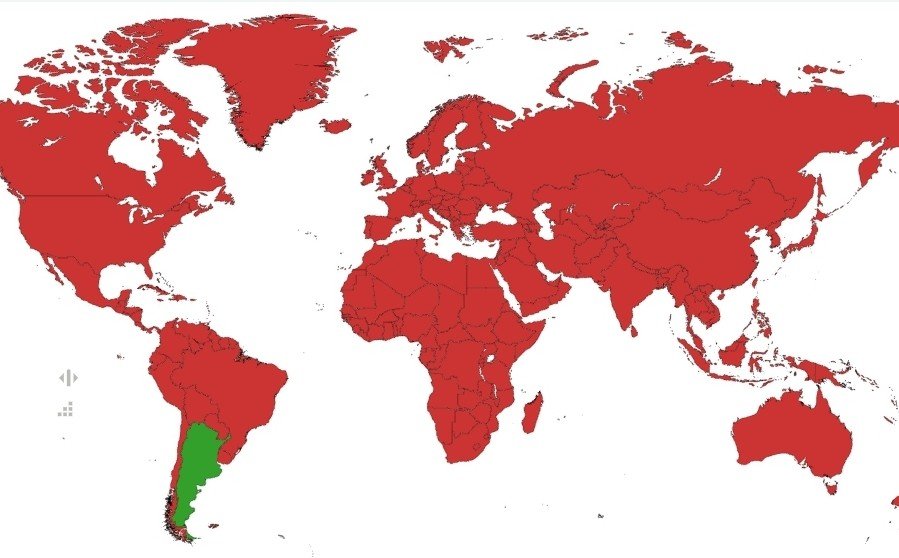
@alpineclub_esp El error lo puede cometer cualquiera. Está la posibilidad de presentar un pedido de revisión. Alpine lo hizo y salió bien. Los demás si hubiera habido error, deberían haber hecho lo mismo. No lo hicieron, que se jodan. No supieron defender su posición. Bien por Alpine y Gasly.
1Password charges $3/month per user.
Dashlane charges $4.99/month.
LastPass charges $3/month.
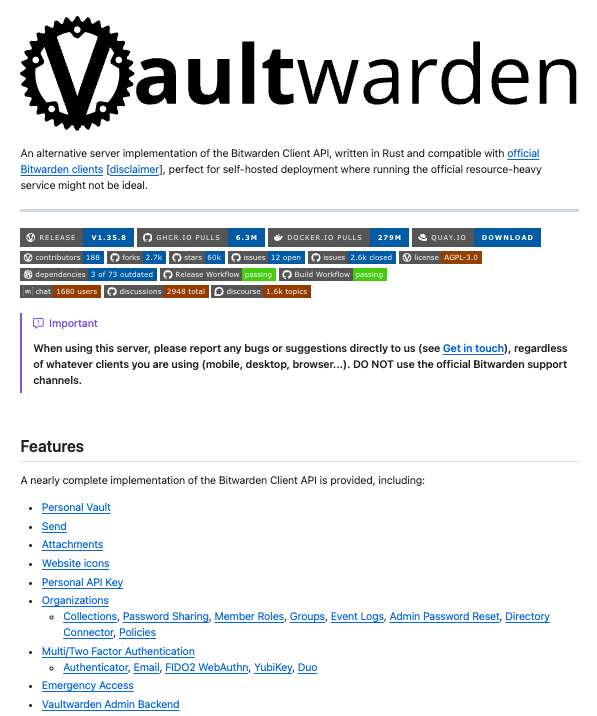
Someone rewrote the entire Bitwarden server in Rust and open sourced it for $0. It works with every official Bitwarden app on every device.
It's called Vaultwarden.
Here's the trick that makes it work:
Every Bitwarden client the iOS app, the Android app, the Chrome extension, the desktop app talks to a server through an open API. Bitwarden publishes that API because their code is open source.
Vaultwarden implements the exact same API. From the perspective of every app on every device, there is zero difference between hitting the official Bitwarden server and hitting your own Vaultwarden instance.
You spin it up on any $5 VPS. Point your Bitwarden apps at your server URL. Every password, every secure note, every 2FA code syncs across all your devices through infrastructure you own.
→ Full AES-256 end-to-end encryption. Same as the paid product.
→ All premium features unlocked. File attachments, vault health reports, hardware 2FA keys. Free.
→ Multi-user support built in. Run it for your family or your whole team.
→ Runs on 256MB RAM. A $5 server handles dozens of users without blinking.
→ One Docker command. Your vault is live in under 10 minutes.
→ Zero subscription. Zero per-seat fee. Zero trust required.
The commercial password manager business model is simple. Take open source encryption. Wrap it in a sync server. Charge per seat forever.
Vaultwarden is the sync server. The apps are free. The encryption is open.
You just needed somewhere to run it.
59K stars. 100% Opensource - https://t.co/kOOUJp937d
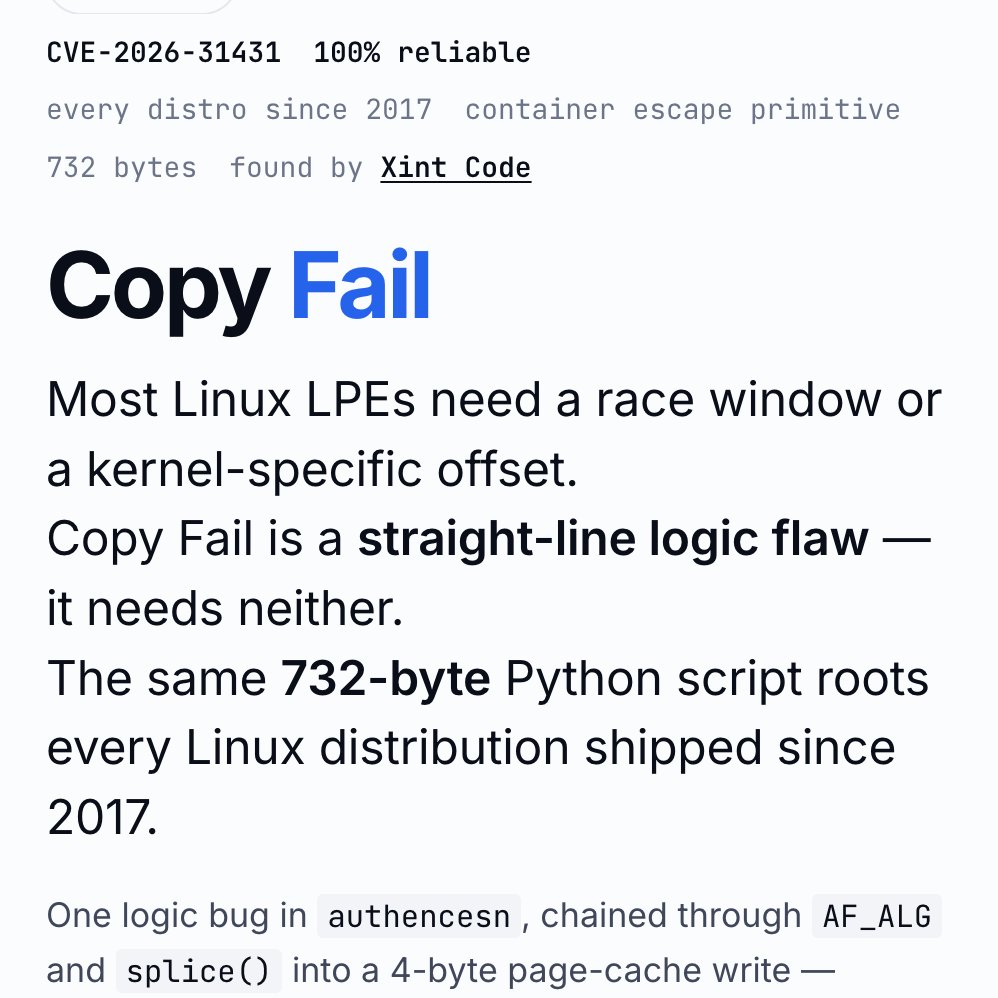
‼️🚨 BREAKING: An AI found a Linux kernel zero-day that roots every distribution since 2017. The exploit fits in 732 bytes of Python. Patch your kernel ASAP.
The vulnerability is CVE-2026-31431, nicknamed "Copy Fail," disclosed today by Theori. It has been sitting quietly in the Linux kernel for nine years.
Most Linux privilege-escalation bugs are picky. They need a precise timing window (a "race"), or specific kernel addresses leaked from somewhere, or careful tuning per distribution. Copy Fail needs none of that. It is a straight-line logic mistake that works on the first try, every time, on every mainstream Linux box.
The attacker just needs a normal user account on the machine. From there, the script asks the kernel to do some encryption work, abuses how that work is wired up, and ends up writing 4 bytes into a memory area called the "page cache" (Linux's high-speed copy of files in RAM). Those 4 bytes can be aimed at any program the system trusts, like /usr/bin/su, the shortcut to becoming root.
Result: the next time anyone runs that program, it lets the attacker in as root.
What should worry most: the corruption never touches the file on disk. It only exists in Linux's in-memory copy of that file. If you imaged the hard drive afterwards, the on-disk file would match the official package hash exactly. Reboot the machine, or just put it under memory pressure (any normal system load that needs the RAM), and the cached copy reloads fresh from disk.
Containers do not help either. The page cache is shared across the whole host, so a process inside a container can use this bug to compromise the underlying server and reach into other tenants.
The original sin was a 2017 "in-place optimization" in a kernel crypto module called algif_aead. It was meant to make encryption slightly faster. The change broke a critical safety assumption, and nobody noticed for nine years. That bug then rode every kernel update from 2017 to today.
This vulnerability affects the following:
🔴 Shared servers (dev boxes, jump hosts, build servers): any user becomes root
🔴 Kubernetes and container clusters: one compromised pod escapes to the host
🔴 CI runners (GitHub Actions, GitLab, Jenkins): a malicious pull request becomes root on the runner
🔴 Cloud platforms running user code (notebooks, agent sandboxes, serverless functions): a tenant becomes host root
Timeline:
🔴 March 23, 2026: reported to the Linux kernel security team
🔴 April 1: patch committed to mainline (commit a664bf3d603d)
🔴 April 22: CVE assigned
🔴 April 29: public disclosure
Mitigation: update your kernel to a build that includes mainline commit a664bf3d603d. If you cannot patch immediately, turn off the vulnerable module:
echo "install algif_aead /bin/false" > /etc/modprobe.d/disable-algif.conf
rmmod algif_aead 2>/dev/null || true
For environments that run untrusted code (containers, sandboxes, CI runners), block access to the kernel's AF_ALG crypto interface entirely, even after patching. Almost nothing legitimate needs it, and blocking it shuts the door on this whole class of bug...
🚨 Bitwarden CLI 2026.4.0 was compromised as part of the ongoing Checkmarx supply chain campaign after attackers abused a GitHub Action in Bitwarden’s CI/CD pipeline.
We’ll continue updating our coverage as more details are confirmed.
https://t.co/G0aakn8swq
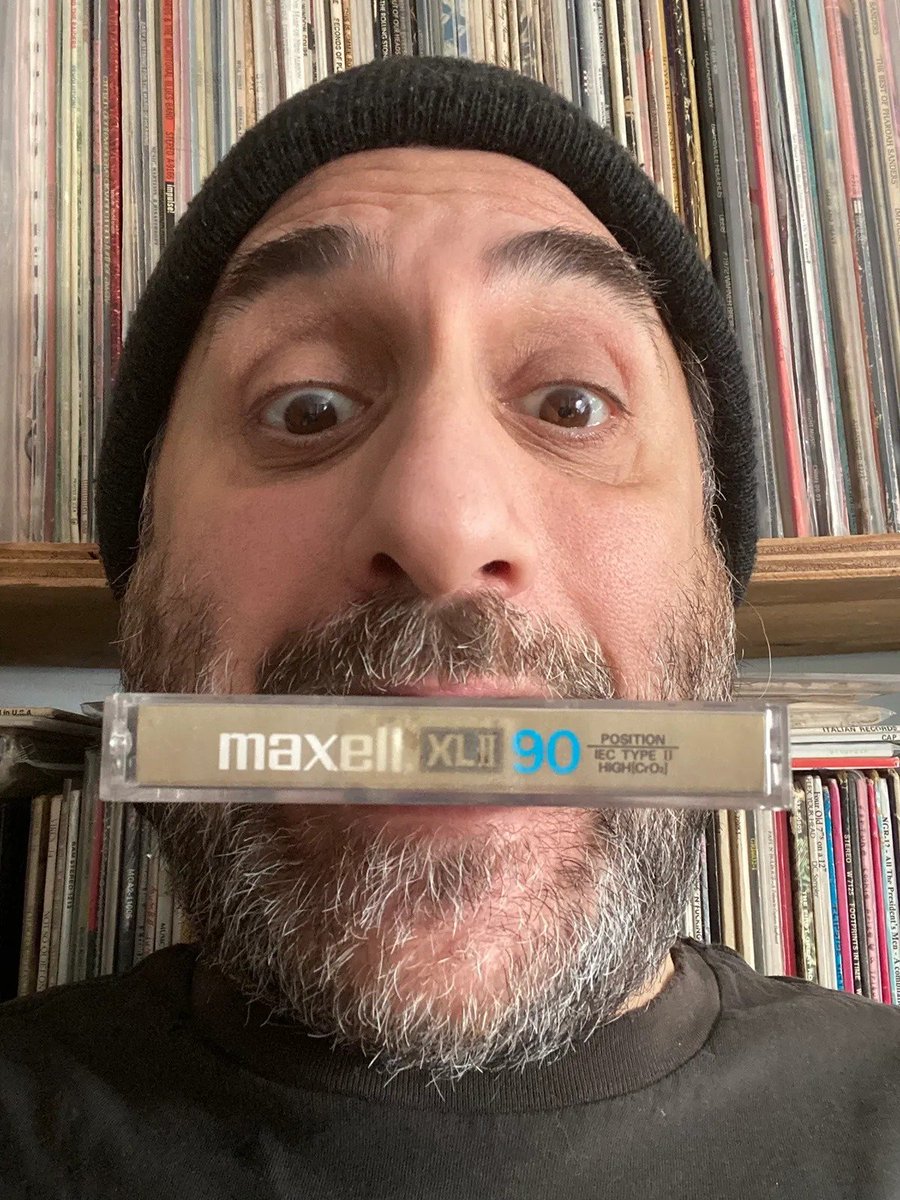
Il nome Aadam Jacobs non vi dirà nulla ma questo benefattore dell'umanità per 50 anni ha registrato di nascosto concerti con un mangianastri
Ora mette tutto online gratis: oltre 10.000 cassette tra cui Nirvana, REM, Cure, Sonic Youth, Björk e molto altro:
https://t.co/3iJwUaOOJK