@RobertMihaly1 Thank you Robert, absolutely delighted to interact with you. Yes, to an extent conditions have eased a little and like famous human trait I've llearned to cope with changed co ditions. Presently visiting my daughter & her family at Canberra, Australia ☺️
Crumbling walls
Is all that's left
As
I roam the battlements
Where I died
Seeking solace
Where
There's none
Alone I am
As rain pours
And
Night is dark
Within
My lost soul
I see
Black-white ashes falling
Around me
Burying me
To die
Over again
Once more
Crumbling walls
Is all that's left
As
I roam the battlements
Where I died
Seeking solace
Where
There's none
Alone I am
As rain pours
And
Night is dark
Within
My lost soul
I see
Black-white ashes falling
Around me
Burying me
To die
Over again
Once more
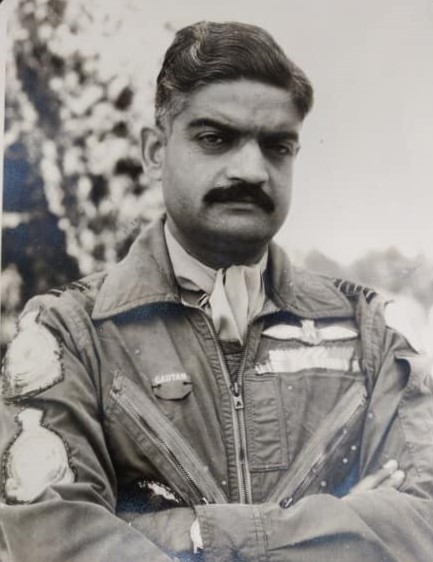
On this day in 1972, one of the IAF's finest Canberra pilots accomplished an extraordinary feat of flying. He brought an engineless MiG-21 down intact in an agricultural field outside Pune. Tragically, it was what happened after touchdown that cost him his life.
Wg Cdr Padmanabha 'Bob' Gautam (4482), MVC & Bar, VM, was just 39. He was one of only two IAF officers to have been awarded the Maha Vir Chakra twice.
An alumnus of 3 JSW at Dehradun, the precursor to the NDA, Gautam was commissioned with the 60th Pilots' Course on 1 April 1953. He started his flying career on fighters, followed by a stint instructing on Harvards at Jodhpur. In 1958, he converted to the Canberra with the very first Jet Bomber Conversion Unit (1 JBCU) course at Agra.
In October 1961, Gautam was amongst the pilots of the six-Canberra detachment of 5 Squadron sent to the Congo under Wg Cdr AIK Suares as part of the UN mission.
The Katangese forces possessed a Fouga Magister jet, flown by mercenary pilots, which had been harassing UN ground forces. On 6 December 1961, Suares and Gautam attacked its base at Kolwezi, nearly 1,300 km from their operating base, through exceptionally difficult weather.
The Fouga had been parked away from the runway in a jungle clearing. Despite heavy ground fire, Gautam destroyed it, attacked three other aircraft and damaged airfield installations. The raid effectively broke the back of the Katangese air arm. Gautam subsequently flew several close air support missions over Elizabethville, earning a Vayu Sena Medal for Gallantry.
By the 1965 War, Sqn Ldr Gautam was commanding JBCU at Agra. The conversion unit and its instructors were pressed into operational service, with Gautam undertaking some of the most demanding missions of the Canberra fleet.
On the night of 13 September, six Canberras raided Peshawar, at the extremity of their operating range, deep inside Pakistan. Gautam was the pathfinder, responsible for locating and marking the target for the other bombers. Despite intense anti-aircraft fire, he accurately placed the Target Indicator Bomb and inflicted damage on the runway. On their way out, the Canberras were intercepted by a Pakistani F-104 Starfighter, which fired a missile at one of them. All six returned safely.
Gautam also undertook reconnaissance, airfield attacks and ground strafing missions against Pakistani troop concentrations in the Gujrat and Chawinda sectors, braving ground fire and Sabre opposition. He earned his first Maha Vir Chakra.
Between 1967 and 1969, Gautam served as a flying instructor in Iraq, flying the MiG-15 and MiG-17. Remarkably, while in Iraq, he accomplished a near dead-stick landing on a MiG-17, earning commendations from both the Iraqi government and the IAF.
Returning to India, he took command of 16 Squadron at Gorakhpur. In December 1971, Gautam and his navigator, Sqn Ldr Kalyan Kumar Dutta (5450), flew six missions together across both theatres of the war, including daring night raids on Mianwali. Gautam earned a Bar to his MVC and Dutta a Vir Chakra.
In 1972, Gautam moved to Pune as Officer-in-Charge Flying of 2 Wing and converted to the MiG-21. Interestingly, his Station Commander, Air Cmde Dilbagh Singh, the first CO of the IAF's first MiG-21 squadron and a future Air Chief, was himself converting to the Canberra.
On the morning of 25 November, Gautam was on his eighth training sortie after conversion, flying a MiG-21 FL of 8 Squadron, when he suffered an engine failure.
The Senior Air Traffic Control Officer on duty, K. Parthasarthy (6175), asked Gautam over the radio, “Ejecting?”
“Belly landing,” came the response.
With its delta wing, high landing speed and rapidly diminishing energy in unpowered flight, the MiG-21 was a particularly unforgiving aircraft to force-land. Attempting it with the undercarriage retracted, outside an airfield, was quite another proposition.
Parthasarthy watched in astonishment as Gautam brought the aircraft down in a large harvested field. The MiG touched down intact and travelled a considerable distance before striking a wall of boulders and catching fire.
Barely half an hour earlier, Gautam and Parthasarthy had been making plans to take their annual physical fitness test together.
In less than twenty years of commissioned service, Gautam had fought in three conflicts, instructed pilots in two air forces and earned three gallantry decorations. His two younger brothers, P Ashoka and P Ajit, were also IAF pilots, both qualifying as test pilots.
There is a little-known tradition at V.S. Satav School in Wagholi, near Pune. Gautam is believed to have steered his stricken aircraft away from the school before attempting the forced landing. More than half a century later, the school reportedly continues to pay homage to him.
#IAFHistory @IAF_MCC
Dear friends you will be glad to know that my latest publication, The Lost Shehnai & Other Treasures : A Chlidren's Story Book, is now available with Bigfoot Publications and Amazon
Shop on Amazon
https://t.co/1KWe36HOOa
Product questions? Ask here:
https://t.co/ZovFUEvM4B